Table of Contents
Before even talking about escapements, “free” hairsprings or marketing feats, we must return to the most living organ of a mechanical watch, its beating heart. THE variable inertia balance wheelit is precisely a very horological, and very pragmatic, way of adjusting this heart without restricting it. A technical device that says a lot about the level of seriousness of a caliber, and sometimes also the character of the house that designed it.
We meet him at Rolex, Patek Philippe, Omega, Grand Seiko, Tudor, but also in more confidential workshops where we prefer to talk about chronometry rather than storytelling. It is often associated with a “free” hairspring, and the promise is simple, to improve walking stability over time, in the face of shocks, variations in position, and the small vagaries of daily life. In reality, it’s more subtle. And much more interesting.
Variable inertia balance wheel, simple definition (without simplification)
In a mechanical watch, the pendulum swings back and forth. This oscillation, regulated by the hairspringgives rhythm to the movement, a bit like a musician’s metronome. Precision depends largely on the regularity of this balance-spring pair.
For a watch to advance or delay less, we must adjust its effective frequency. There are two main approaches:
- Adjust the active hairspring length with a racking (regulator, index), by pinching the hairspring more or less to shorten or lengthen it.
- Adjust the balance inertia by moving small masses located on the balance wheel, without affecting the length of the hairspring.
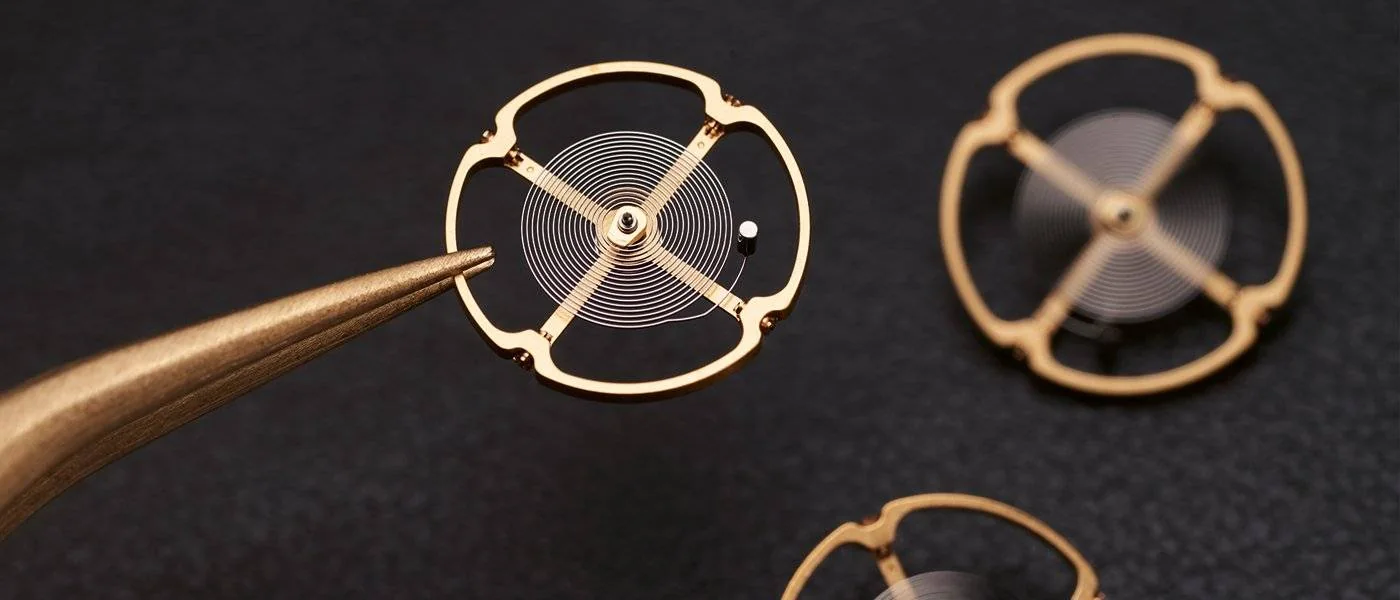
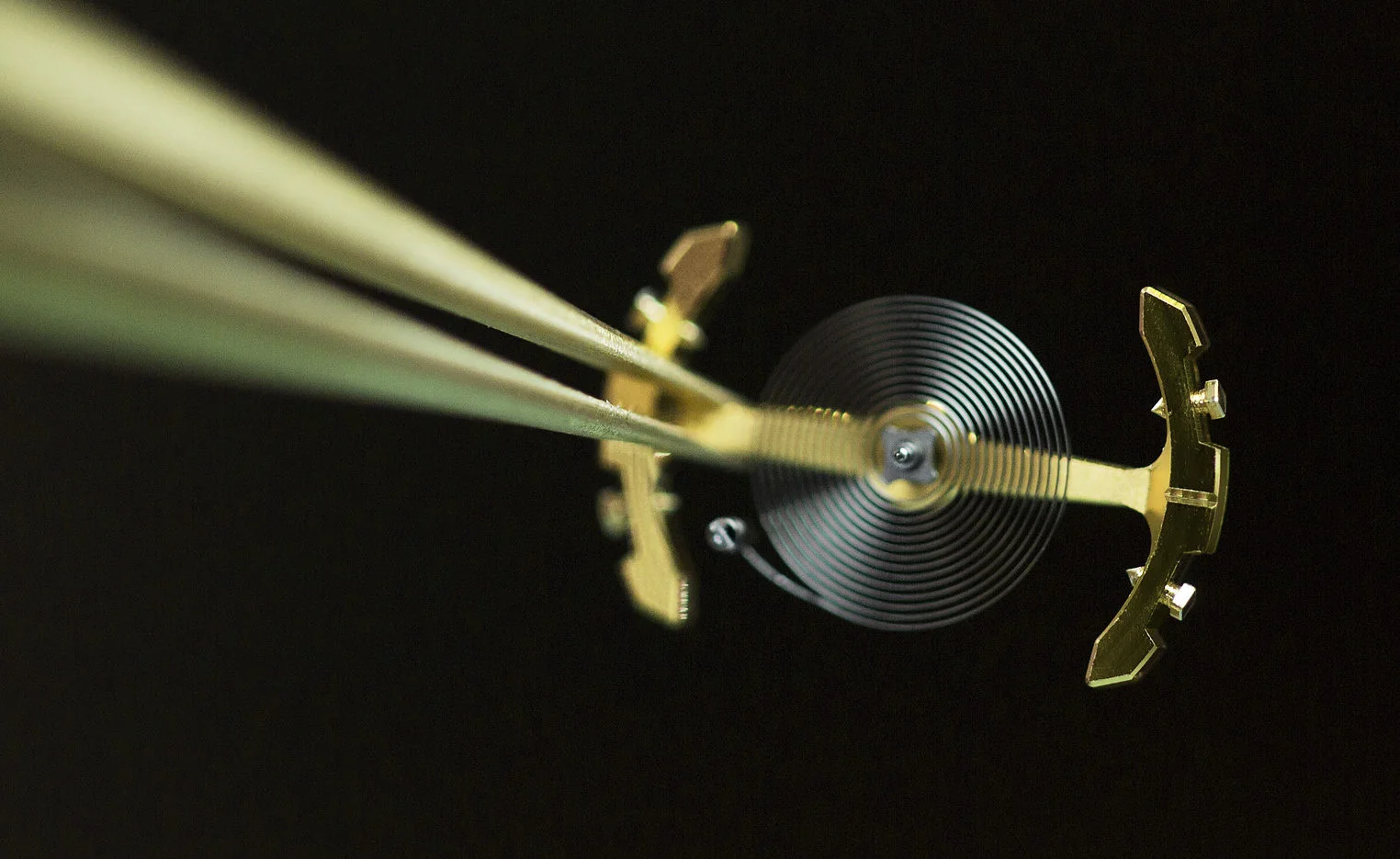
A variable inertia balance wheel is therefore a pendulum whose course is adjusted by modifying its mass distributionvia adjustment screw or weights on his crown. We change the inertia, and therefore the speed of oscillation, without “strangling” the hairspring. The hairspring breathes. And the watchmaker too.
Why inertia changes accuracy
In physics, the inertia of a pendulum, its moment of inertia, determines the energy and stability of its oscillation. At equal amplitude:
- the higher the inertia, the more the system tends to resist disturbances, shocks, micro-variations in torque, changes in position,
- the lower the inertia, the more “nervous” it is, easier to accelerate or slow down, and therefore potentially more sensitive.
Concretely, on a balance wheel with variable inertia, we screw or unscrew tiny masses located on the rim of the balance wheel. We increase or decrease the inertia. This changes the oscillation period. It is a fine adjustment, often more stable than a classic adjustment, because it lets the hairspring work in a less constrained geometry.
Variable inertia balancer vs racket, the real difference
The racket, the traditional (and not necessarily shameful) tool
The classic system uses a racket : an index that moves two pins and modifies the active hairspring length. It is efficient, quick to adjust, economical, perfect for many industrial movements and for routine maintenance. And no, it’s not automatically “inferior.” A good, well-designed racket can produce excellent results.
But it has two limits:
- he forced the hairspring between pins, which can introduce micro-friction and variations depending on the position,
- it can be less stable over time if the setting moves, or if the hairspring behaves differently as it ages.
Variable inertia, a more “chronometric” approach
With a variable inertia balance wheelwe often remove the racket. The hairspring is said to be “free”: no rack pins that pinch it. It is adjusted by adjusting the masses of the balance wheel, generally with a specific key.
Typical advantages:
- better stability adjustment over time,
- better isochrony potential, the ability to keep the same period despite variations in amplitude,
- better shock resistance on the setting, because there is no index finger that can move.
Disadvantages, because there are:
- longer settingmore demanding, you have to know what you are doing,
- more expensive industrialization of equivalent quality,
- and, in some cases, a intervention which requires more tools and experience in service.
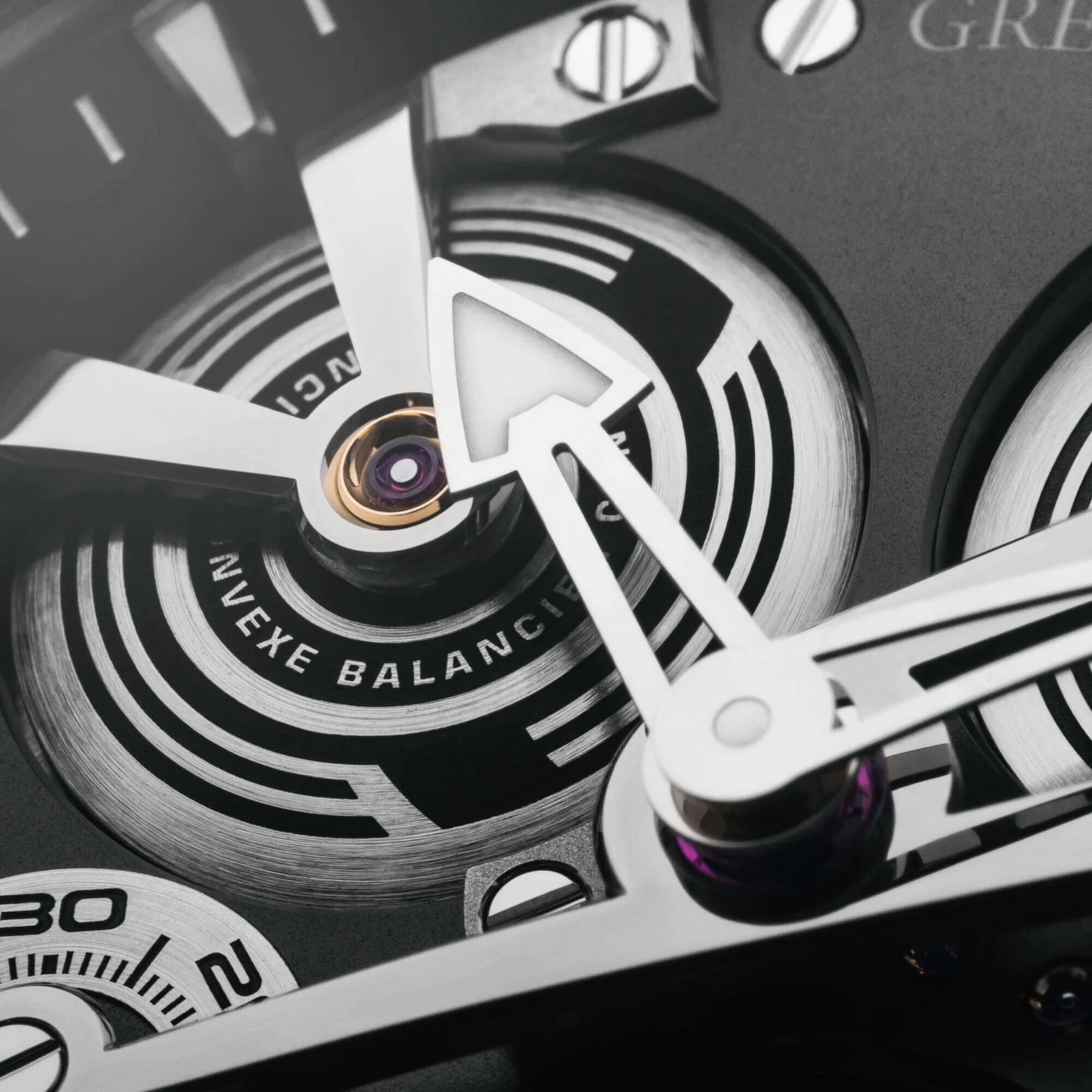
Visually, a variable inertia balance wheel generally displays adjustment elements on its rim:
- adjustment screws traditional, often in even numbers, on the outskirts, “classic” haute horology style,
- weights or adjustable “weights”, sometimes internal to avoid air turbulence and limit risks,
- proprietary systems whose name ends up becoming a conversation starter, Microstella at Rolex, Gyromax at Patek Philippe, etc.
The principle remains the same: we modify the inertia by moving the mass closer or further away from the axis. The further the mass is, the more the inertia increases, and the balance tends to to slow down. By bringing it closer to the center, we accelerated.
Why Brands Love Variable Inertia Balancers (And Why You Should Care)
Because precision isn’t just a number on a warranty card. It’s a held over timean ability to remain adjusted when the watch takes knocks, changes wrist, alternates office and weekend, heat and air conditioning.
A balance with variable inertia, especially with a free hairspring, is a design choice that goes in the direction of:
- the robustness of the adjustmentfewer parts likely to move,
- regularity in positionsone of the major themes of real chronometry, that which is not experienced on a measuring bench but on your wrist,
- industrial coherence modern high-end calibers, where we prefer to control the geometry of the hairspring and the stability of the system rather than adjusting the old-fashioned way, on the chain.
And yes, it is also a marker of “upgrading”. Not because it’s magic, but because it is often the symptom of a movement designed with ambitious specifications.
Concrete examples, from theory to the wrist
We find this type of adjustment on very well-known watches. Some benchmarks, without inventing prices or playing guessing games on vague references:
Rolex, Microstella and the utilitarian approach to performance
At Rolex, many modern calibers use a variable inertia balance wheel with Microstella nuts. The idea is typically Rolex, not useless poetry, but an obsession with stability and repeatability. The brand combines this with its own oscillator architecture, and internal precision standards (often communicated as stricter than the COSC).
The exact references and prices vary depending on the model, and change regularly, it is therefore more relevant to remember the principle than setting a price in stone. What matters here is the choice of an inertia adjustment, designed to last and to withstand everyday use.
Patek Philippe, Gyromax, variable inertia haute horology version
THE Gyromax by Patek Philippe is another emblematic example: adjustable masses on the balance wheel, which allow fine and stable adjustment. Technically, it’s the same philosophy, adjusting the oscillator without a racket, and preserving the behavior of the hairspring.
In the Patek context, this is part of a search for chronometric performance but also finishes and overall coherence of the movement. The balance wheel is not an isolated component, it is a part that is both functional and identity.
Omega, modern architecture and stable tuning
Omega also uses variable inertia balance wheels on many recent calibers, often in combination with a silicon hairspring and solutions aimed at stability and resistance to magnetic fields. Here again, the interest is the same: robust regulation, less dependent on a racking index, and more stable over time.
Depending on the model, the certification specifications (COSC, Master Chronometer METAS) and prices are public, but they must be cited case by case, reference by reference, as Omega offers these technologies across multiple families.
What it really changes on a daily basis
The healthiest question is also the simplest: does a variable inertia balance wheel make a watch “more precise”? Not automatically. A watch is a system. If the exhaust is average, if the lubrication is poorly controlled, if the assembly lacks rigor, you will just have a sophisticated balance wheel in a mediocre environment, like a competition suspension on a road full of potholes.
On the other hand, with a well-designed movement, the typical benefits experienced are:
- a more stable walk between two services,
- less drift after a moderate shock,
- more constant regularity depending on the positions, in particular if the balance spring assembly is optimized.
It is a precision that is more “lasting” than spectacular. Which, in the real world, is the only accuracy that matters.
Things to watch out for when reading a data sheet
Brands love to flaunt “variable inertia balance” as a quality stamp. Alright. But a few nuances are worth remembering:
- Variable inertia does not always mean free spiral. Often yes, not always. The presence or absence of a racket changes the meaning of the architecture.
- The number of masses and their design count, external screws, internal masses, anti-loosening system.
- The hairspring is at least as important as the balance: material, terminal curve, geometry, centering, fixing to the eyebolt.
- Factory setting quality and the level of control (positions, temperatures, criteria) determine the final result.
And obviously, certification. COSC, METAS, Poinçon de Genève, house standards, each tells a different story. But none replaces the most reliable observation: the watch on the wrist, over several weeks.
The final word, variable inertia as a signature of seriousness
A variable inertia balance wheel is not a gimmick. It’s an engineering decision. A way of saying, “we want to fine-tune, and make sure it holds”. Purists like it because it’s elegantly logical. Collectors because it is a premium construction marker. Beginners should especially remember one thing: when a brand chooses this path, it generally requires greater manufacturing and adjustment discipline.
Does this guarantee a perfect watch? No. And fortunately, otherwise we would be bored. But it is an excellent clue, in this great game of observation that is watchmaking, where we learn to read a watch not as an object, but as an intention.