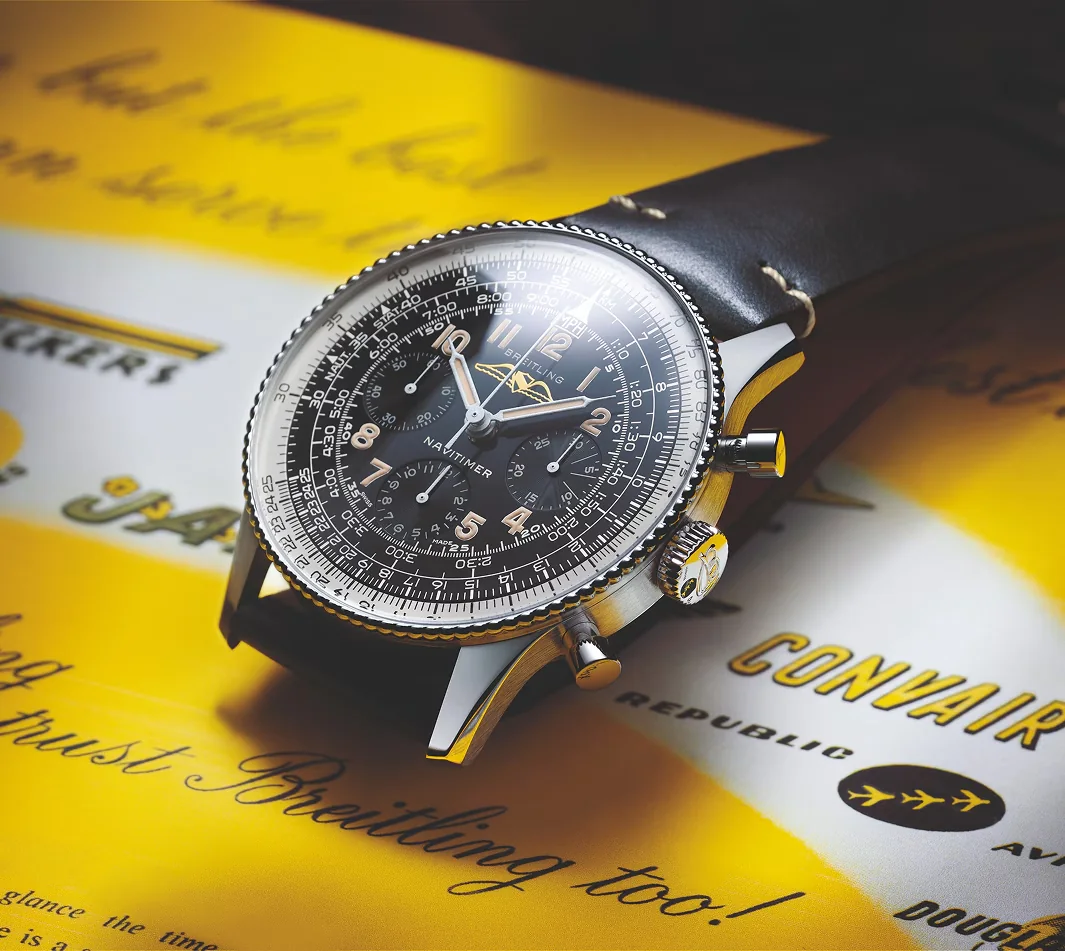
A watch born from a real need: calculating in flight
At the beginning of the 1950s, civil aviation entered a golden age: transatlantic lines, star pilots, on-board instruments which passed from the military to the general public. In this world where we live to the rhythm of flight plans, precision is not limited to time. You have to calculate quickly: consumption, average speed, distance, climb rate, nautical mile conversions. Before on-board computing, it was slide rules and tables, when you had time to consult them. In this demanding environment, the large dial opening of pilot watches becomes essential to ensure immediate readability, even in the most difficult conditions.
Breitling then took a rare decision: to design a tool watch that was not a simple chronograph, but a navigation instrument on the wrist. In 1952, the Navitimer, a contraction of “navigation” and “timer” (it seems obvious but did you know?), arrived with a distinctive element that would change everything: a circular slide rule integrated into the bezel. This is not a design gimmick. It’s a language. And this language will become universal in the pilot’s imagination, just as the bicompax chronograph has won over collectors with its functional elegance and exceptional readability.
The slide rule: when the telescope becomes a dashboard
At first glance, the Navitimer looks like a “loaded” watch: numbers, scales, graduations, two or three hands dedicated to the chrono. But that’s precisely where his genius lies. The circular slide rule, composed of two logarithmic scales (one on the bezel, the other on the dial), allows you to perform multiplication and division operations, but above all practical calculations for aviation: conversions (kilometers/nautical miles), estimation of travel time, fuel consumption at a given flow rate, etc.
In aviation, the watch is not a piece of jewelry: it is an extension of the cockpit. The Navitimer adopts this philosophy with assumed elegance. Its design is not “minimalist”, it is functional, in the sense that each information is there to serve an action. Even today, in the age of GPS and screens, this slide rule retains cultural value: it recalls a time when the pilot was one with his instruments. Wearing a Navitimer is carrying a fragment of this analog age, where we learned to calculate, to anticipate, to decide.
A chronograph designed for aviation: readability, rhythm, precision
The Navitimer is also, very simply, a formidable chronograph of consistency. Pilots need to measure flight segments, procedures, warm-up times, expectations, corrections. The chronograph becomes a metronome. Breitling, a brand historically linked to measuring instruments, knows how to build a watch where the chrono is not a complication “for style”, but a reflex of use.
The recipe comes down to a few key choices: a large dial opening, a hierarchy of information (hours, minutes, seconds, then chrono functions), and an immediately recognizable visual identity. In the most legendary version, the one with a “tri-compax” dial, the counters balance like a miniature dashboard. We have the sensation of a work instrument, but with a graphic precision that borders on architecture.
Controlled complexity: a dense dial, never free
It’s a delicious paradox: the Navitimer is a complex watch that can be read naturally… once you understand its logic. This is exactly what a pilot is looking for: a rich, yet familiar tool. The settings, the rotation of the bezel, the use of the chrono are learned like learning a checklist. And, over time, it becomes intuitive.

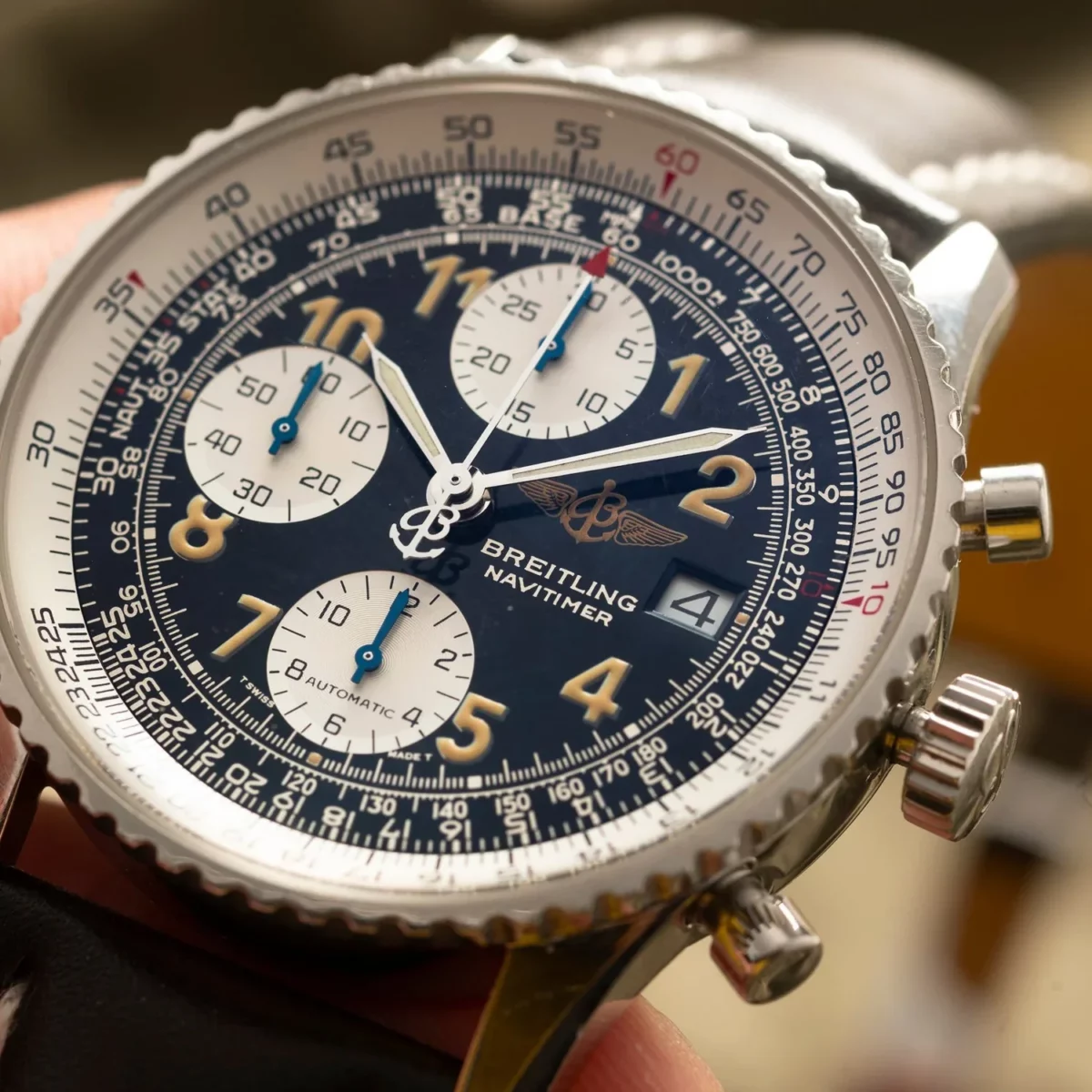
A legend shaped by history: from cockpits to the world’s wrists
What makes a watch “the ultimate pilot’s watch” is not just specifications. This is the way she goes through the times. The Navitimer anchored itself very early in aeronautical culture, in particular thanks to its links with pilot organizations and its image as a professional tool. But she quickly crossed another milestone: that of the icon. In the 1950s and 1960s, aviation was glamorous. It embodies technological avant-garde, mobility, a form of virile elegance made of leather, metal, and precision.
The Navitimer then becomes a double symbol: a serious instrument for those in the know, and a stylish talisman for those who dream of altitude. It’s this ambivalence that makes it so strong. It speaks to technology, but also to the imagination, a balance that few watches manage to maintain without caricaturing themselves.

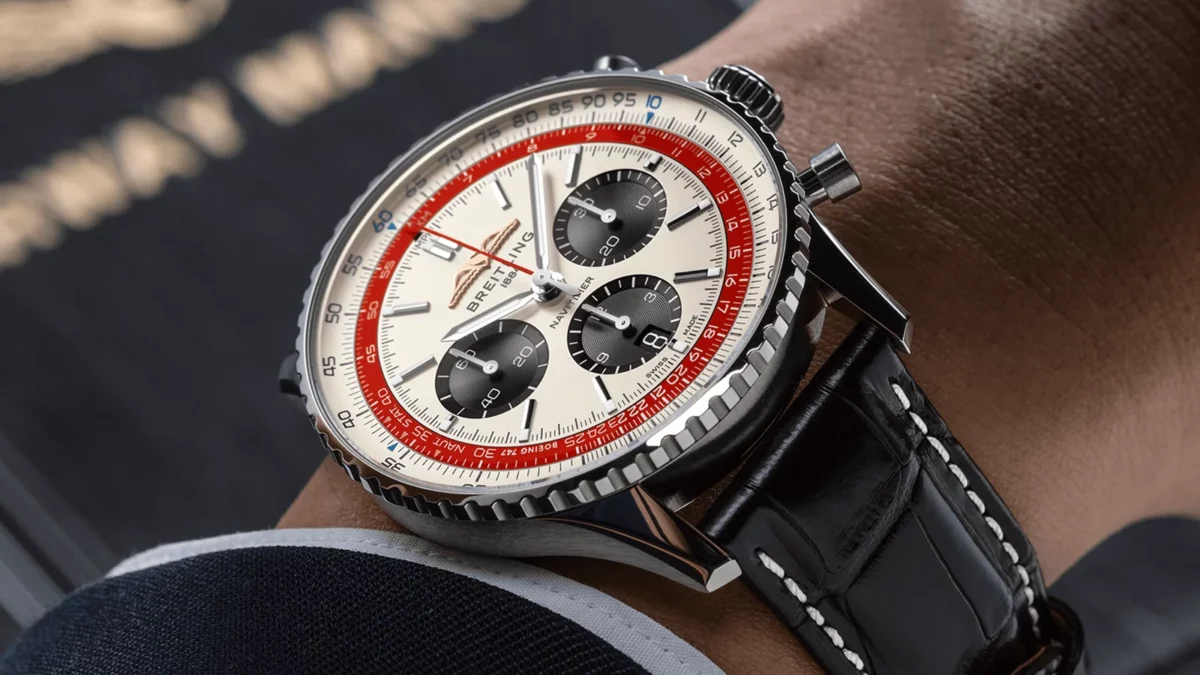
The Navitimer cannot be confused with any other. Its fluted bezel, designed to be easily manipulated, gives relief and grip. Its information-rich dial creates an almost typographic graphic signature. And its presence on the wrist, often between sport and elegance, makes it surprisingly versatile.
It has this rare power: to be at home under a blazer sleeve or at the end of a weathered leather bracelet, with an aviator jacket. She’s not trying to pass herself off as a dress watch, or a diver. It assumes its category: the tool watch. And it is precisely this honesty that ends up being “luxury”.
The detail that changes everything: the bezel as a gesture
Many watches look at each other. The Navitimer can be handled. Turning the bezel, aligning the numbers, starting the chronograph: we find a period gesture, almost ritual. It is these micro-actions that create attachment. A pilot’s watch doesn’t just have to look good; it must invite use.


Why it remains the benchmark, even in the face of “modern” watches
You might think that the rise of smartwatches, avionics instruments and advanced materials would relegate the Navitimer to the status of nostalgia. In reality, it has gained an even more solid status: that of archetype. The modern, readable, robust, tool-oriented “pilot watch” owes a lot to the idea that the Navitimer popularized: a watch designed first for a real function, then sublimated by design.
It also remains a gateway to watchmaking culture: there we discover the chronograph, the logic of scales, the history of instruments. And, at a time when so many products are becoming simpler, the Navitimer offers the opposite: an assumed richness, which rewards curiosity.
- It has an iconic function : the slide rule, unique and immediately identified.
- It embodies the golden age of aviation : a powerful, coherent, documented imagination.
- It imposes a signature design : recognizable in a second, without an ostentatious logo.
- It remains a “tool” watch : an object of gesture, not just for display.
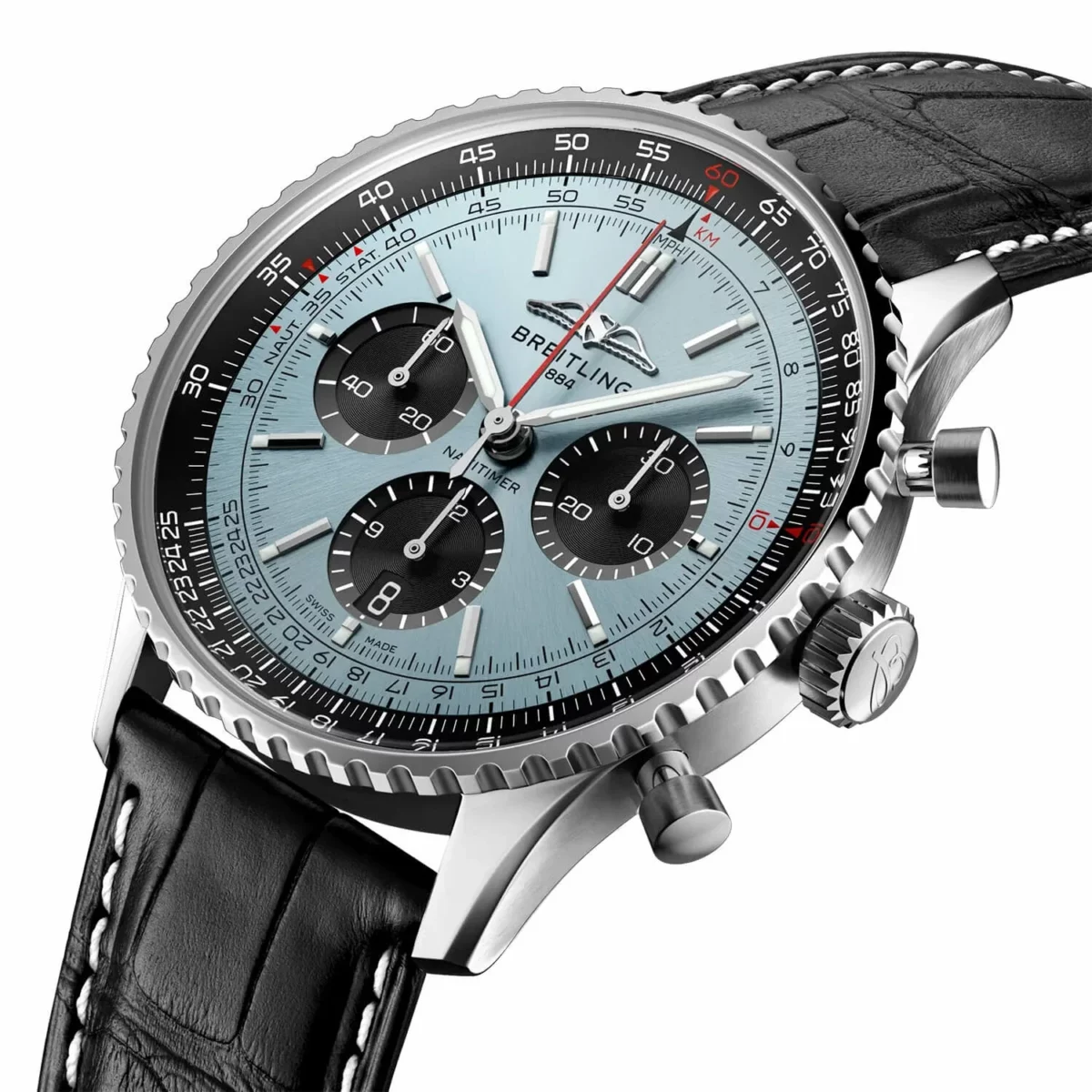
The Breitling Navitimer is not just a pilot’s watch: it is the watch that gave navigation a face on the wrist. Through its slide rule, its chronograph, and this dense dial like a road map, it tells of a time when we also drove with our hands and our heads, not just with screens.
If it remains “par excellence”, it is because it has remained faithful to its DNA: to serve, measure, support. And, in the process, she did what only great objects achieve: transforming a technical necessity into timeless style. For watch enthusiasts, the Navitimer is not a simple reference. It’s a cultural compass that always points to the sky (it’s beautiful, right?).