Why does a mechanical watch, sometimes adjusted to the exacting standards of a master watchmaker, lose or gain a few seconds every day? Because behind its impeccable dial a fragile score plays out, where gravity, temperature, oil and even your rhythm of life influence a precise ballet. It is precisely this tension between science and poetry which gives the charm of a living mechanism. Decryption.
Imperfection as a signature
The daily drift is the difference between the time displayed by your watch and the reference time over the course of a day. Where a quartz stubbornly clings to the second, a mechanical watch negotiates. She performs the score. Far from being a fault, this slight fluctuation is a reminder that you are wearing an instrument designed to breathe, not a miniaturized atomic clock. This margin is not anarchic: it is expressed in accepted and measured thresholds.
What does “well adjusted” mean?
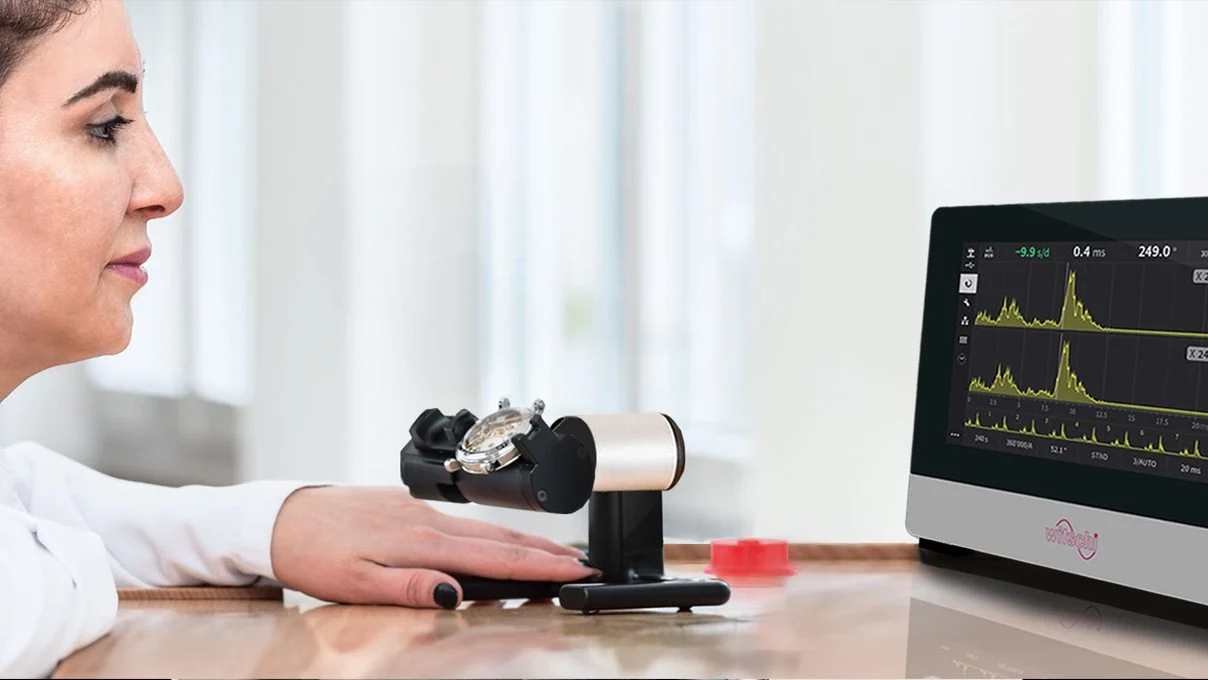
In industry, accuracy is measured in seconds per day. A COSC certified chronometer tolerates between −4 and +6 s/day. Some labels go further: METAS imposes 0 to +5 s/day on fully assembled watches exposed to high magnetic fields. Many manufacturers claim their own standards — from −2/+2 s/day to ±5 s/day. The important thing is not just average, but consistency in various positions and contexts. Because a watch does not live on a test bench: it lives on your wrist.
The main causes of variation
Positions and gravity
Flat, crown up, lugs down… each position modifies the way gravity influences the balance axis and pivots. The result: gait differences sometimes of several seconds between positions. A good “multi-position” setting will narrow the gap, but real life — keyboard, gestures, sleep — creates its own mix. Hence the interest in knowing the “signature” of your watch to tame it at night (we’ll come back to that).
Temperature and materials
The oscillation frequency depends on the elasticity of the hairspring and the inertia of the balance wheel. Heat expands, cold contracts. Modern alloys such as Nivarox and silicon have considerably reduced these effects. Historically, we compensated with bimetallic balances; today, the silicon balance spring and anti-variation processes do more than compensate: they stabilize. But going from 5°C to 35°C in a few hours remains a challenge.
Spring torque and isochronism
A watch is more regular when the amplitude of the balance wheel is stable. However, the torque delivered by the mainspring decreases as the power reserve increases. The solutions: optimized barrels, efficient automatic winding, isochronism brakes, hairsprings with elaborate curves (terminal curve or overcoil, when the geometry allows it). High frequencies (5 Hz) can smooth out some irregularities, but require more energy and optimization.
Lubricants and wear
Oils age, thicken, migrate. Increased friction modifies the amplitude, therefore the gait. This is often where a drift is hidden which grows over time. We do not revise out of snobbery: we revise to preserve the dynamic balance and health of the movement. A watch that is rarely worn and stored incorrectly can age more quickly than a watch that runs regularly.
Shocks, vibrations and magnetism
An impact can shift a balance microscrew or create an imbalance imperceptible to the eye. Magnetism sticks together the turns of the hairspring: the watch then moves forward. Today, non-ferromagnetic components, internal cages and anti-magnetic certification (up to 15,000 gauss) limit this risk. But a magnetic travel bag, a speaker, a tablet clasp… are sometimes enough to derail the pace. A demagnetizer corrects the situation in a few seconds at the watchmaker.
Tolerances and adjustment philosophy
Mobile index or variable inertia balance (Microstella, Gyromax): the adjustment method changes the behavior. The “free sprung” is more stable over time, because we adjust the inertia rather than the active length of the hairspring. But beyond the architecture, everything depends on the watchmaker’s hand: balancing a balance, centering a hairspring, minimizing the reference error, balancing the positions… It’s an art as much as a science.
- Wind regularly: daily manual winding in the morning stabilizes the torque. For an automatic, wear it enough or use a quality winder if necessary.
- Test the nighttime positions: if your watch moves forward, leave it crown down or up depending on its behavior; If it delays, flat top dial is often faster. Take your own measurements over a few nights.
- Avoid magnets: keep the watch away from speakers, double phone cases, magnetic clasps. If in doubt, a quick test at the watchmaker.
- Keep a cool head: no sauna, no hot dashboard. Temperature differences are the enemy of isochronism.
- Watch for the signs: a noticeable drop in amplitude, an unexpected stop, a runaway drift? Pass the workshop. A well-executed review often saves precious seconds.
- Stay realistic: −4/+6 s/day (COSC) is already excellent in real life. The obsession with 0 s/day belongs to laboratory chronographs.
Observatories on your wrist: a culture of precision
In the 19th century, the Neuchâtel or Kew observatory competitions were the equivalent of the Grands Prix: Longines, Zenith, Patek Philippe sharpened movements regulated like scientific instruments. Even earlier, Harrison’s marine chronometers made it possible to determine longitude — an accuracy that literally changed the map of the world. Today, METAS, the Superlative Chronometer or internal tests continue this tradition, adapted to the modern wrist and its omnipresent magnetic fields.
Precision is not the prerogative of Haute Horlogerie: it results from a coherent chain – design of the hairspring, functional finishes, chosen lubricants, adjustment protocol – served by ruthless controls. The rest ? It’s your personal story with the watch writing it, second by second.
Questions we are often asked
Is a new watch “made”?
We sometimes talk about a break-in period. In practice, the remaining changes after a few days are due to the stabilization of the lubricants and your actual usage. If the drift remains significant, an adjustment under warranty is required.
Should I aim for 0 seconds/day?
No. Aim for regularity consistent with the standard of your watch and your habits. A known and stable drift is easily compensated for over a week.
Marked sudden advance, sometimes greater than +20 s/day. A watchmaker will confirm in a few minutes and demagnetize it just as quickly.
Ultimately, drifting is not a betrayal: it is a breath of fresh air. It says something about mechanics, about the way you live, and about the intimate connection between an object and its owner. The seconds you “lose” are often those you gain in watchmaking culture.