Table of Contents
When the watch was not a piece of jewelry…but an instrument
Before being a status symbol or a style accessory, the wristwatch has long been a utilitarian object. A tool watchliterally “tool watch”, is born from this logic: responding to a specific need, in the field, with method and robustness. It is designed as an extension of the hand, a measuring instrument in the same way as a compass, an altimeter or an on-board chronometer.
The paradox is that by being effective, the tool watch has become desirable. By being hard to use, it has become an icon. And today, it embodies a form of modern luxury: that of functionality, honest design and lived history.
A tool watch is a watch designed primarily for a specific mission and demanding conditions of use. It favors readability, reliability, waterproofness, resistance to shocks and magnetic fields, as well as useful functions (rotating bezel, chronograph, GMT, etc.).
The tool watch is distinguished from a “dress watch” by its approach: here, form follows function. This does not mean that it is devoid of elegance, on the contrary. But its elegance is that of the tool: a beauty born from accuracy.
The criteria that (almost) always come up
- Immediate readability : large indexes, strong contrast, luminescent material, clear dial.
- Robustness : protective casing, resistant glass, construction designed to withstand.
- Waterproofing and protection : screwed crown, serious joints, tolerance to humid or dusty environments.
- Useful functions : diving bezel, tachometer, compass, second time zone, etc.
- Ergonomics : easy handling, even with gloves; bracelet adapted to the action.
A story of necessity: from war to the depths
The tool watch is the daughter of industrialization, 20th century conflicts and exploration. When pilots need to navigate at night, when divers need to measure their immersion time, when engineers need to protect a movement from magnetic fields, watchmaking responds with concrete solutions.
In the 1930s to 1960s, the golden age of professional watches, the specifications were clear: precision, resistance, readability. The superfluous disappears. The codes are born: graduated bezel, baton hands, Arabic numerals, matte black dials, steel cases. Originally, it’s not an aesthetic. It’s a necessity.
Three main families of tool watches
1) The diver: the tool that conquered the city
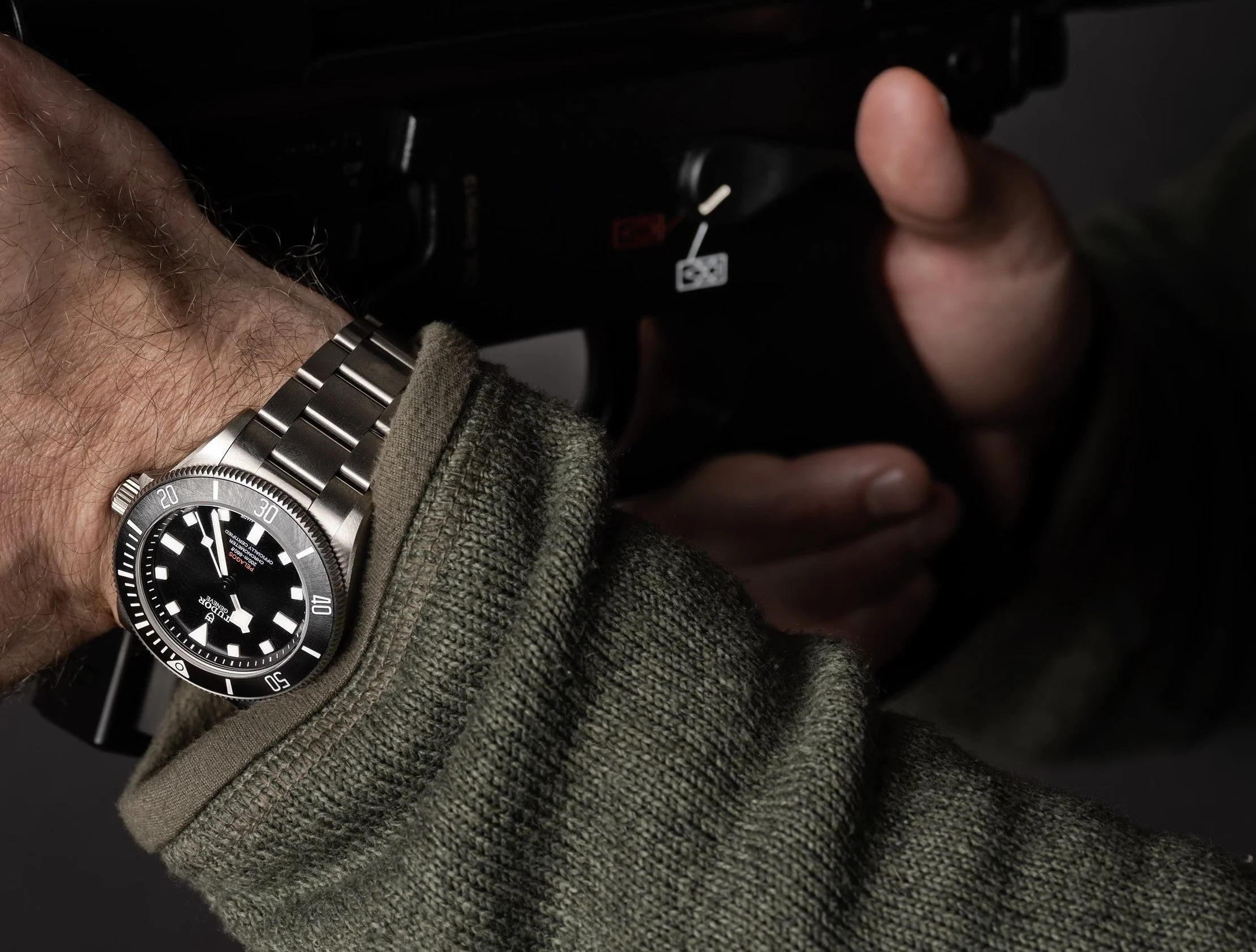
The diver’s watch is undoubtedly the most recognizable tool watch. Its distinctive sign: the unidirectional rotating bezel to count the elapsed time, associated with a high tightness and readability designed for low light.
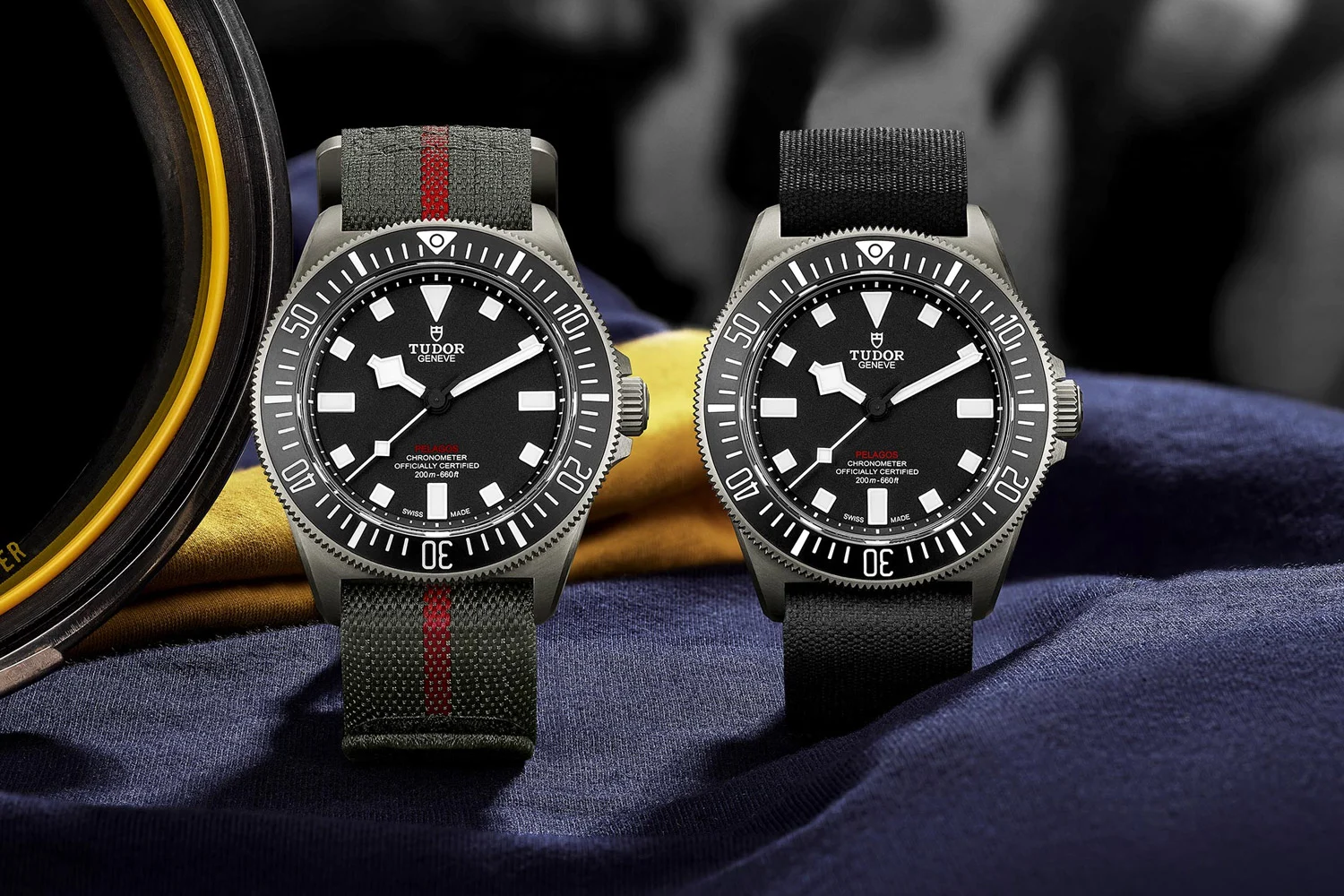
What fascinates is the coherence of its design: each detail has a reason for being. And yet, its silhouette has become universal, to the point of matching both a work jacket and a white shirt.
2) The pilot: instant reading and cockpit spirit
The pilot tool watch prioritizes readability and navigation. Historically, it results in a very contrasting dial, often large numerals, very visible hands, and sometimes a oversized crown designed to be handled with gloves.
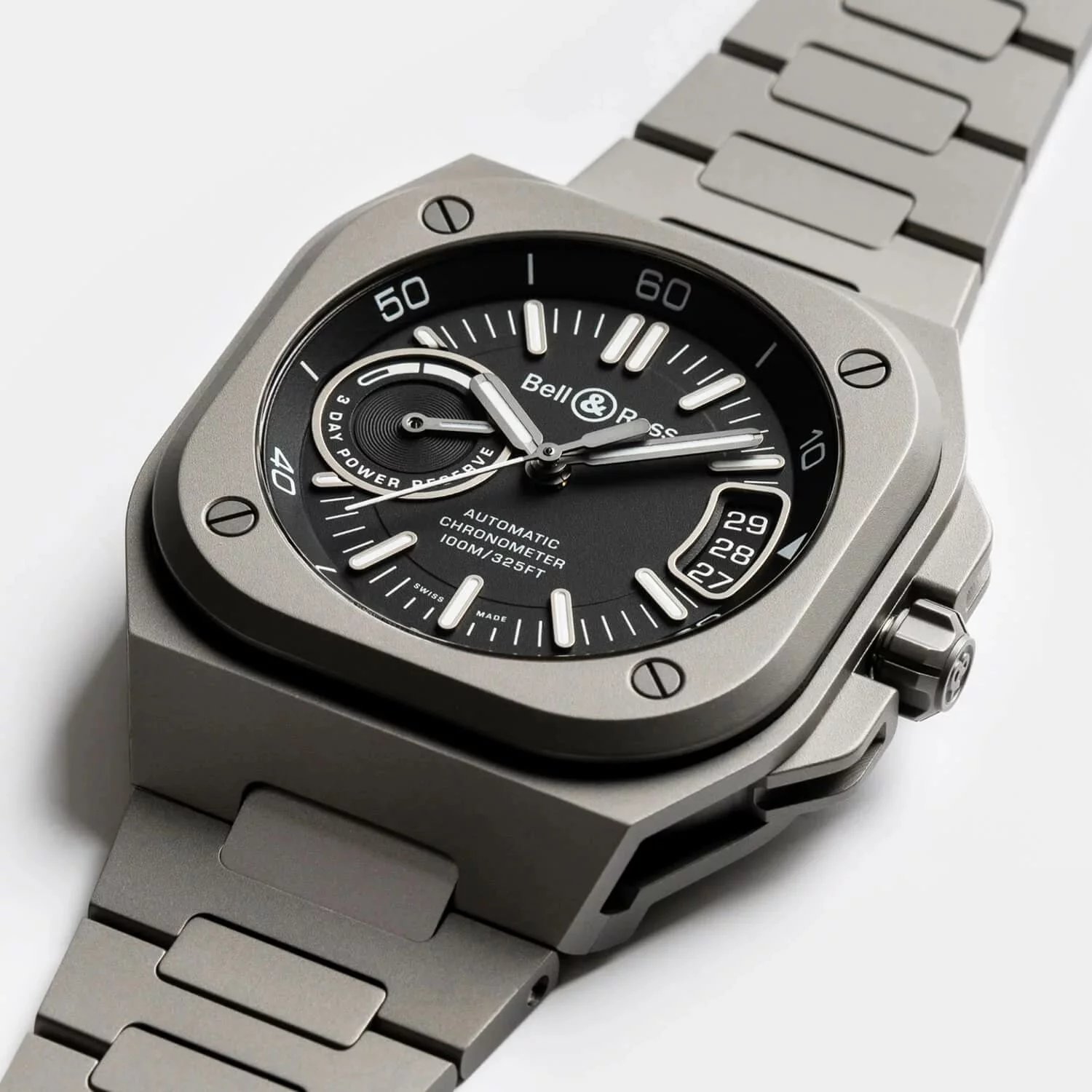
From military observation watches to pieces inspired by civil aviation, this family conveys a powerful imagination: that of precision, discipline and travel.
3) The field watch: military sobriety, total efficiency
There field watchor field watch, is the very essence of the tool watch: a simple, robust, easy-to-read watch, often with three hands, sometimes with a 24-hour scale. It evokes the daily life of soldiers, explorers, engineers: a watch designed to “be worn”, not contemplated.
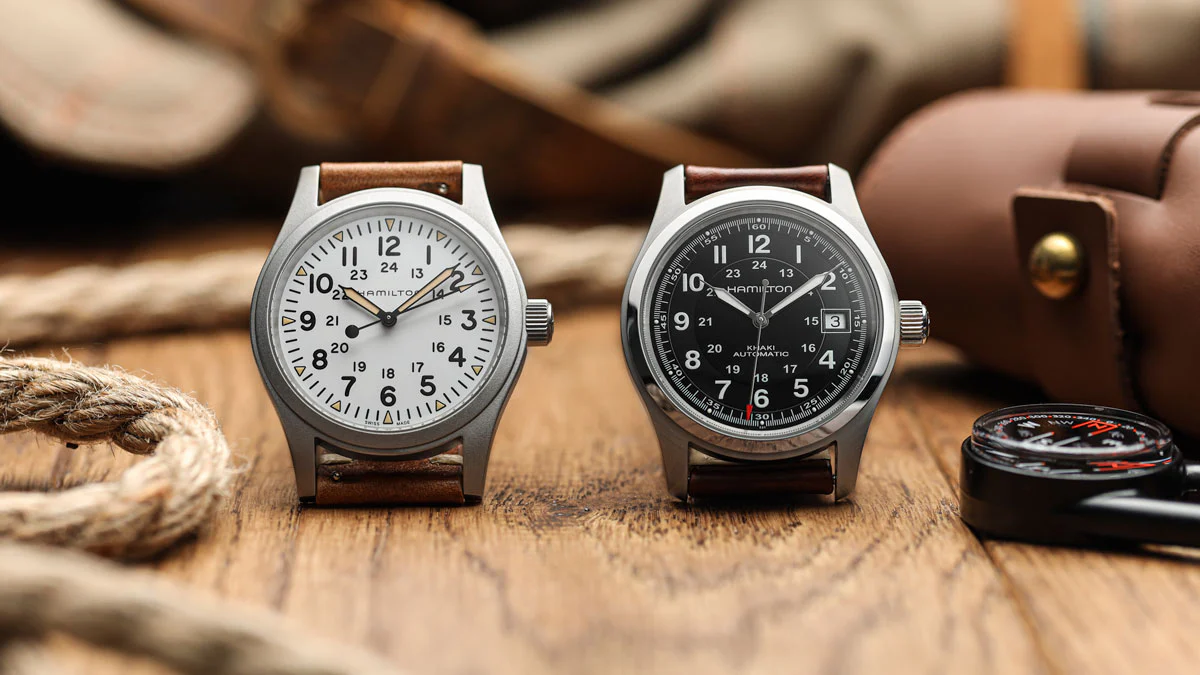
Its charm lies in its modesty. She does not seek to impress, she seeks to last.
The tool watch appeals because it tells a story that goes beyond classic luxury. She talks about usage, gestures, situations. It suggests adventure without forcing the point. In an era saturated with “marketing” objects, it embodies a form of authenticity: a product designed to serve.
There is also a cultural dimension: tool watches are everywhere in the collective imagination. Cinema, exploration, sport, army, submarine, circuit… They were worn by professionals, then adopted by those who dreamed of being so. And this is how a tool watch becomes a signature watch.
The detail that changes everything: the tool as a design language
A successful tool watch has its own grammar: functional proportions, readable dial, sometimes utilitarian finishes (brushed rather than polished), steel or rubber bracelets, and a general impression of “coherence”. Even flamboyant, she seems rational. Even luxurious, it seems ready.
Iconic features: what are they really for?
- Diving glasses : measure an elapsed time in complete safety (hence the unidirectional direction).
- Chronograph : time an action (sport, maneuver, procedure).
- GMT / dual time : follow a second time zone, travel tool.
- Antimagnetism : Preserve accuracy near magnets, devices and technical environments.
- Screw-down crown : reinforce sealing and safety in real use.
An important point: owning a tool watch does not mean using all of these functions on a daily basis. But their presence speaks of the seriousness of the object. It’s a bit like wearing a pair of boots designed for the rain: even on a clear day, you appreciate the idea that they’re not afraid of anything.
The two worlds overlap, but the nuance is real. A sports watch can be thought of first as a sport-inspired style product, while a tool watch finds its origin in a concrete need and strict specifications.
In practice, many contemporary models combine the two: luxurious finishes, sophisticated calibers, high-tech materials. But the tool watch DNA is based on one thing: the priority given to function and readability, even when the watch becomes more “premium”.
The right question is not “what is the best tool watch?” but “what mission do you want to entrust to him?”. Even if this mission boils down to facing the subway, the rain and the days that are too long.
Some simple guidelines
- For versatile daily use : look for readability, good water resistance (at least 100 m) and a comfortable strap.
- To travel : favor a readable GMT and a bezel or a hand dedicated to the second time zone.
- For water : a real diver (200 m and unidirectional bezel) provides incomparable peace of mind.
- For a “field” spirit : simplicity, robustness, refined dial, sometimes on a textile or leather strap.
The tool watch does not need to convince: it proves. It proves by its construction, by its readability, by its capacity to absorb reality. It’s a watch that takes on the friction of the world, and that’s precisely what makes it so contemporary.
In a collection, it often plays the role of a “trusted” watch. The one you grab without thinking, the one you take everywhere, the one that ages well because it was born for that. And ultimately, this is perhaps the most accurate definition: a tool watch is a watch that we wear to live, not to appear.