There are watches for strutting around and others that are used. There field watchOr field watch in French, is part of this second family, that of honest pieces, designed to live. Born in the shadow of barracks, she left the field of operations for café terraces, hiking trails and open-air offices. A watch for use, in the noble sense: the tool which tells the story of a life as much as it accompanies it.
Definition: the essence of a field watch
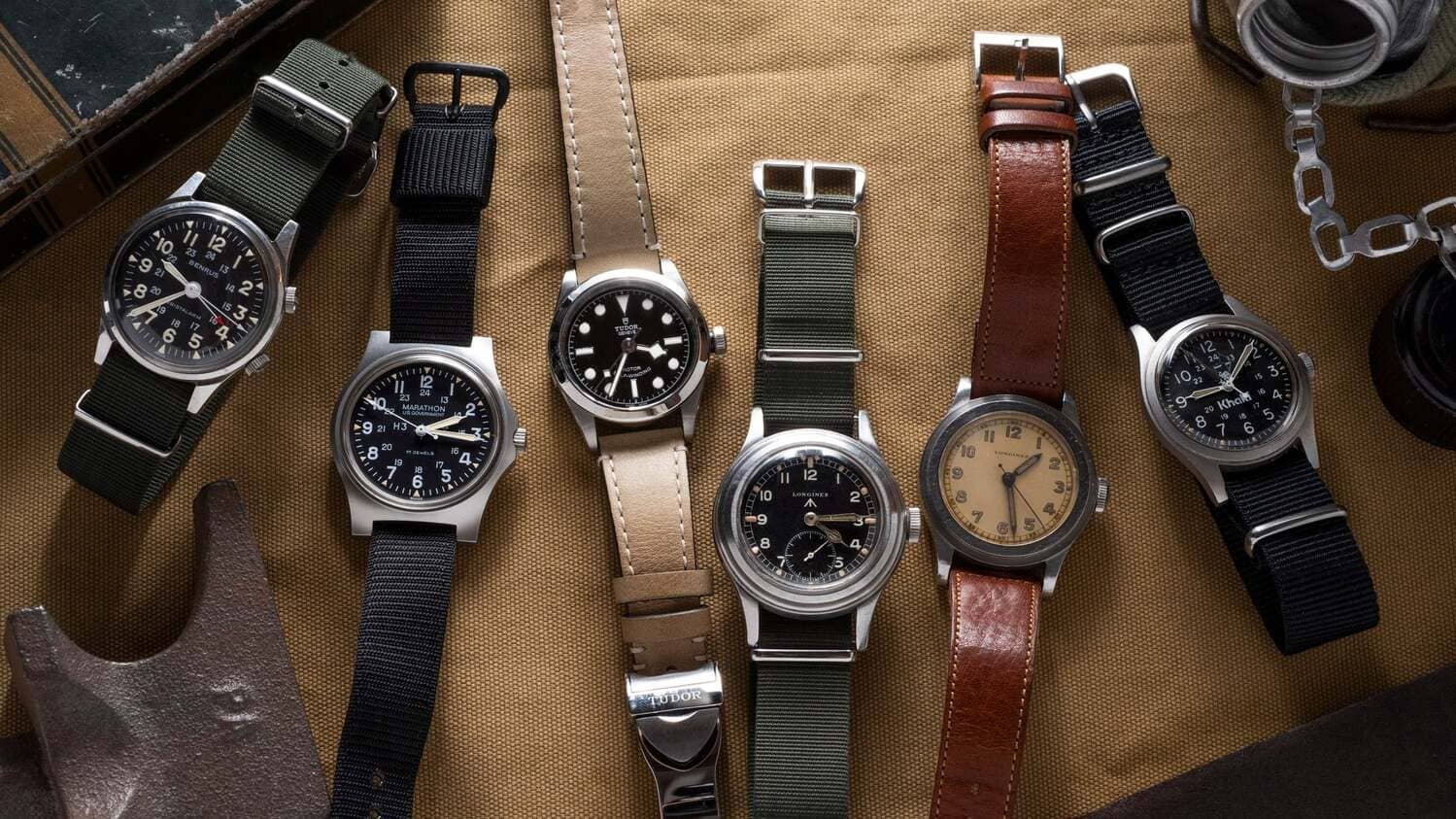
“Field” as “field” — battlefield, originally. The field watch is a military watch, designed for readability, resistance and reliability. Its specifications are contained in three words: simple, robust, readable. Usually there is a matte black or khaki dial, large Arabic numerals, a precise timer, sometimes an internal 24-hour scale, generously luminescent contrasting hands and a second which stops at the setting (stop-seconds) to synchronize the time.
On the case side, the brushed steel limits reflections; the diameter remains contained (36 to 40 mm) so as not to bother the wrist; waterproofness ranges from 50 to 100 m; the glass is hardened mineral or sapphire depending on budget. The movement? Mechanical with manual or automatic winding – purists will love the daily gesture of winding –, sometimes quartz for maintenance-free precision. On the wrist, a robust textile, a NATO G10, thick leather or a canvas strap: the field likes raw materials.
A captivating military heritage
The trenches of 1914-1918 accelerated the migration of the pocket watch to the wrist: it was necessary to tell the time at a glance. During the Second World War, the American specification A-11 dictated a grammar that became canonical, to the point that it was nicknamed “the watch that won the war”. The A-17 and the GG-W-113 followed for Vietnam, while the British army ordered its WWWs from twelve manufacturers — the famous “Dirty Dozen”, from Omega to Longines, from IWC to Jaeger-LeCoultre.

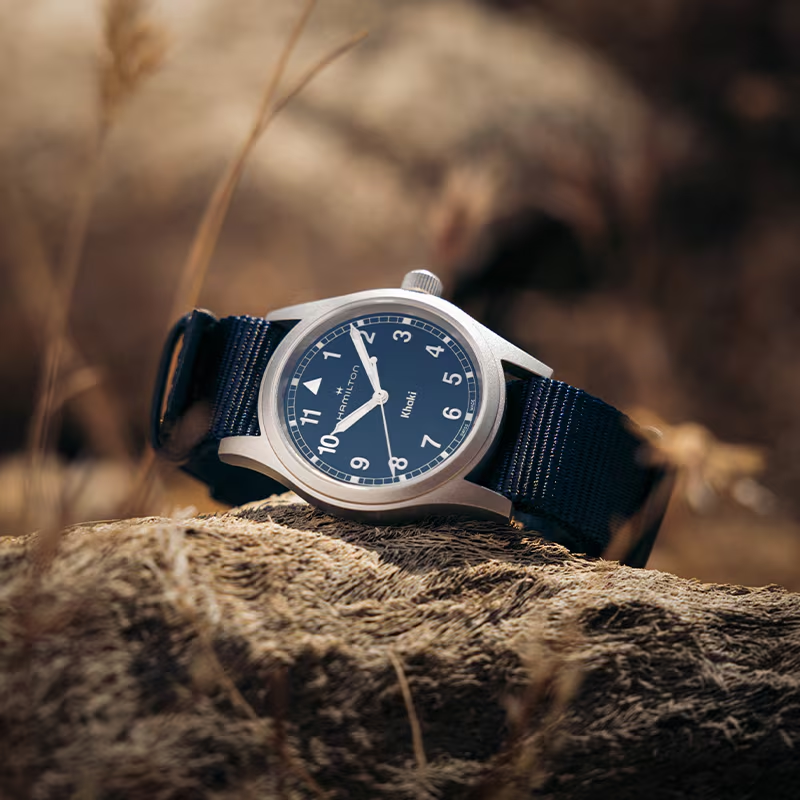
Beyond operations, the field has evolved into a symbol of concrete adventure: daily odysseys, weekend expeditions, return to functionality. Its aesthetic has become a language. You don’t wear a field to show off; we wear it to do.
Design codes, line by line
- Absolute readability: matte dial, solid Arabic numerals, stick or syringe hands, “railroad” timer, maximum contrast.
- Utility Case: Brushed Steel, Straight Lugs, 36-40mm, Measured Thickness, Simple and Walkable Crown.
- Robustness: sapphire crystal preferably, serious seals, 50–100 m water resistance, shockproof and sometimes antimagnetic cage.
- Synchronizable movement: obligatory stop-second for the “mil-spec” spirit; manual for ritual, automatic for practicality.
- Tactical strap: NATO G10 (born in the British MoD in the 1970s), canvas, patinated leather; welded bars on certain models.
- Luminous without ostentation: Super-LumiNova or tritium tubes on some military references.
Why the field watch is popular today
Because it is the antithesis of superfluous. A field goes with raw jeans, an Oxford shirt and an oiled jacket; it also goes under a textured suit, when we like to blur the lines between chic and utility. Fine and contained, it is forgotten on the wrist, but its character is revealed in the detail: a silky brushed finish, a discreet 24h, a patina that belongs only to you. It is the “capsule” watch par excellence: neutral enough to do everything, distinctive enough to tell a story.
- Weekend: on an olive NATO and boots, she smells like a walk in the forest and a steaming thermos.
- Office: grained brown leather, blue shirt, unstructured jacket — the perfect contrast between rigor and relaxation.
- Summer: sand canvas, rolled up sleeves; a nod to exploration rather than the yacht club.

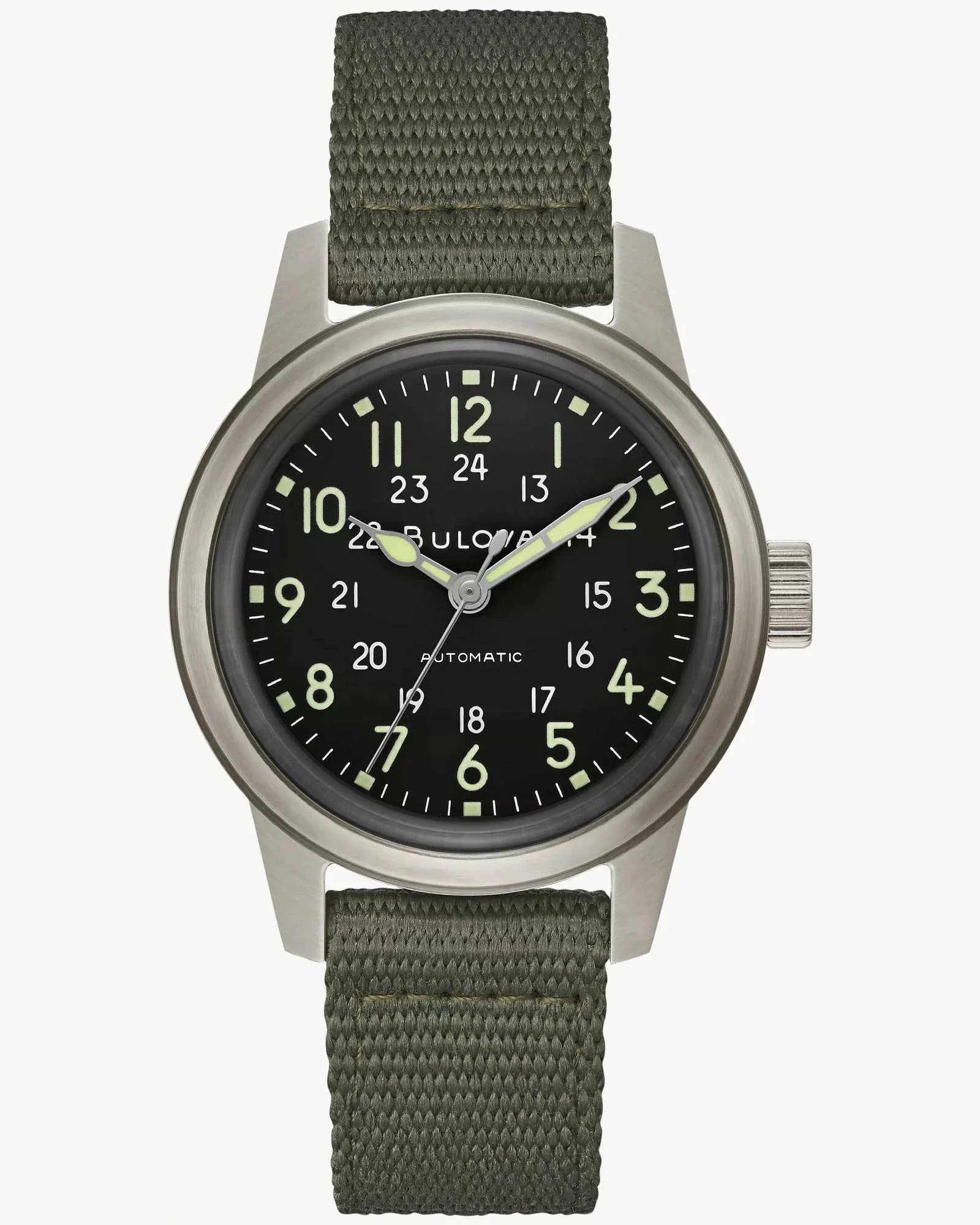
Iconic and contemporary models
- Hamilton Khaki Field Mechanical 38 mm: the modern archetype. Manual winding, 80 hours of power reserve, refined dial and authenticity at a low price.
- Bulova Hack: homage to the US “hack” watches of the 40s and 50s, standard stop-seconds and instant vintage charm.
- CWC G10 and W10 (vintage): British DNA. From endowment quartz to old mechanics, a lesson in pragmatism.
- Marathon General Purpose (GPM): purely military, with tritium tubes and sentinel readability.
- Seiko 5 Field (SRPG, etc.): the accessible and reliable option, with modern stop-second movement and useful day-date.
- Citizen Promaster Tough: robust monocoque, solar Eco-Drive; the civilian tool watch that takes it without flinching.
- The vintage “Dirty Dozen”: for collectors. Cyma, Vertex, Omega, Longines… a watchmaking saga with twelve voices.
Choose your field wisely
- Size: 36–38mm for vintage look, 39–40mm for modern versatility.
- Glass: sapphire for durability; hardened mineral if budget comes first or to accept a patina of life.
- Movement: manual for daily use, automatic for forgetting, quartz if precision is paramount. Always with stop-second if possible.
- Waterproofing: 100 m if you live outside, 50 m is enough in dry urban areas.
- Lume: Generous Super-LumiNova; tritium for professional use (constant monitoring), knowing the standards.
- Bracelets: invest in a trio (NATO, canvas, leather). Pierced horn = easy changes; fixed bars = military security.
Maintenance and longevity
A field is maintained: rinse with fresh water after the sea and check the waterproofness every 5 years. A mechanical movement is serviced on average every 5 to 7 years; a quartz requires a battery from time to time, and here we go again. The bracelets can be replaced like changing playing fields.
Beyond the watch: a state of mind
The field is not a fashion, it is a morality. She says that a beautiful thing can be useful, that a design can be born from a constraint and become a style. In a world of complications, it recalls the elegance of the necessary. Whether you’re walking in town or along a trail, it keeps time — and pace.