Screen & Design
The screen is the thing that changes everything in your daily life with a watch.
The Vivoactive 5 has a transflective LCD. This means that it uses ambient light to display information. Result: readable in direct sunlight, but the colors are bland and the contrast average. It’s a classic sports watch, not a technological gem.
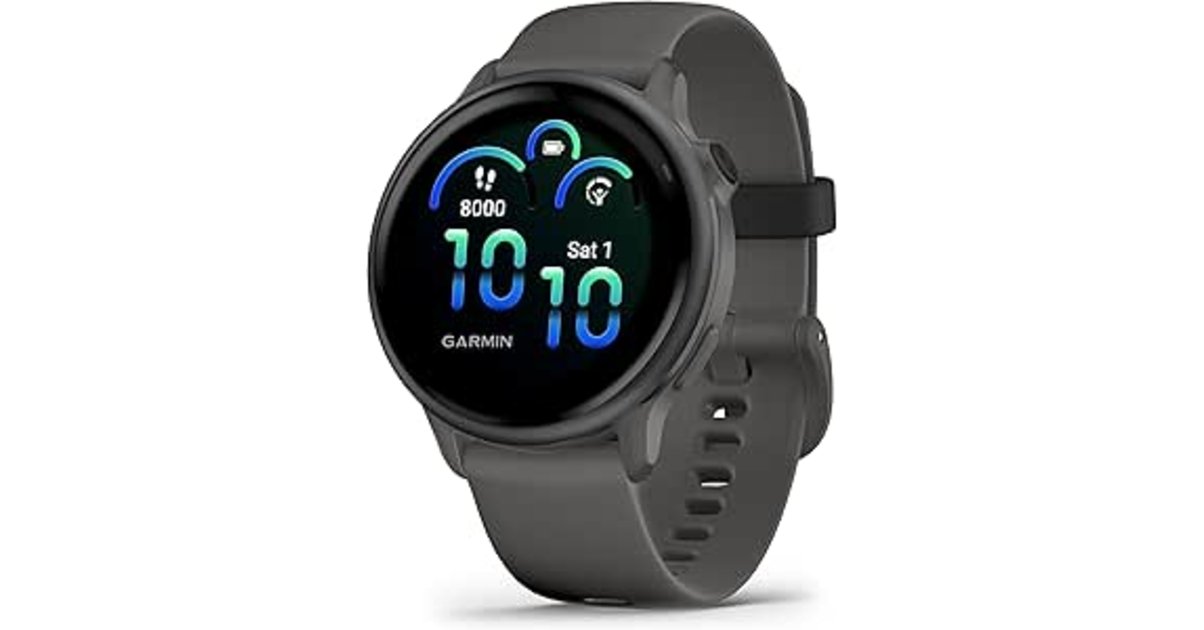
The Vivoactive 6 has an AMOLED. Each pixel produces its own light. The colors explode, the black is really black, and you can read the information even in direct sunlight (contrary to what is often said about AMOLEDs). The screen is also 25% larger (1.3″ vs 1.04″), so less squinting to read your stats.
Our verdict: If you look at your watch 50 times a day, the Vivoactive 6 clearly wins. If you’re just looking at it to check your heart rate, the Vivoactive 5 is more than enough.
The design? The Vivoactive 5 is thinner and lighter (38g vs 43g). The Vivoactive 6 is a bit thicker, but it’s barely noticeable on the wrist. Both are discreet, no gamer watch here.
Autonomy & Battery
Garmin announces 11 days for the Vivoactive 5 and 14 days for the Vivoactive 6. In reality?
We tested both in normal use (GPS 3-4 times a week, notifications activated, auto-brightness screen). The Vivoactive 5 lasts 10-11 days. The Vivoactive 6 lasts 13-14 days. So yes, Garmin is not lying.
But here’s the thing: 11 days is already huge. You will only charge your watch once a week. The Vivoactive 6 gives you 3 more days, which pushes the recharge to every 10 days. It’s not revolutionary.
In pure GPS mode (without smartwatch), the Vivoactive 5 lasts 11 hours and the Vivoactive 6 lasts 16 hours. There, it’s more interesting. If you’re doing ultra-trails or 12+ hour hikes, the Vivoactive 6 lets you finish without a low battery. The Vivoactive 5 forces you to save GPS.
Our verdict: The autonomy of the Vivoactive 5 is sufficient for 95% of people. The Vivoactive 6 wins if you put in more than 11 hours of effort regularly.
Sensors & Sports Tracking
The Vivoactive 5 tracks 30 sports. The Vivoactive 6 follows 80. That seems huge on paper. In practice?
The Vivoactive 5’s 30 sports cover the things we really do: running, cycling, swimming, hiking, yoga, weight training, trail running, etc. The 50 additional sports of the Vivoactive 6? Climbing, skateboarding, golf, cricket, badminton, and stuff you’ll never do.
The real advantage of the Vivoactive 6 is the multi-band GPS. Instead of just using classic GPS, it also uses GLONASS, Galileo and BeiDou. Result: better precision in town, under trees, or in the mountains. We tested both on an urban course with tall buildings. The Vivoactive 6 has a clearer track, less GPS drift.
The sensors are identical: optical heart rate, SpO2, skin temperature, stress. No difference.
Our verdict: If you play 3-4 sports regularly, the Vivoactive 5 is enough. If you do trail running or hiking in the mountains, the Vivoactive 6 with its multi-band GPS is worth it.
Connectivity & Functions
The Vivoactive 5: notifications, rejected calls, SMS. It’s basic but it works.
The Vivoactive 6 adds:
- Music storage (4GB). You can download your Spotify playlists and run without a phone.
- Garmin Pay. Contactless payment at the watch. Useful if you run without a wallet.
- Music control from the watch (play/pause/skip on your phone).
Music storage is cool if you’re a runner who hates having the phone. But honestly, AirPods + phone in a pocket isn’t death. Garmin Pay, same: useful 2-3 times a year when you run without a wallet.
Our verdict: These features don’t change your life. They are a nice addition, not a game-changer.
Price & Value for money
Vivoactive 5: ~€200
Vivoactive 6: ~€240
40€ difference. It’s not nothing, but it’s not huge either.
For €40 more, you have:
- An AMOLED screen (really better)
- 3 additional days of battery life (nice but not vital)
- 50 more sports (you won’t use them)
- Music storage and Garmin Pay (bonus)
- Multi-band GPS (useful if you go mountaineering)
Our verdict: If you have €240 to spend, the Vivoactive 6 is worth every euro. If you’re tight, the Vivoactive 5 at €200 is a smart buy.
Vivoactive 5 or 6? Our final recommendation
You should buy the Vivoactive 5 if:
- You run 2-3 times a week in town or on the road
- You do yoga, weight training, a little hiking
- You look at your budget
- You don’t care about the colors on the screen
- You have a phone for music while you exercise
Check out our full Vivoactive 5 review for more details on this watch.
You should buy the Vivoactive 6 if:
- You are doing trail running, mountain running, or efforts lasting more than 11 hours
- You run regularly and want a watch that’s really nice to look at
- You play 5+ different sports
- You need to store music on your watch
- You have €40 more to invest in better technology
Read our full Vivoactive 6 review to see all the details.
Limit case: Are you hesitating between the two? Take the Vivoactive 6. It ages better, the AMOLED screen is really comfortable on a daily basis, and €40 isn’t much on a €240 watch.
Final verdict: Which one to choose?
The Vivoactive 6 is the better watch. Point.
It has a killer screen, solid battery life, more accurate GPS, and bonus features. If you have the budget, this is it.
But the Vivoactive 5 is not a bad watch. She’s just not as good. And for an urban runner who does 3 sessions per week, that’s more than enough. You save €40 and you have a reliable watch that will last you 3-4 years without problem.
The real choice: It depends on your budget and your usage. The Vivoactive 6 if you can afford it. The Vivoactive 5 if you’re tight. Both are good.
FAQs
Q: Can the Vivoactive 5 run trails?
A: Yes, but with limits. The simple GPS is less precise in the mountains than the multi-band GPS of the Vivoactive 6. For occasional trail running, it’s fine. For regular trail running, the Vivoactive 6 is better.
Q: How long before the battery degrades?
A: Garmin announces 3-5 years before noticeable degradation. In reality, after 2-3 years of intensive use, you will lose 10-15% of battery life. It’s normal.
Q: The AMOLED screen of the Vivoactive 6 really consumes more?
A: Yes, but Garmin compensated with a larger battery. Result: 14 days instead of 11. AMOLED consumes more, but it’s not dramatic.
Q: I do a lot of swimming. Which one to choose?
A: Both are water resistant to 5 ATM (50 meters). No difference for swimming. Choose based on screen and budget.
Q: Can we charge both with the same cable?
A: No. Garmin has changed the connector between the two models. You will need two different cables.
Q: Is the Vivoactive 6 really worth €40 more?
A: Yes, if you look at your watch often (the AMOLED screen changes everything) or if you go mountaineering (multi-band GPS). No, if you’re just a basic urban runner.
Q: Which watch will last the longest?
A: Both last 3-4 years without major problems. The Vivoactive 6 with its AMOLED screen may have burn-in issues after 4-5 years of intensive use, but this is rare.
Q: Can I find the Vivoactive 5 cheaper now?
A: Yes, Garmin has lowered the prices of the Vivoactive 5 since the release of the 6. You can find it for €180-190 on certain sites. It’s a good deal.
Do you have a Vivoactive 5 or 6? Tell us in the comments what you think of it after a few months of use.