3) “Okay, but is it dangerous?” The 5 classic fears, sorted neatly
We’ll take them one by one. Without theater.
1) Waves at night: the loudest fear
The watches mainly use Bluetooth Low Energy. Exposure level, we are on low powers, and above all very intermittent (it sends, it is silent, it sends back). The solid, factual point: WHO explains that, below safety limits, research does not show consistent adverse effects from radiofrequencies.
Does that mean “zero risk”? No. No one can sign this for you. That means: no robust evidence of a problem at these exposure levels. And if you want to reassure yourself: airplane mode / turn off the Bluetooth at night (when possible) and synchronize when you wake up. Simple. You sleep better because you are peaceful, not because physics changes.
2) The real danger: notifications
Do you want to sleep or respond to “did you see the thing” at 1:47?
If you sleep with your smartwatch, you activate a sleep/do not disturb mode. Mandatory. Otherwise, you paid a lot to be woken up by a stupid vibration. And then you wonder why your sleep tracking is bad. Yes, it’s absurd.
3) Irritation, maceration, pimples: the very concrete problem
The wrist is a hot area. If you wear a watch 24/7, you create a micro-climate. Sweat + friction + soap scum + wet silicone = irritation. You see the picture.
Field solutions (not glamorous, but it works): clean the bracelet, alternate two bracelets, switch to breathable nylon, loosen a notch at night. And if your skin reacts often, you take a break. Sleep tracking doesn’t deserve inflammation.
4) The battery: the thing that kills the habit
If your watch has to charge every night, you’re going to give up. You already know that. The simplest solution: charge while showering + during morning coffee. You keep the night free. Clean routine, without fighting with a cable at midnight.
5) Private life: not sexy, but real
Your sleep is sensitive data. Some apps sync in the cloud, share with third-party services, cross-reference your other health data. Nothing illegal necessarily… but you have to know where you’re putting your feet. Check permissions, deactivate what is useless, avoid dubious “bonus” apps just for a prettier graph. Yes, I insist. It depends on the profiles, but the risk exists.
4) How to wear your watch at night so that it (really) helps
Do you want useful data? You need to stop wearing your watch “randomly”.
Tightening: neither tourniquet nor floating bracelet
The optical sensor likes stable contact. If the watch moves, the measurements deteriorate. If you tighten too much, you hinder circulation and you sleep poorly. The right setting is one where the watch doesn’t run, without leaving a deep mark on you in the morning. Yes, it’s subjective. And yet it is the basis.
Position: one finger above the bone is often better
Many people put it too close to their hand. Result: wrist flexion, unstable contact, average readings. Goes up slightly on the forearm. Test 2–3 nights, and keep what works. So.
Simple protocol over 7 nights (to stop telling yourself stories)
Do you want something serious, without a lab? Do this:
- 7 nightsnot 2.
- Approximately stable bedtime (within 30–45 min).
- You notice 3 things when you wake up: energy (0–10), stress (0–10), desire to move (0–10). Yes, it’s basic.
- Only one variable changes at a time: alcohol/sport late/screen late. Not all at once, otherwise you don’t understand anything.
After a week, you’re not looking for “the best night”. You are looking for a pattern. Example: “when I train after 8 p.m., my night HR remains higher”. There, you have something. You can act.
And if you want to compare watch vs bracelet (because some people hate sleeping with a watch), I detailed it here: connected watch vs bracelet: the differences that matter.
5) When it’s better to take it off (and stop feeling guilty)
We’re not going to lie: there are nights when you benefit from taking it off.
You have skin that reacts : redness, itching, plaques. You take a break. You change your bracelet. And you avoid the “watch + cream” combo at night. Bad idea, it macerates.
You wake up with discomfort : wrist pain, numbness, feeling of compression. You adjust, or you stop. Sleep comes before a PDF report.
You become addicted to scores : you look at your sleep before you even get up. And your day already starts with a “bad sleep” label. Stop. The data serves you, not the other way around. This is the moment when the watch eats your head.
You suspect a disorder (loud snoring, observed breathing pauses, drowsiness while driving, waking up in panic): the watch can sometimes raise a flag, but it is not the one that decides. If you want a clear point on this specific subject: sleep apnea: what your watch detects.
Buying experience: what really matters if you want to sleep with it
If your goal is sleep tracking smart watchyou don’t buy “the most expensive”. You buy the one that you can wear for 8 hours on your wrist.
Quick checklist (and yes, I’ve seen the wrong selection too often): decent battery life, comfortable bracelet, simple sleep mode, stable sensors. The rest is a bonus. And for the return: choose a store that lets you test it for a few days without tearing your head out if you send it back. A watch sitting in a drawer is of no use.
Last digression – quick: sleep rings and armbands are very popular, precisely because many people can’t stand the watch at night. Nothing shameful. It’s just comfort.
Recap (to keep in front of you)
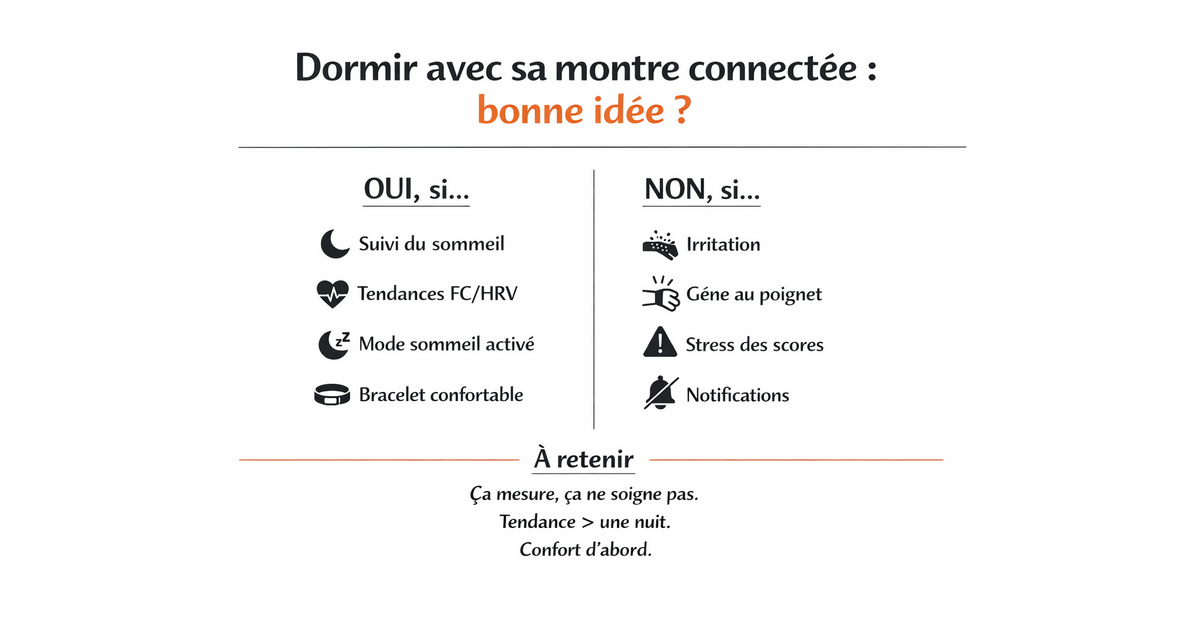
- Yes, sleeping with your connected watch helps spot trends.
- No, this is not a medical diagnosis.
- Trap #1: notifications who sabotage the night.
- The sensor likes stable contact — but not a compressed wrist over 8 hours.
- Sleep stages? indicative, not sacred.
- If scores stress you out… take it off. Point.
- Irritated skin, pain, discomfort: you take a break, you change the bracelet, you don’t force it.
- You suspect a real disorder (snoring + drowsiness): you take it seriously and you consult.
Signed: David Deteve, editor & field tester — L’Swiss Made Watch (Toulouse and surrounding areas).