The mystery of the “California” dial, between watchmaking culture and assumed strangeness
In the cozy world of fine watchmaking, there are few aesthetic codes that arouse as much curiosity and perplexity as the “California” dial. At first glance, it is confusing. At the second, it intrigues. And in the third, he captivates.
Because this dial, half-Roman, half-Arabic, is anything but a designer whim. It tells a story. A story of readability, military history, Californian restoration… and a certain taste for objects that refuse to fit into boxes.
A mismatched dial… deliberately
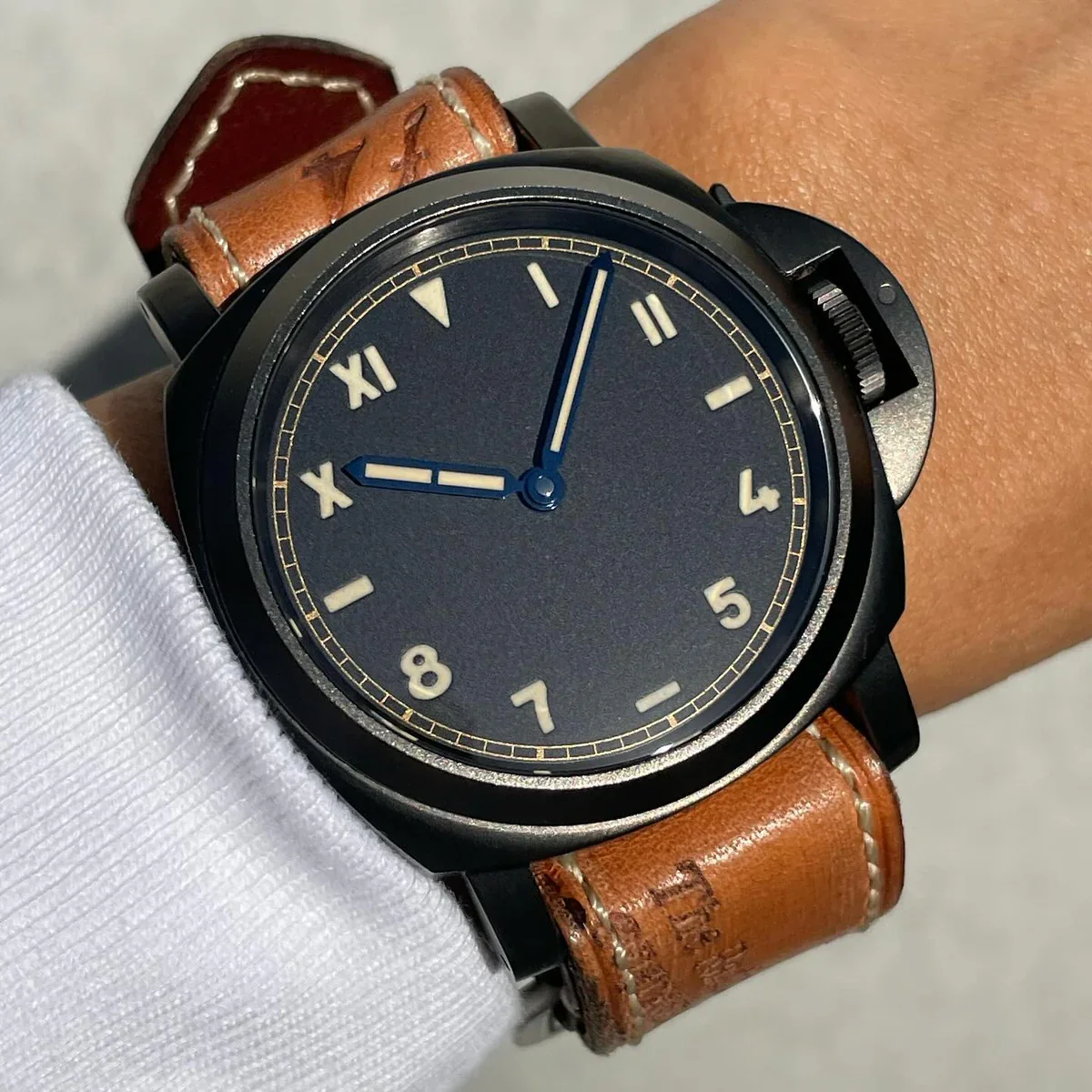
The “California” dial is instantly recognizable by its hybrid typography:
– Roman numerals on the upper half, usually from 10 o’clock to 2 o’clock
– Arabic numerals on the lower half, from 4 o’clock to 8 o’clock
– a triangle at 12 o’clock, often accompanied by dots or stick indexes to mark the other positions
Result: an asymmetrical dial, almost unbalanced at first glance, but surprisingly readable once on the wrist.
This mixture is not an accident. It responds to a very simple functional logic: immediately distinguish the orientation of the watch, even in conditions of reduced visibility. A crucial quality at a time when the wristwatch is essential in military and professional contexts.


Origins: Rolex, Panerai and the military track
Contrary to what its name suggests, the “California” dial was not born under the sun of the American West Coast.
Its roots date back to the 1930s and 1940s. At that time, Rolex produced watches equipped with this type of dial, often intended for utilitarian or even military uses. Panerai, then supplier to the Italian navy, also adopted dials of this type on certain Radiomirs.
The objective is clear: maximize readability. The more visually distinctive Roman numerals allow you to quickly locate the upper part of the dial, while the Arabic numerals provide quick reading at the bottom.
It is a typographic compromise in the service of a function. Not a fantasy.


Why “California” then?
The name appeared much later, in the 1970s and 1980s. During this period, a large number of old Rolexes were restored in the United States, particularly in California.
Damaged dials are then repainted using this hybrid style, which has since become identifiable and sought after. The nickname “California dial” gradually established itself among American collectors, before being exported throughout the world.
Irony of history: it is not the origin of the dial that is Californian, but its rebirth.


Readability thought above all else
Beyond its atypical aesthetic, the California dial is based on very concrete principles of readability.
First, the clear separation between up and down allows the brain to orient itself instantly. In the dark or under stress, this visual distinction can make the difference.
Then, the frequent presence of luminescent material, historically radium then tritium, today Super-LumiNova, further reinforces this nighttime readability.
Finally, the triangle at 12 o’clock acts as a universal marker, which is also found on many modern diving watches.
This dial is therefore less eccentric than it seems. He is even deeply rational.
Panerai, modern ambassador of the California dial


If we had to cite a contemporary house that has put the California dial back in the spotlight, it would without hesitation be Officine Panerai.
With models like the Radiomir California, the Italian brand capitalizes on its military heritage to offer faithful and consistent interpretations.
The reference PAM00424, for example, perfectly embodies this aesthetic:
– Case: 47 mm polished steel
– Movement: manufacture caliber P.3000, manual winding
– Power reserve: 72 hours
– Dial: California with luminescent indexes
– Waterproofing: 100 m
All in a generous, almost disproportionate format, faithful to the Panerai DNA. Here, the California dial is not a gimmick. It’s a signature.
Rolex and vintage “California dials”
At Rolex, California dials are today highly sought-after collector’s items.
They are found in particular on certain references from the 1930s and 1940s, often in the Oyster family. These watches, sometimes restored over the decades, feature dials whose authenticity is debated, but whose charm is undeniable.
The vintage market has seized on the phenomenon. Result: numerous variations, sometimes far from historical standards, but always recognizable.
A well-preserved vintage California dial can significantly increase the value of a watch. Provided, obviously, that it is documented and consistent with the piece.


A divisive aesthetic… and assumed
Let’s be honest: the California dial clearly doesn’t appeal to everyone.
Some find it unbalanced, almost incoherent. Others see it as a strong signature, a refusal of the overly smooth conventions of contemporary watchmaking.
There is something a little rebellious about this dial. A way of saying that readability does not need to be uniform to be effective.
And then, in a world saturated with baguette, sunray or black lacquered dials, this mixed typography provides a welcome breath of fresh air.


Contemporary reinterpretations
Beyond Panerai, other brands have tried their hand at the California dial, with varying degrees of success. Some micro-brands use it to inject a vintage touch to their collections. Others, more established, see it as a nod to history.
But the exercise is delicate. Poorly executed, the California dial can quickly turn into pastiche. Too clean, it loses its soul. Too busy, it becomes unreadable.
The best versions are often the most faithful to the original spirit: simple typography, a controlled patina, and above all, overall coherence.
And nowadays?
If the California dial continues to appeal today, it is not only for its aesthetics. This is because it embodies an era when the watch was first and foremost an instrument. Where each detail responded to a precise function.
In a market dominated by storytelling and limited editions, it reminds us of a simple truth: a watch can be strange, imperfect, asymmetrical… and yet perfectly accurate. And perhaps that is its greatest strength.
A California dial does not seek to convince immediately. It takes a little time. But once you’re hooked, it’s hard to go back.