Table of Contents
A mechanical heart beating on the wrist
At a time when the world is synchronizing with notifications, the automatic watch remains one of the rare everyday objects whose precision is born from a purely mechanical ballet very different from quartz. It lives from your gestures, comes to life without a battery, and transforms each movement into energy. It is this organic, almost animal autonomy that gives it a unique and lasting charm, beyond fashions and screens.
The rotor ballet
At the center of the show is the rotor — an oscillating mass that rotates with your movements, recharging the mainspring in the barrel. Depending on the architecture, it can be central, peripheral or micro-rotor, each imposing its signature on the design and thickness. The winding systems, unidirectional or bidirectional, ensure efficiency, while the bearings and pawls transform the slightest swing into power reserve. This invisible choreography, sometimes perceptible to the ear or to the touch, establishes an intimate relationship with the object.
The pulsation of the exhaust
Further away, the Swiss lever escapement sets time. At 3 Hz, 4 Hz, sometimes 5 Hz, the frequency sculpts the sound signature and walking stability. Watching the second hand slide in 8 half-oscillations per second is an irrational pleasure: you can read a tempo as much as an hour. Let’s see it in slow motion in this video:
Here, technology becomes music, and mechanical watchmaking reminds us that a mechanism can be as expressive as an instrument.
A tactile ritual, a presence
Turn the crown to start the mechanism, feel the slight resistance of the spring, capture the discreet quiver of the rotor which resumes its cycle: the automatic enacts a ritual. We tame our power reserve, we listen to our moods, we turn the dial up for the night, we rediscover its precision after a few days. This interaction is cultural as well as technical; it creates a deep attachment, far from instant consumption.
Watchmaking heritage and culture
Automatic watches are the culmination of a century of engineering, from the first winding systems of the 1920s–30s to post-war technical maturity. They got through the quartz crisis not through obstinacy, but thanks to a paradigm shift: mechanics is not intended to beat an electronic oscillator, it celebrates know-how, functional beauty, heritage. Wearing an automatic means extending the chain of watchmakers, from workshops to wrists, and participating in the great watchmaking conversation.
When technique shapes style
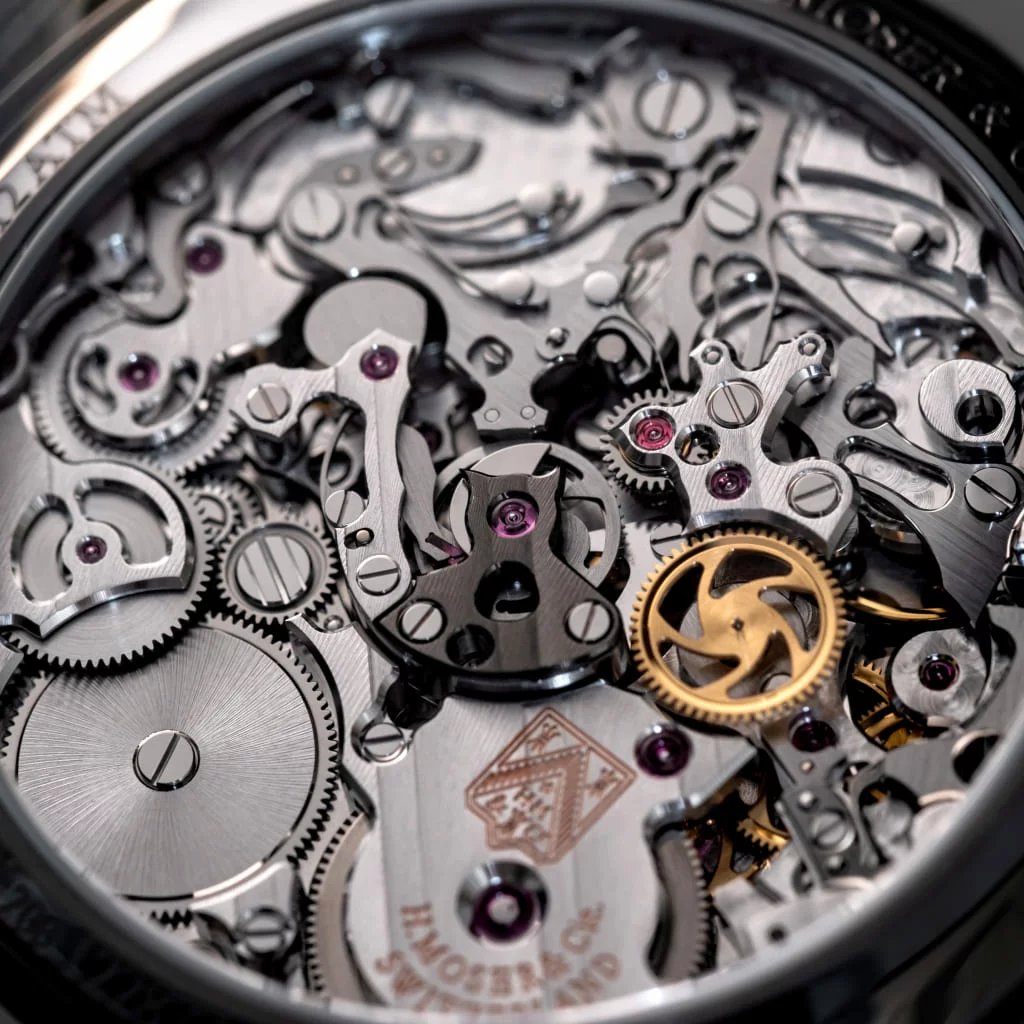
Mechanics influence aesthetics. A micro-rotor allows for thinner packages; a solid rotor imposes a more assertive build. A sapphire caseback reveals Côtes de Genève, perlage, beveling and sculpted bridges: so many finishes that speak of the hand of the craftsman. Gauge geometry often dictates diameter and thickness; the architecture of the cog train or calendar positions the counters. Here, form follows function — and the design is enriched with narrative depth.
Durability, precision, modernity
A well-designed automatic watch is made to last, to be repaired, to be passed down. With no battery to replace, it relies on long-lasting components, modern oils and anti-magnetic materials. Special alloy hairsprings and silicon components improve resistance to everyday magnetic fields; shock absorber systems protect the balance shaft. In terms of precision, good adjustment offers consistent performance on a daily basis, while chronometric certifications attest to a stable level of performance. Above all, mechanical precision has a face: it can be adjusted, understood, appreciated.
Received ideas, useful truths
- Precision: quartz remains more precise, but a well-regulated automatic goes through everyday life calmly, with an assumed and controllable margin.
- Maintenance: periodic service (approximately every 5 to 10 years depending on use and brand) preserves oils and sealing. Longevity is its best promise.
- Power reserve: 40 to 80 hours on average, sometimes more. A real freedom to the rhythm of the weekends, without energy anxiety.
- Magnetism: our environments are charged; favor models with non-magnetic alloys or silicon components.
- Waterproofing: check the joints during services. An automatic likes water if the transmission is designed for it — and if maintenance follows.
- Movement: manufactured or proven (Swiss or Japanese families), favor technical transparency and availability of parts.
- Architecture: central, peripheral or micro-rotor; impact on thickness, wrist balance and bottom aesthetics.
- Power reserve and frequency: a balance between autonomy and finesse; 3–4 Hz remains the all-purpose standard.
- Anti-magnetism and adjustment: modern hairspring, possible certification (stopwatch), adjustment in several positions.
- Finishes: sapphire back, bridge decoration, beveling quality; beauty is not cosmetic, it reflects the care taken over the whole.
- Usage: real waterproofness, suitable bracelet, readability; mechanics should serve your life, not the other way around.
Why the charm remains
The automatic watch does not seek to compete with digital; she suggests something else. A mechanical presence, a memory of gestures, a fragment of clockwork that we carry like we carry a bound book: for the texture, the patina, the continuity. In an optimized world, it claims a margin of poetry. This is perhaps where its ultimate charm lies: in this rare harmony between mechanics, automatics and watchmaking culture – a measured time, certainly, but deeply lived.