Table of Contents
From constraint to style: when the tool becomes a school
In the history of watchmaking, few terrains have shaped design as much as the battlefield. Military watches were not intended to seduce: they had to survive, tell the time to the nearest second, be read at night, resist mud, salt and heat. And yet, ironically, these constraints have given rise to an aesthetic language that has become synonymous with functional elegance. From the wrists of officers to those of creatives, from the trenches of 14-18 to contemporary display cases, military codes have infused modern watchmaking to the point of defining what we call, today, good utilitarian taste.
From the trenches to the city: birth of a grammar
The “trench watch”: the moment when everything changes
At the beginning of the 20th century, the wrist dethroned the pocket. So-called “trench” watches improvise specifications: wire horns or fixed bars to secure the bracelet, oversized Arabic numerals, black dial with white printing, cathedral or syringe hands lined with luminescent material, railroad timer for whistle synchronization. Sometimes metal protective grilles cover the glass. Readability becomes monarchical; decoration, subsidiary. We still find this hierarchy on countless contemporary watches.
Standardize to Win: A-11 and “Dirty Dozen”
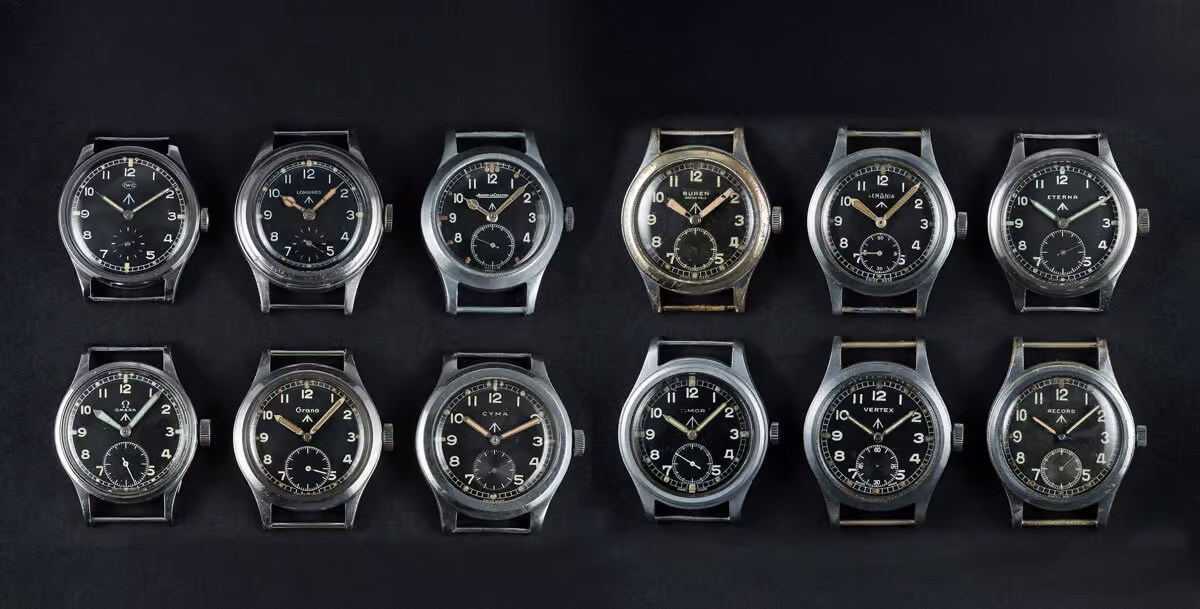
The Second World War refined the recipe. The American A-11 — “the watch that won the war” — imposes the second in the center, the stopping second (hacking) to stall operations, a contained diameter and matte anti-reflective dials. In Great Britain, the WWW — the famous “Dirty Dozen” — established a lexicon: stick or syringe hands, Broad Arrow marking, painted indexes, waterproof and shockproof case. We are not yet talking about “design”, but about specifications. After the war, they became desirable silhouettes.
Air, sea, land: three theaters, three signatures
In the air: Flieger and Type 20
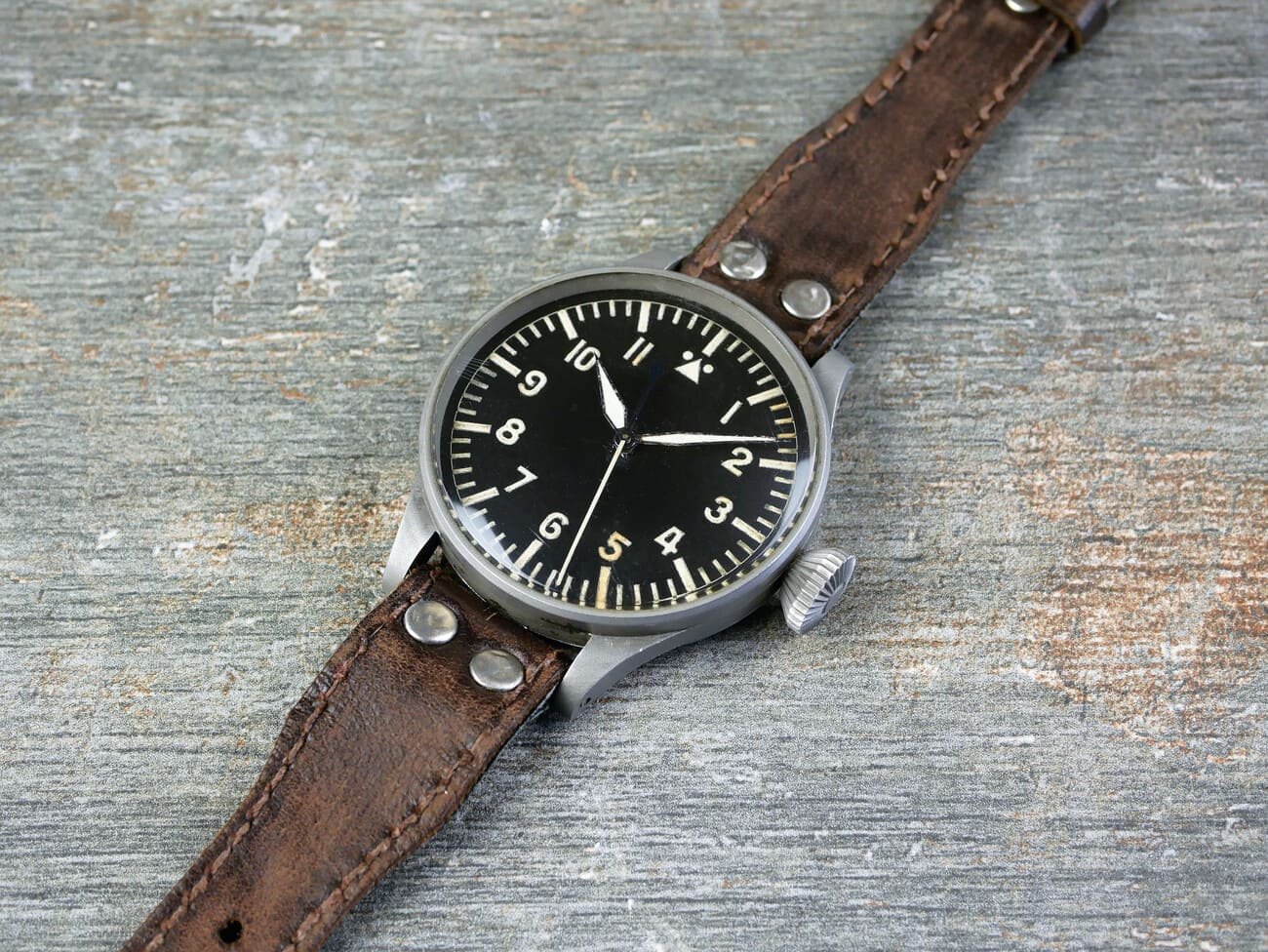
Aviation watches push readability to its peak. The German B-Uhrs multiply the contrasts, adopting the triangle at 12 o’clock and, on certain models, a concentric “Type B” dial. Later, the Type 20 specifications for the French Air Force required the flyback: a chronograph capable of instantly resetting and restarting to follow headings. Large crown that can be handled with gloves, knurled bezel, scale readable to the tenth: ergonomics as well as aesthetics.
At sea: the advent of the modern diver
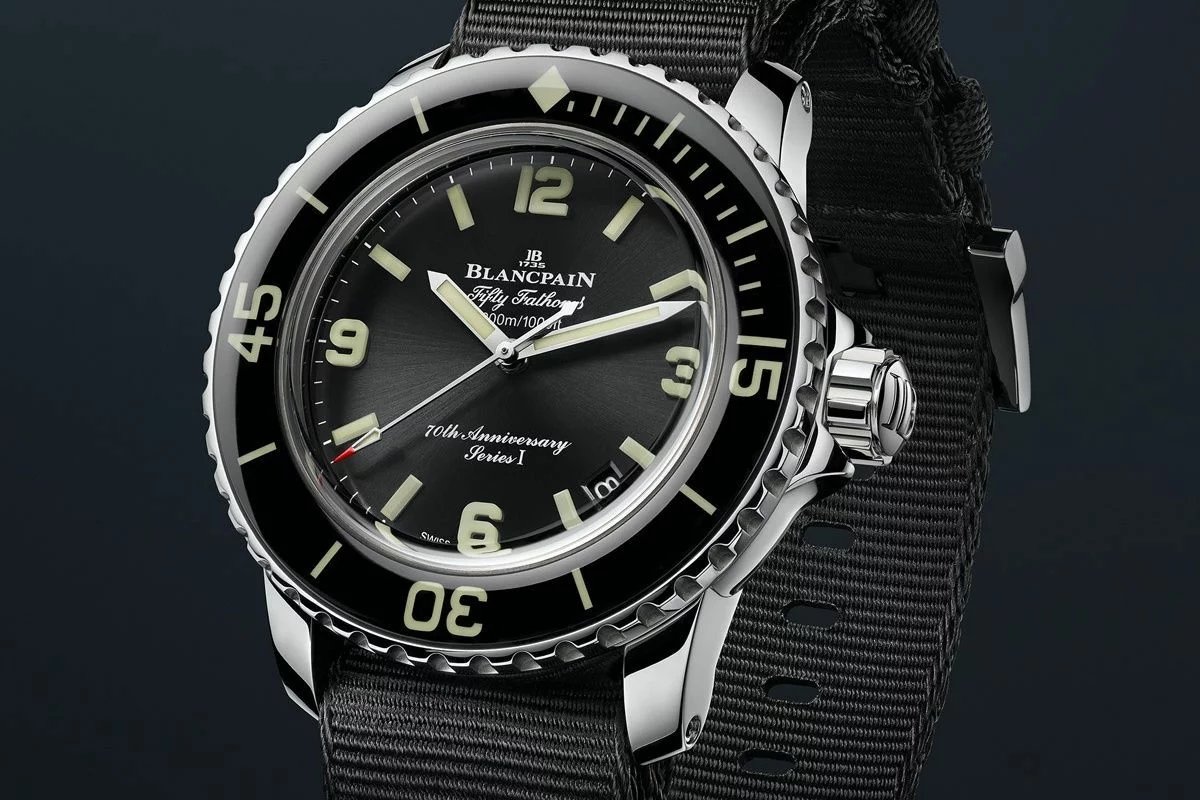
Combat swimmers demand waterproofing, robustness and instant reading of times. Born from these imperatives, the great icons of the 1950s, notably illustrated by the specifications developed for swimmers’ units, set the diver’s DNA: notched unidirectional bezel, generously luminescent geometric indexes, screw-down crown and refined dial. Since then, whether it’s diving or the city, this equation has hardly changed.
On land: the field watch, quintessential utility
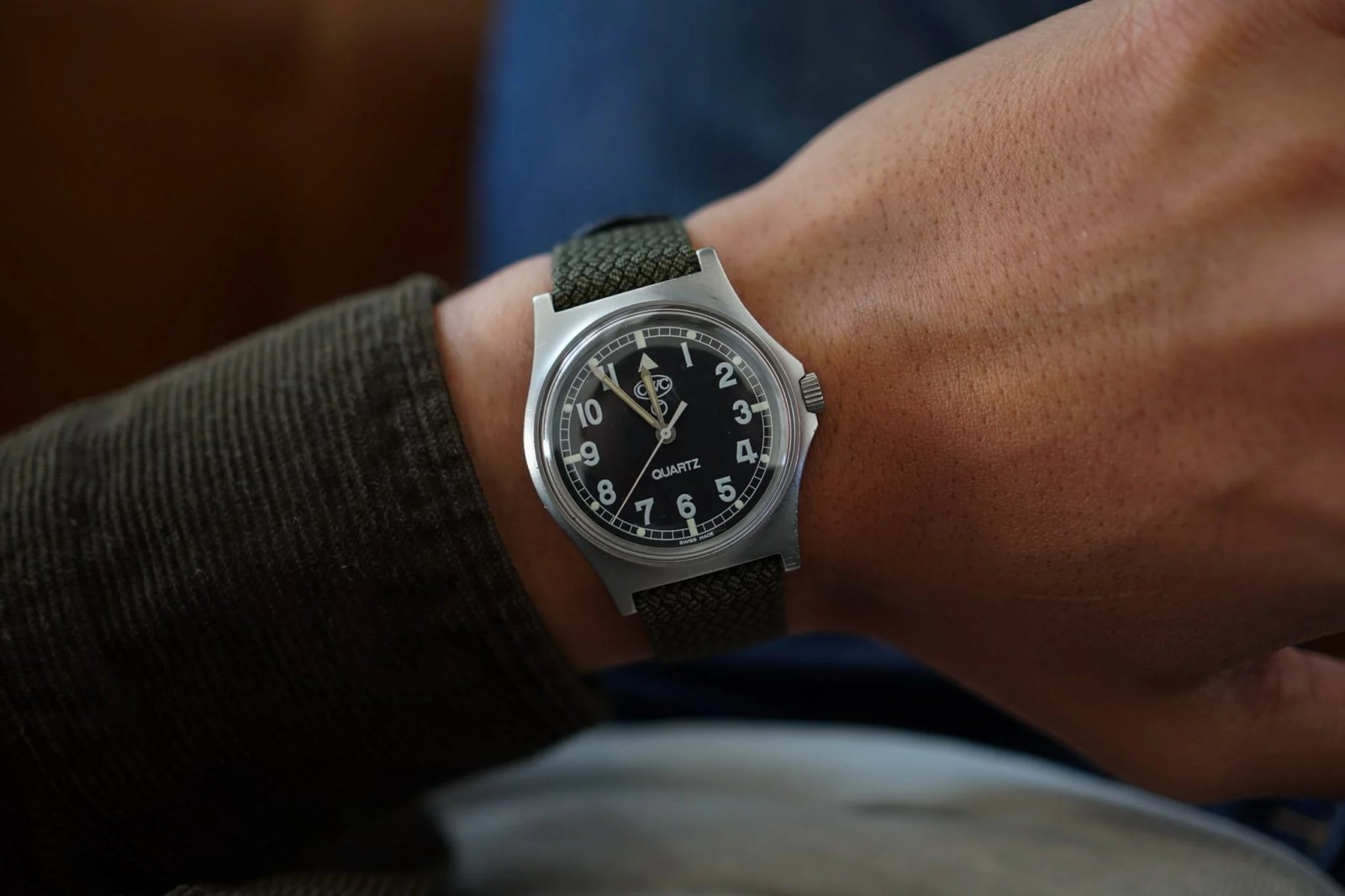
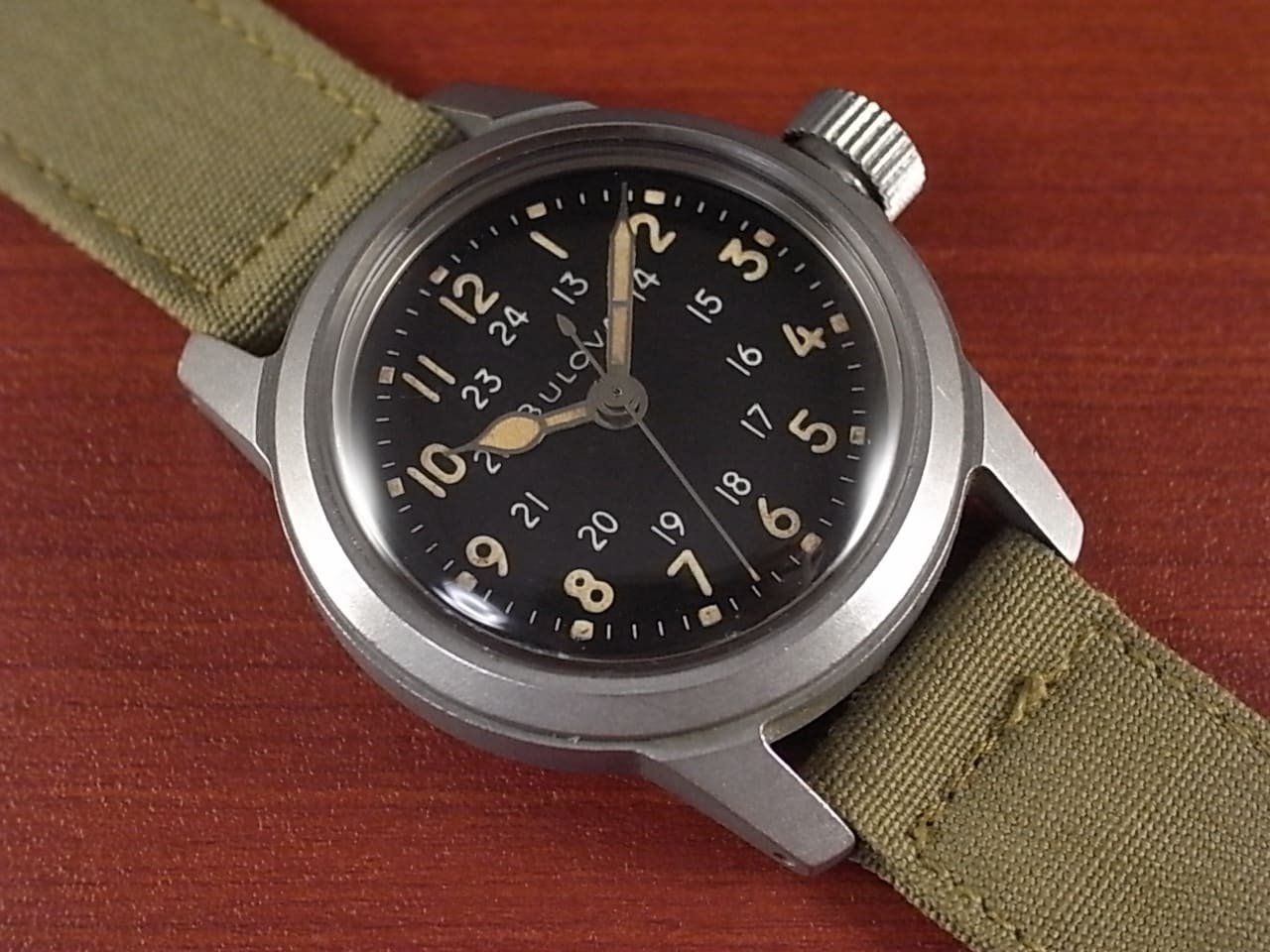
Mil-W-3818 then Mil-W-46374 in the United States, G10 in the United Kingdom: the “field” watch is the tool par excellence. Brushed or microblasted case so you don’t have to think, solid Arabic numerals, sometimes double 12/24 hour scale, second hand with red tip, fixed horn bars to prevent loss of watch, textile strap replaceable in an instant. The icon was born, and has survived the decades without showing any wrinkles.
What we still wear today
Many of the details we take as “obvious” come directly from the uniform:
- Matte, contrasting dials: readable in low light as well as in the middle of the night.
- Luminescent hands and indexes: from historic radium to modern Super‑LumiNova.
- Prominent or screwed crowns: easy handling, guaranteed tightness.
- Fixed horn bars and NATO straps (G10): security and modularity.
- Brushed/mirror-polished cases: zero unwanted reflection.
- “Ready for action” functions: hacking, flyback, graduated bezel, shockproof, antimagnetic.
Beyond technique, it is a philosophy: aesthetics is not a varnish, it arises from need. Hence the graphic strength of these watches, this military “less is more” which goes surprisingly well with a blazer, raw jeans, or an olive parka.
Heirs and reinterpretations: the era loves the classics
Each great family has its contemporary descendants. The modern field keeps its numbers clear, sometimes a diameter increased to 38‑40 mm to adapt to current wrists. The pilots reinterpret the fliegers by refining them, adding discreet anti-magnetism and curved sapphire crystals. The Type 20-inspired chronos retain their fluted bezels and nervous look. Divers have conquered the streets with their notched glasses and maxi-index dials, becoming the Swiss army knives of everyday life. In all cases, the utilitarian DNA remains legible: we recognize the soldier under the costume.
- Prioritize readability: strong contrast, clear typography, well-divided minutes.
- Look at the surface finish: brushed or microblasted rather than full mirror.
- Consider usage: sufficient water resistance (100 m for everyday use), screw-down crown if possible.
- Scalable strap: NATO or robust textile strap, patinable raw leather, brushed steel.
- Useful functions: hacking for precision, minute bezel for timing, anti-magnetism if you work near devices.
- Controlled size: 36 to 40 mm for the “field” spirit, 39 to 42 mm for a versatile diver.
A legacy of truth
In a world saturated with effects, military-inspired watches offer a truth: that of a design that does not lie about its intentions. Each line, each index, each luminescent material has a reason for existence. This is undoubtedly why these pieces stand the test of time better than many others. They say the essentials, without emphasis. And remind us, at every glance, that beauty can be born from constraint, and that true elegance is often measured by the yardstick of utility.