Aesthetics, physical buttons and customization
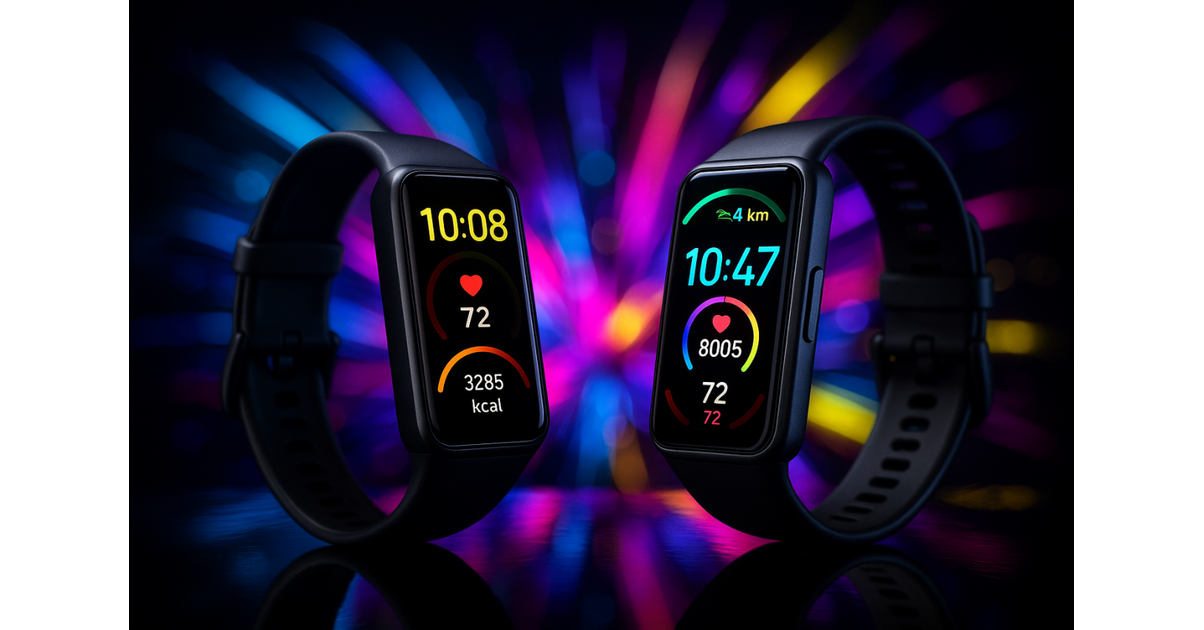
Samsung pushes hard on aesthetics: large, slightly curved screen, contained edges, dials inspired by the Galaxy Watch. You can go from a simple dial for the office to a more fun dial for the gym. THE Huawei Band 10 remains more modest: case + bracelet in continuity, clean lines, sometimes brighter colors to target a young audience.
Both offer a physical button on the side. That of Galaxy Fit 3 is well placed and serves as a home shortcut. That of Huawei Band 10 is more discreet, since navigation relies mainly on touch.
|
Element |
Galaxy Fit 3 |
Huawei Band 10 |
|---|---|---|
|
Physical button |
Side button, very accessible |
Smaller button, secondary role |
|
Dial style |
Various dialsGalaxy Watch spirit |
Oriented dials health & sport |
|
Customization options |
Lots of themes, simple complications |
Display focused on key metrics |
In short: Samsung seeks to please the eye, Huawei seeks to feed your brain with numbers. You get the idea.
Ergonomics and comfort 24/7
On a real day (and a real night), the differences quickly become apparent. THE Galaxy Fit 3 remains comfortable, the bracelet is flexible, the back side does not create hard points. But you still feel it a little on the pillow. THE Huawei Band 10he plays in another category: light, thin, he is forgotten, especially at night.
For Clara, after several nights, Band 10 completely disappeared. The Fit 3 still recalled its presence from time to time. On the other hand, during full exercise, the Fit 3’s larger screen is more relaxing to read on the fly.
|
Ergonomic appearance |
Galaxy Fit 3 |
Huawei Band 10 |
|---|---|---|
|
Daytime comfort |
Very good, a little present |
Excellent, ultra discreet |
|
Nighttime comfort |
Correct, but you still feel it |
Perfect for sleep |
|
Maintaining sport |
Stable, even in sudden movements |
Very stable, especially on small wrists |
In short: overall comfort slightly to the advantage of the Band 10, immediate readability to the advantage of the Fit 3.
Lifestyle adaptation
Very urban life — metro, open space, gym? THE Galaxy Fit 3 makes a very good versatile accessory, a little “smart” but not ostentatious. More outdoor style, light hikes, lots of travel, suitcase always ready? THE Huawei Band 10 sticks better: you keep it on permanently, you almost don’t feel it.
Sustainability and perception of quality
Over several months, feedback shows good performance of both models. The Fit 3 gives a slightly more “premium” impression in the hand, the Huawei Band 10 makes more functional tool. Micro-scratches on the screen happen on both anyway. A protective film is still a good idea, frankly.
Screen & visual experience: Samsung’s playground
Technology, screen size and readability
Both have a screen AMOLEDso deep blacks and striking colors. But the Galaxy Fit 3 benefits from a slightly larger diagonal. Result: more air between the information, more pleasant menus to scroll through.
In direct sunlight, the Fit 3 performs better: higher brightness, more comfortable readability. THE Huawei Band 10 remains readable, but sometimes you play a little with the angle of your wrist to read your stats. Nothing dramatic, but you can feel it during the race.
|
Display criteria |
Galaxy Fit 3 |
Huawei Band 10 |
|---|---|---|
|
Screen size |
A little bigger |
More compact |
|
Technology |
AMOLED |
AMOLED |
|
Sun readability |
Very good |
Good, sometimes borderline |
-
Intensive outdoor use: Galaxy Fit 3 more comfortable.
-
Discreet, urban use: Huawei Band 10 remains largely sufficient.
Resolution, finesse and fluidity
Both screens are clean, but the Galaxy Fit 3 gives a finer rendering: better cut texts, more detailed icons. You really feel like you have a more high-end product. THE Huawei Band 10 remains clear, but a little more “raw” visually.
On the fluidity side, the system FreeRTOS from Samsung is very responsive, the transitions are smooth. THE Huawei Band 10 with HarmonyOS 5 is also lively, but goes more straight to the point, with more sober animations.
|
Visual appearance |
Galaxy Fit 3 |
Huawei Band 10 |
|---|---|---|
|
Finesse of texts |
Very clear |
Clean, a bit less fine |
|
Transitions |
Smooth animations |
Direct transitions |
|
Overall feeling |
“Premium” visual experience |
Functional, data-oriented display |
-
Galaxy Fit 3 : perfect when you often consult your data.
-
Huawei Band 10 : sufficient, but less “wow”.
Dials and visual customization
The dials of Galaxy Fit 3 reflect Samsung’s know-how: varied themes, graphic complications, small aesthetic details. You can have fun. THE Huawei Band 10 aims for efficiency: dials focused on numbers, cardio zones, steps, active time, etc.
-
Galaxy Fit 3 : visual pleasure and good readability.
-
Huawei Band 10 : monitoring tool, priority to health data.
Basically: if you like to match your bracelet to your mood, the Fit 3 speaks to you. If you don’t care but want your numbers at a glance, Band 10 wins.
Software & interface: FreeRTOS vs HarmonyOS 5
Fluidity and handling
THE Galaxy Fit 3 rotates on a base FreeRTOS optimized for responsiveness and low consumption. You swipe, it responds. You start a sport, it starts straight away. Nothing to explain here, you take charge, you understand.
THE Huawei Band 10 used HarmonyOS 5designed by Huawei for its health ecosystem. It’s a little denser in the menus, but very powerful for those who like to configure everything.
|
Software aspect |
Galaxy Fit 3 (FreeRTOS) |
Huawei Band 10 (HarmonyOS 5) |
|---|---|---|
|
Interface fluidity |
Very responsive |
Very good, more sober |
|
Philosophy |
Simple, effective, without overhead |
Strong health and data orientation |
|
Ecosystem |
Android / Samsung Health integration |
Huawei Health & connected home integration |
Widgets, notifications and alert management
The widgets of Galaxy Fit 3 provide quick access to sport, cardio, weather, basic tools. Those of Huawei Band 10 grow healthier: stress, SpO2, sleep score, etc.
For the notificationsboth bracelets do the job. On Fit 3, you receive messages, calls, reminders, with the possibility of filtering finely enough so as not to be bombarded. On the Huawei Band 10you also have good notification management, including with an iPhone, which changes everything for certain mixed households.
|
Function |
Galaxy Fit 3 |
Huawei Band 10 |
|---|---|---|
|
Widgets |
Sport, weather, cardio, quick tools |
Cardio, stress, SpO2, sleep detailed |
|
Notifications |
Fine filtering, practical for staying focused |
Complete management including iOS |
|
Quick responses |
Limited responses on Android |
Answers via Huawei Health |
Compatibility, updates and ecosystem
There, it’s simple:
If you’re full Samsung / Android, the Fit 3 blends perfectly into the ecosystem. If you want a bracelet that can follow a change of smartphone (or an Android/iPhone pair), the Band 10 is clearly more flexible.
Both benefit from regular updates (health algorithms, small optimizations). For a more focused Fit 3 feedback in real conditions, you can watch the Samsung Galaxy Fit 3 review.
Health & sports monitoring: the comfort zone of the Huawei Band 10
Sports modes and training experience
On paper, it looks similar: running, cycling, swimming, weight training, yoga, HIIT, walking… Both largely cover the needs of a regular athlete. THE Galaxy Fit 3 automatically detects several activities and offers cardio zone alerts. THE Huawei Band 10 also has a large catalog of sports, sometimes finer on fitness profiles.
Important point: neither has a standalone GPS. They use the smartphone’s GPS. So if you want your precise trace, you have to take your phone. Believing that these bracelets replace a real GPS running watch is a false good idea.
|
Sports function |
Galaxy Fit 3 |
Huawei Band 10 |
|---|---|---|
|
Number of sports |
Large panel |
Panel just as wide, sometimes thinner |
|
Auto detection |
Yes on several activities |
Yes on the main ones |
|
Integrated GPS |
No (via smartphone) |
No (via smartphone) |
Sleep, calories, stress: Huawei takes the lead
The Fit 3 tracks sleep phases (light, deep, paradoxical), gives a score and simple advice. THE Huawei Band 10 goes further: it mixes movements, breathing, HRV and gives you more detailed reports, with a link to the stress and activity of the day.
Calorie side, the algos Huawei are a little sharper, especially for certain profiles (women, mixed sports). User feedback often shows more consistent data on the Band 10.
|
Health function |
Galaxy Fit 3 |
Huawei Band 10 |
|---|---|---|
|
Sleep |
Phases + score |
Phases + HRV + advanced analyzes |
|
Calorie accuracy |
Correct |
More precise in general |
|
Stress |
Present, but discreet in the interface |
Highly integrated (Health Clovers) |
Sensors, auto-pause & elevation
The sensors are generally the same (accelerometer, gyroscope, optical cardio, SpO2). The difference is mainly made in the use of data on the Huawei.
On the other hand, the Galaxy Fit 3 retains a very concrete asset: theself-pause. You stop at a red light while running, he pauses the session on his own. THE Huawei Band 10No. You have to manage this by hand. Small detail… that matters for average pace freaks.
For the height difference, both remain limited (no real dedicated barometer). This is suitable for light hikes with the smartphone, but not for demanding mountain use.
Motivation & behavior: the Health Clovers weapon
THE Huawei Band 10 has a real card in addition: the system of Health Clovers. You complete clovers by validating sleep, activity, breathing, hydration, etc. It’s fun, it motivates you to move and organize yourself better on a daily basis.
THE Galaxy Fit 3 offers more classic activity goals (rings, steps, active time). Effective, but less “behavioral coaching”.
Overall reliability of measurements
Both are reliable for consumer use. But on comparative tests, the Huawei Band 10 often comes out with a slight advantage on the stability of long-effort cardio measurements and on calories. Nothing shocking for the Fit 3, eh, but if you compare several devices in parallel, you see the difference.
And compared to other bracelets?
If you look at the broader market, models like the Xiaomi Smart Band come into the equation. THE Xiaomi Smart Band 10 Review shows that Xiaomi is especially focused on aggressive quality/price ratio.
Faced with this, the Galaxy Fit 3 and the Huawei Band 10 rely less on the shock price and more on the ecosystem: software experience for Samsung, advanced health for Huawei.
Connectivity, battery & user reviews: what it really gives
Bluetooth connectivity, Wi-Fi and limits
THE Galaxy Fit 3 embark a Bluetooth more recent than Huawei Band 10. Result: stable connection, smooth sync, a tad less energy intensive.
THE Huawei Band 10 benefit from the ecosystem Huawei and possible support via Wi-Fi on the telephone side, which facilitates certain data exchanges. But both remain satellites of the smartphone, without NFC, without autonomous GPS, without ANT+.
|
Connectivity |
Galaxy Fit 3 |
Huawei Band 10 |
|---|---|---|
|
Bluetooth |
Recent version |
Slightly older version |
|
Wi-Fi |
No |
Indirect support via ecosystem |
|
NFC |
No |
No |
|
Autonomous GPS |
No |
No |
-
Galaxy Fit 3 : clean connectivity, very well integrated with Android/Samsung.
-
Huawei Band 10 : versatile, very complete Huawei Health app.
Apps, sync and stability
The two apps — Samsung Health And Huawei Health — offer complete dashboards: activity, sleep, cardio, stress, weekly summary, etc.
|
Connected use aspect |
Galaxy Fit 3 |
Huawei Band 10 |
|---|---|---|
|
Companion app |
Samsung Health |
Huawei Health |
|
Data Clarity |
Very visualeasy to read |
Very detailed, health oriented |
|
Long term stability |
Good, sometimes sensitive to big updates |
Very good, often positive feedback |
-
If you change your smartphone often: slight advantage Huawei Band 10.
-
If you want a very clear, visually clean app: Galaxy Fit 3.
Real autonomy & recharge
There, it’s settled. On the ground, the Huawei Band 10 lasts longer. In intensive use (cardio 24/7, sleep, stress), you can aim 10–12 days according to feedback. THE Galaxy Fit 3 revolves more often around 5–7 days with the same options.
Both recharge quickly (around an hour) via proprietary magnetic cable. No wireless charging.
|
Battery criterion |
Galaxy Fit 3 |
Huawei Band 10 |
|---|---|---|
|
Autonomy announced |
Up to approximately 1 week |
Up to 2 weeks |
|
Intensive real autonomy |
About 5–7 days |
10–12 days |
|
Cooldown |
About 1 hour |
About 1 hour |
-
Huawei Band 10 : king of autonomy.
-
Galaxy Fit 3 : correct, but you recharge more often.
Impact of activated options
As always, the autonomy quickly disappears if you activate everything: very bright screen, frequent switching on, nocturnal SpO2, continuous stress. THE Galaxy Fit 3 suffers more from its large screen in these conditions. THE Huawei Band 10more visually sober, copes better with these aggressive settings.
User reviews & verdict
In summary what comes up:
|
Perceived criterion |
Galaxy Fit 3 |
Huawei Band 10 |
|---|---|---|
|
Design & screen |
Much appreciatedtop screen |
Sober, discreet, efficient |
|
Health monitoring |
Good, enough for most |
Reference in its range |
|
Autonomy |
Good |
Very good |
|
App & ecosystem |
Samsung Health pleasant to use |
Huawei Health very complete |
-
Galaxy Fit 3 : for you if you want a beautiful bracelet, a snappy screen, a fluid interface and easy use on Android.
-
Huawei Band 10 : for you if you want to dissect your sleep, track your stress, optimize your workouts and forget about recharging for almost two weeks.
For Clara, the match came down to a specific point: the depth of health monitoring and autonomy. She chose the Huawei Band 10 to last over the long term, without recharging every four mornings, while keeping a curious eye on what Samsung will release after the Fit 3. So, it’s up to you: do you want visual comfort… or health in data addict mode?