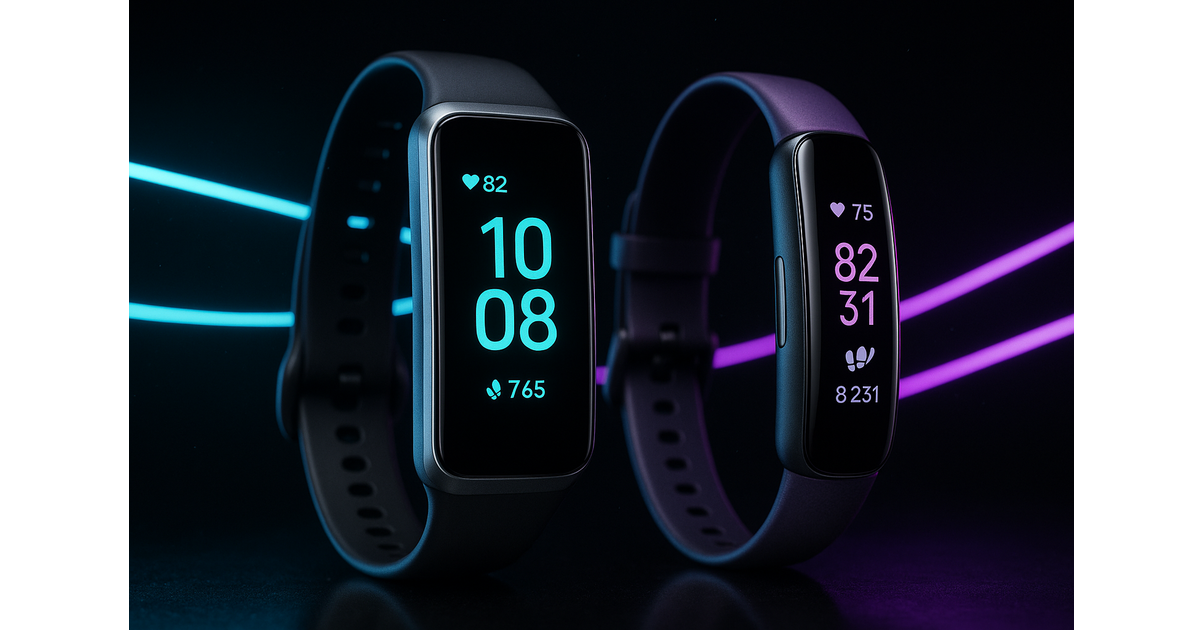
2. Screen and comfort: read, move, sleep with it
There, the difference is seen in three seconds. You put one on, you put on the other, you raise your wrist. You understand right away.
Screen size: Galaxy Fit 3 clear advantage
- Galaxy Fit 3: big screen 1.6″ AMOLEDlarge display, multiple data visible at the same time. When running, you can keep an eye on duration + cardio + calories without incessant swiping.
- Fitbit Inspire 3: Narrower AMOLED screen, “thin bracelet” format. Readable, yes, but you see less information at once, you swipe more often.
On a 45-minute jog around Toulouse, the Fit 3 allowed me to monitor my cardio zones and my duration without touching the screen. With the Inspire 3, I had to scroll through screens more regularly. It seems trivial sitting on your sofa, but when running it really changes the comfort.
If you want a complete focus on the screen, the dials and the display in direct sunlight, you can see this complete field test of the Samsung Galaxy Fit 3 on the wrist that I published with more photos and concrete cases.
Everyday comfort…and at night
Both are light, really. We’re talking about less than 20 g without a bracelet. In everyday life, you quickly forget that you are wearing a tracker.
The nuance is done at night:
- L’Inspire 3 is finer, more discreet. If you sleep on your side with a pillow tucked under your face, you barely feel it.
- THE Fit 3 fills the wrist a little more. Nothing dramatic, but if you’ve never slept with a bracelet, you’ll notice it the first few nights.
Frankly, for the majority of people, it’s both. But if you are extremely sensitive to what you wear on your wrist, a little preference for Fitbit.
3. Sport and tracking: what the data really gives
Neither the Galaxy Fit 3 nor the Fitbit Inspire 3 are triathlete watches. And that’s not the point. Here, we’re talking about moving more, tracking your progress, without spending your evenings zooming in on complicated graphs.
GPS: both dependent on the smartphone
Important point in this fitbit inspire 3 vs galaxy fit 3 :
- No integrated GPS on the Galaxy Fit 3. It relies on the smartphone’s GPS via Bluetooth.
- No integrated GPS no longer on the Inspire 3, same principle: phone GPS required for precise traces.
In short:
- Do you want to track your distance and track on a map? You leave with your phone.
- Do you run “by feeling” without GPS? The two bracelets give you the duration, the heart rate, and an estimate of the distance.
If you’re looking for integrated GPS, you have to go up a notch and upgrade to a real sports watch. There, we stay on the assumed entry-level sports connected bracelet.
Cardio, steps, calories: sufficiently precise for this level
Over a typical week with 3 fitness sessions and 2 jogging sessions of 35–40 minutes :
- There average heart rate was very close between the two straps, within 2–3 bpm, compared to a more high-end watch.
- THE not on a busy day (around 10,000 steps) showed a slight difference, but nothing shocking: we remain within a very correct range.
- THE calories remain estimates. Both are in the same orders of magnitude, with a slight tendency for Fitbit to remain a little more conservative.
Basically: for a beginner or a regular athlete who wants to follow their progress without dissecting everything, it is more than sufficient. If you start comparing each BPM to a beat-precise cardio belt, you are no longer in the target range of these two bracelets.
If you want to understand why I completely recommend against certain models for serious sports use, you can read this article on alternatives to the Apple Watch which I clearly avoid. It puts a few scales in their place.
4. Sleep and recovery: where the gap widens
This is often where everything plays out. You can miss a workout, but if you sleep poorly three nights in a row, your body sends you a strong reminder.
What each bracelet measures
Galaxy Fit 3:
- Sleep stages (light, deep, paradoxical).
- Sleep score.
- SpO2 tracking and sleep coaching tools in Samsung Health, especially if you’re on a compatible Samsung smartphone.
Fitbit Inspire 3:
- Sleep stages detailed with a sleep score very readable.
- SpO2 tracking, resting heart rate, multi-day trends.
- Health dashboard with several metrics grouped together every morning.
Readability and daily interest
Over a series of ten nights in a row, the difference is very concrete:
- L’Inspire 3 is more immediate. You open the app, you see your score, your duration, your phases, your trend over the week. You understand in a few seconds what happened.
- Samsung Health doesn’t lag, but often requires one or two more taps to get the same level of detail.
If your number one obsession is sleep – understanding why you wake up broken, seeing the effect of your bedtime – a slight edge to Fitbit in this duel sleep tracking Galaxy Fit 3 vs Fitbit Inspire 3.
And if you want to expand the match to other well-being-oriented bracelets, you can take a look at this Amazfit vs Fitbit beginner’s guide to tracking which sets the record straight on this segment.
5. Autonomy, apps and price: the crux of the matter
We always underestimate these three points at the beginning. And after a few weeks, that’s exactly what decides whether the bracelet ends up in a drawer… or stays screwed to your wrist.
Battery life Galaxy Fit 3 vs Fitbit Inspire 3
On paper:
- Galaxy Fit 3: up to 13 days announced.
- Fitbit Inspire 3: up to 10 days announced.
In real life, with active notifications, 3 sports sessions per week and sleep monitoring every evening:
- THE Fit 3 generally held between 8 and 11 days before dropping below 15% battery.
- L’Inspire 3 rather revolved between 7 and 10 dayssometimes more if you turn off certain notifications and the screen turning on too frequently.
Simple conclusion: both are very good. Basically, you charge once a week. It takes away a lot of stress compared to a watch that needs to be recharged every two days.
Applications, subscription and compatibility
Galaxy Fit 3:
- Used Samsung Healtha free app, increasingly complete, with clear stats and some additional content.
- Optimized for Samsung Galaxy smartphone under Android. On other Androids, it works, but you sometimes lose a little fluidity in the overall experience.
- No official iOS compatibility. If you’re thinking of switching to iPhone, it’s a real obstacle.
Fitbit Inspire 3:
- Fitbit app, now in the Google ecosystem, compatible Android and iOS.
- Fitbit Premium : 6 months often free, then paid subscription for more in-depth analyzes and guided programs. You can do without it, but part of the “intelligent overlay” is behind this paywall.
If you want the blunt truth: if you refuse any subscription on principle, the Galaxy Fit 3 is more peaceful in the long term. If you are ready to invest a little each month in more in-depth monitoring, the Inspire 3 can take on another dimension with Premium… but it is not obligatory to benefit from the bracelet.
Prices, promotions and shopping experience
The two bracelets are in the same range:
- List price often between €90 and €110.
- Frequent promotions on Amazon and at large merchants: we regularly see them around €70–90.
Honestly, you are not making a “bad purchase” by taking one or the other. The real mistake would be to ignore your ecosystem (Android vs iOS, Samsung vs the rest) and your relationship to subscriptions.
6. So… Galaxy Fit 3 or Fitbit Inspire 3?
We’re coming to the point where you have to decide. No artificial suspense, just clear storylines. You’ll see, in general the answer is obvious.
Choose the Galaxy Fit 3 if…
- You are already equipped with a Samsung smartphone or an Android that you don’t plan to let go of.
- You want one large AMOLED screenreadable in direct sunlight, pleasant during sport and in everyday life.
- You are looking for a simple, reliable bracelet, without compulsory subscription, with comfortable autonomy.
In this scenario, the Galaxy Fit 3 just makes sense. You stay in the Samsung ecosystem, you benefit from clean integration, and you don’t break the bank.
Choose the Fitbit Inspire 3 if…
- You want something ultra light and discreetwhich you forget on your wrist, especially at night.
- You want it best combo “sleep + clear app” at this price level.
- You want to keep the Android / iOS door completely open, without locking yourself into a camp.
In this case, the Inspire 3 remains a real step ahead. You install the app, you sleep with it, you look at your score the next day, and you start adjusting your pace without any hassle. It seems simple. This is precisely what we want.
7. Final recap: who should take what?
- Samsung Galaxy Fit 3 : perfect if you are already in the Samsung world, want a large screen, good battery life and an entry-level sports connected bracelet without subscription. Ideal for 2–4 sessions per week, plus proper sleep monitoring.
- Fitbit Inspire 3 : ideal if you are looking for a very discreet, sleep-oriented tracker, with an ultra-readable app, compatible with Android and iOS, and you want to keep the possibility (but not the obligation) of a Premium subscription.
In both cases, this galaxy fit 3 or fitbit inspire 3 does not aim for extreme performance. It targets your daily life. You put it on, you walk a little more, you understand your nights better. And honestly, at this price point, it’s already a huge step forward for your health.
Author : David Deteve, editor & field tester
Test location: Toulouse and van outings in the Pyrenees (Ordesa, Louron valley), with 3 to 5 sessions per week over several weeks of continuous use.
Last update: December 6, 2025