Design and comfort on the wrist
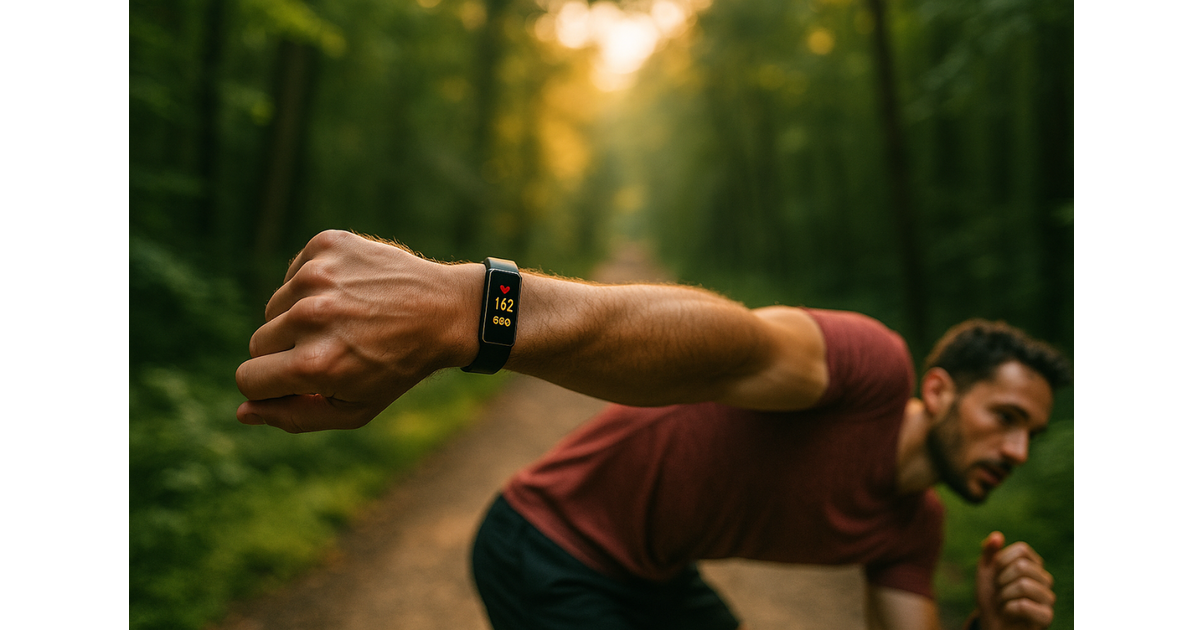
Visually, the Galaxy Fit 3 remains in the very sober rectangular bracelet style:
- Aluminum housing, 42.9 × 28.8 × 9.9 mm,
- 18.5 g without the bracelet, it’s really light on the wrist.
Really, what does that give?
Daily: you forget it quickly. The light weight + the thin format means that it does not hit the keyboard, does not get stuck under the sleeve, does not bang on the desk constantly.
The working day: pass cream, even if you work in front of a PC. It’s more “discreet bracelet” than “big triathlete’s watch”.
At night: for sleep tracking, the narrow format works in its favor. Those who hate sleeping with a big watch like Galaxy Watch or Garmin will appreciate it.
Sport & sweat: classic silicone bracelet, 5 ATM + IP68, you can go swimming, get in the rain, run in the dust, it holds up.
For a thin wrist, it’s great. For a big ex-rugby player’s wrist, it’s still portable but it feels a bit like a “small tracker” rather than a massive sports tool. In short: very good comfort, but clearly “fitness band” look and not a chic watch.
Screen, readability and ergonomics
The huge strong point of the Fit 3 is its 1.6″ AMOLED screen, 256 x 402 px. For a bracelet of this size, it’s generous.
Readability
- In direct sunlight: with the auto brightness well adjusted, you can read your pace and HR without squinting.
- At night: the AMOLED does the job, the blacks are deep, you don’t explode your retinas with each consultation.
- In the rain: the screen remains responsive, even if like all touchscreens, a few false gestures can slip through.
Ergonomics
- Mainly touchscreen navigation, with a side button to go back/start workouts.
- Simple interface, many in vertical scroll: activity widgets, HR, sleep, weather, etc.
- Menus: Not gas plant, but it takes 1-2 days to memorize where the main settings are.
In effort, you can display several data: pace, distance, time, HR… but space remains limited compared to a real round watch. For jogging or leisure cycling, you read the essentials. For very structured sessions with a lot of fields, you will feel the limits.
Frankly: correct, simple ergonomics, but we remain on a “tracker” logic and not on an ultra-configurable training machine.
Sports tracking and training tools
There, we attack the nerve of the thing.
The Galaxy Fit 3 offers 100+ sports profiles, with automatic detection for the most classic ones (running, walking, indoor cycling, rowing, elliptical, swimming in the pool, etc.).
Running/Walking
- Distance, pace, time, cardio, calories, approximate cadence.
- To follow your jogging, it’s more than enough.
- No advanced stats like “training load”, “recommended recovery time” like Garmin.
Bike
- OK to track duration, calories, HR, distance via phone GPS.
- If you are looking for power monitoring, external sensor cadence, etc., forget it.
Room/muscle
- Profiles for rowing machine, elliptical, treadmill, etc.
- You have time tracking, HR, calories. No tracking of sets/repetitions like some more muscle-oriented watches.
Swimming
- Waterproof 5 ATM, pool swimming profile available.
- You track the duration, the lengths, the calories. It’s not a dedicated swim watch, but for leisure use, it does the job.
“Coach” side
- You have daily goals (steps, activity, active time).
- You can track HR, sleep and stress trends in the Samsung Health app.
But let’s be honest: the Fit 3 behaves more like a sleek data logger than a real workout coach. If you prepare a semi with detailed plan, intensity zones, timed load, you will be better off on a dedicated Garmin / Coros / Polar.
Navigation, mapping and GPS
Sensitive subject: GPS.
The Galaxy Fit 3 does NOT have built-in GPS. Point.
To have a correct trace, it relies on the GPS of your smartphone, via Bluetooth connection.
Real consequences
- You have to run/ride with your phone if you want clean distances and tracks.
- Without a phone, the Fit 3 will estimate the distance via the sensors (accelerometer, stride, etc.), but the precision will vary, especially on trails or changes in pace.
- Zero mapping and no turn-by-turn guidance. No detailed live altimeter profile.
SO :
- For jogging in town on routes you know, that’s fine.
- For a 4–5 hour trail or a mountain hike without a phone… it doesn’t inspire confidence. Here you need a real GPS watch with integrated navigation.
To summarize: GPS = dependent on the smartphone, we are in the “connected tracker” pure and simple.
Heart rate accuracy
The Fit 3’s optical cardio sensor is not revolutionary, but it is about average for current bracelets.
In general
At rest/daily
Resting HR, daily curve, notifications if HR too high or too low: it works well for most users.
Quiet jogging
The curve generally remains stable, with consistent values, some small variations but nothing dramatic.
Intervals, hills, HIIT
As is often the case with wrist optics:
- Slight latency when starting efforts,
- Some dropouts on very sudden changes in intensity,
- Possible over/underestimation on very large peaks.
Useful reminder
The cardio belt remains the reference if you work in very specific intensity zones.
The problem: the Fit 3 is not positioned as a machine with external sensors, so if your project is very serious split + belt, take a real sports watch instead.
Basically: reliable for 80–90% of people, for “normal” training. If you are a dataset freak, you will be frustrated.
Battery life: how many days before looking for the charger?
Officially, Samsung announces up to 13 days of battery life.
The various tests and feedback show instead:
- Light use (moderate notifications, no AOD, 2–3 GPS sessions via smartphone per week):
→ you can really flirt with 10–12 days. - Realistic mixed use (4 sessions/week, active notifications, sleep monitoring, regular HR):
→ takes 7–10 days, which is already very good. - Nasty use (AOD activated, notifications galore, almost continuous HR, everything to the max):
→ some users go down to 2–4 days.
It’s the classic: the autonomy announced is the “best case”, not the reality for an active athlete. But even with regular sports use, going a week without worrying about the charger is comfortable.
Charge
Fast recharge, approximately 65% in 30 minutes, full in just over an hour.
So clearly:
- If you agree to recharge once a week, you have peace of mind.
- If you want to completely forget about the charger for 3 weeks of trekking, no, this is not the device.
Connected functions and ecosystem
The Galaxy Fit 3 runs Samsung Health and connects via Bluetooth 5.3 to your Android smartphone.
Important
- Android compatible only (and clearly optimized for Samsung Galaxy smartphones).
- Not compatible with iOS, no official stable solution with iPhone.
Connected functions side
- Notifications: calls, SMS, WhatsApp, various apps. You can read messages, sometimes reply with quick replies if your phone supports it.
- Media control: change tracks, manage the volume from the wrist during a session.
- Phone : you see who is calling you, you can accept/reject, but no speaker or microphone on the bracelet: you pick up, but you speak via the telephone.
- No NFC payments: no Samsung Pay on the Fit 3.
Samsung Health app
- Clear view of your steps, sessions, sleep, HR, stress, SpO2.
- Readable graphs, correct history, possible integration with Health Connect to cross with other sports/nutrition apps on Android.
Overall: if you’re already in the Samsung ecosystem, it fits very well. If you’re on generic Android, it’s still clean. You don’t spend your evenings insulting the app, and that’s already a lot.
Strengths and limitations to know before buying
What the Galaxy Fit 3 does very well
- Great comfort/price ratio: light, pleasant, discreet, perfect for wearing 24/7.
- Large and readable AMOLED screen for a simple bracelet. That changes everything compared to small, cramped displays.
- Solid autonomy for a “normal” athlete: a real week without stress.
- Sleep & health: sleep monitoring, score, snoring detection via smartphone, SpO2, stress… very complete for this price.
Where it really gets stuck
- No integrated GPS: if you like to run light without a smartphone, this is a bad idea.
- No advanced training features: no real load tracking, no serious training strategy.
- No NFC, no microphone/speaker: zero contactless payment, no calls from the wrist.
- Android only: automatically excludes all iPhone users.
If you know these limits before purchasing, you will not be disappointed. You know exactly what you’re buying: a good tracker, not a mini-Fenix.
Should you buy the Samsung Galaxy Fit 3, and for whom?
In brutal summary:
The Galaxy Fit 3 is a great choice if…
- You train 2 to 4 times a week (running, cycling, gym, a little swimming).
- You run or ride with your smartphone and you accept connected GPS.
- You want a light bracelet, pleasant to keep at night for sleep.
- You’re looking for a simple tool to: move more, track your progress, keep an eye on your sleep and your cardio, all for less than €100.
You should look elsewhere if…
- You are preparing for long trails, ultras, big hikes and you want a reliable autonomous GPS.
- You want a real training watch with training load, status, recovery recommendations, etc.
- You want a very chic watch for the office, metal, leather, large premium finishes.
- You hope to pay with your watch, call from your wrist, or live without a smartphone while exercising.
In the end, for a reader of Passion time who is starting or slowly structuring their practice, the Galaxy Fit 3 is a smart, light and economical companion. If you accept its lack of integrated GPS and its training limits, you are not making a mistake: you are just making a choice consistent with your practice… and your budget.