Accutron Spaceview 214 “Alpha” (Solid Gold/Gold Filled) review: should you invest?
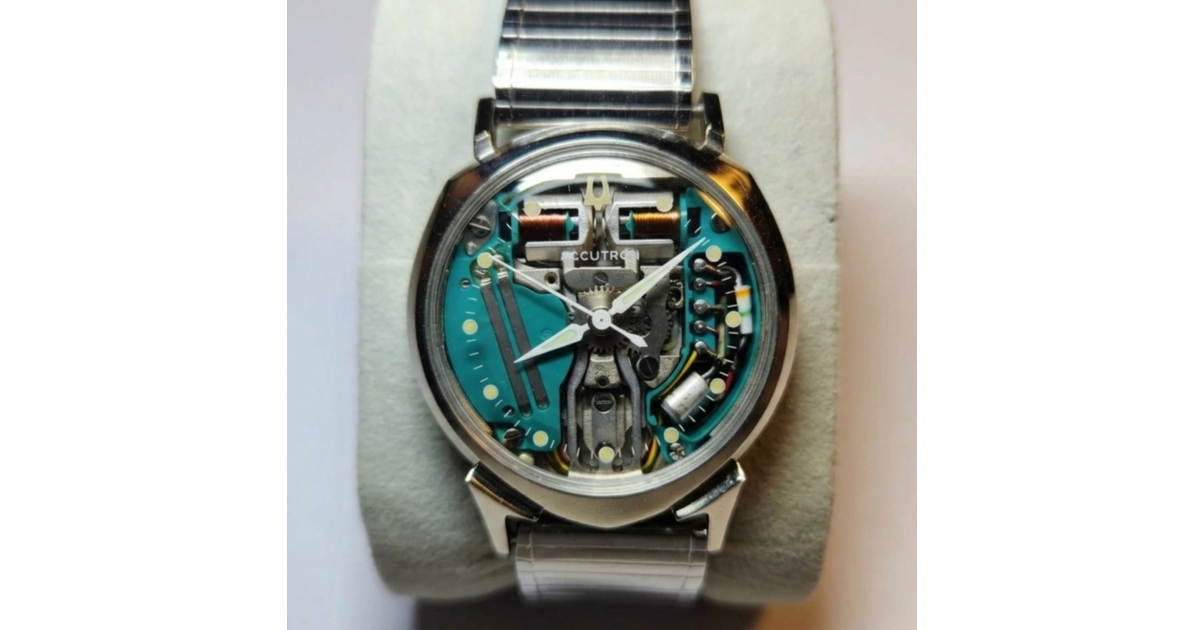
The Accutron 214 Alpha is not a Spaceview like any other. It is there Original Spaceview. The one that Bulova exhibited in its windows in 1960 to show the tuning fork vibrating at 360 Hz. No dial removed afterwards. No improvised marketing effect. A watch designed from the start to show the movement.
In solid gold or Gold Filled version, the asymmetrical gold Accutron 214 becomes a separate collector’s item. Rarer, more expensive, more risky too. Prices have risen sharply. The demand is real. But the market is riddled with conversions.
Should you invest? Yes, if you know exactly what you are buying. No, if you don’t understand the technical details. Alpha rewards rigor. It sanctions improvisation.
Why the Alpha is the only “real” original Spaceview
In 1960 (M0 marking), Bulova launched the Accutron 214 with classic dial. To convince retailers, the brand removed certain dials and exposed the bare movement. The effect is immediate.
Faced with the enthusiasm, Bulova decided to produce a version without a dial from the factory. This version adopts a unique asymmetrical case, known as “Shield form”. It’s Alpha.
The Alpha is the only Spaceview designed from the outset to be worn without a dial.
All other Spaceview 214s come from variations of existing cases. The Alpha is a model in its own right. This is what establishes its historical legitimacy.
Verdict: centerpiece… and riskiest model
In an Accutron collection, the Alpha is often the centerpiece. Especially in Bulova Accutron 1960 solid gold. It concentrates design, innovation and rarity.
- Historically legitimate model
- Unique asymmetrical housing
- Strong demand from collectors
- Many conversions
- High prices in 14k
- Specific technical maintenance
The problem is the reassembly. Many single-ended cases were converted to Spaceview with later kits. To the untrained eye, the watch appears okay. In fact, it is not.
My verdict is clear: yes, it is a masterpiece. But it is also the riskiest of the 214 range. The investment only makes sense if the watch is consistent on all points: case, date, glass, movement.
Recognizing a genuine Accutron 214 Alpha in gold
Identifying a true Alpha requires method and composure. We trust neither the seller’s speech nor the simple mention “Spaceview”. We check point by point.
“Shield shape” asymmetry: the signature of the case
The case of the asymmetrical gold Accutron 214 is immediately recognizable. The horns are not symmetrical. The right flank descends lower, forming a shield silhouette.
Seen from the front:
- shorter left upper horn,
- lower right horn more stretched,
- fluid profile, without abrupt angles.
In 14k solid gold, the hallmark must be clear. In Gold Filled, the wording is clearly engraved. The proportions are constant: approximately 34 x 40 mm, lug width 18 mm.
M-Dates (M0 to M4): how to date an authentic Alpha
The first Alphas appeared in 1960, marked M0. Production lasted until around 1964 (M4).
A bottom struck M9 (1969) with an Alpha kit is suspect. At this date, the model is no longer produced in its original form. Date/case consistency is a simple and formidable filter.
Wired glass: indexes and logo printed under the plexiglass
On a real Alpha, the indexes and the Accutron logo are printed under the plexiglass. This is not a highlight added around the movement.
This “reinforced glass” presents:
- a fine and regular print,
- typography consistent with the 1960s,
- a homogeneous patina with the rest of the watch.
Many conversions use aftermarket lenses. The print is too white, too thick, or poorly positioned. The logo may appear to float.
| Element | Authentic Alpha | Conversion |
|---|---|---|
| Index | Printed under plexiglass | Ring added or recent print |
| Date background | M0 to M4 consistent | M9 frequent |
| Patina | Uniform | Inconsistent |
This detail of the glass often makes the difference between a collector’s item and a simple reassembly.
Difference Spaceview Alpha original vs conversion: avoid fakes
The difference Spaceview Alpha original vs conversion is in the details. A conversion can be attractive. But it does not have the same historical or financial value.
Late conversions and aftermarket kits: warning signs
In the following years, Bulova offered Spaceview kits to transform certain models. Then the parallel market takes over.
Warning signs:
- new glass too perfect,
- lack of consistency between wear of the case and the plexiglass,
- non-compliant internal engravings.
A conversion can work perfectly… while still remaining a conversion. The value is not the same.
M9 case (1969) with Alpha kit: why it’s suspicious
An asymmetrical case marked M9 indicates 1969. However, the original Alpha stops around 1964.
If you see:
- bottom M9,
- Alpha type glass,
- presentation “1960” in the ad,
there is inconsistency. This does not necessarily mean fraud, but further transformation.
Accutron 214 asymmetric gold: check points before purchase
Before any purchase:
- check the M-Date,
- inspect the plexiglass with a magnifying glass,
- check the consistency of solid gold / markings,
- listen to the steady hum at 360 Hz.
Request clear photos of the bottom, movement and plexiglass before any decision.
Accutron Alpha 14k Rating and Gold Filled Value
The Accutron Alpha 14k Rating first depends on authenticity. A real Bulova Accutron 1960 solid gold in beautiful condition fetches high amounts. Gold Filled remains more accessible, but sought after.
Bulova Accutron 1960 solid gold: rarity and collectible premium
14k combines historical legitimacy and material value. Copies M0 to M2 in consistent condition are particularly prized.
Rarity comes less from the number produced than from the number surviving without modification.
Condition, originality, movement: the criteria that vary the price
Three axes influence the value:
- Originality : consistent glass, hands, background.
- Case Condition : angles preserved, little polishing.
- Movement : stable operation.
| Criteria | Impact on value |
|---|---|
| Original glass | Very strong |
| Coherent M0–M4 background | Strong |
| Recent revision | Moderate to strong |
A conversion, even to gold, trades significantly below a genuine Alpha.
Diapason 214 movement: maintenance, reliability and power supply
Caliber 214 works using a tuning fork vibrating at 360 Hz. The crown is on the back. The buzzing is continuous, almost hypnotic.
Diapason 214 movement maintenance: overhaul and sensitive parts
Maintenance of the tuning fork 214 movement requires a watchmaker trained in this technology. Sensitive parts:
- reels,
- transistor,
- index wheel.
A serious overhaul includes cleaning, electrical inspection and fine tuning.
394 cell with voltage reducing diode: protect the 360 Hz circuit
Originally, the battery delivered a lower voltage than modern batteries. Today, we use a cell 394 with reducing diode.
Without voltage reduction, the circuit may be damaged. The stability of 360 Hz depends on it.
Technical data sheet: caliber 214, case 34 x 40 mm, lug width 18 mm
| Movement | Pitch 214 (360 Hz) |
|---|---|
| Housing | 14k solid gold or Gold Filled |
| Dimensions | 34 x 40mm |
| Entrecorne | 18mm |
| Bracelet | Black leather, 16 mm yellow gold pin buckle |
| Dial | Skeletonized (without traditional dial) |
How do you know if an Alpha is a conversion?
Check the M-Date (expected M0 to M4), type of plexiglass, and general consistency of patina. An M9 back with Alpha glass should alert you.
What is the current Accutron Alpha 14k Rating?
It varies depending on the condition, originality and presence of the original glass. Consistent and revised copies are the most sought after.
Can you wear an Accutron 214 Alpha on a daily basis?
Yes, provided that it is serviced and powered with a 394 equipped with a suitable diode.
Why is asymmetrical housing so important?
Because it is specific to the Alpha model and constitutes a major marker of authenticity.
Is Gold Filled less valuable than 14k?
Yes, because it is not solid gold. It nevertheless remains sought after if it is original and consistent.