Table of Contents
I threw 1,400 euros out the window. Transfer made, watch on wrist, seller evaporated. So. The rest is how I got here — and how to avoid the same stupidity.
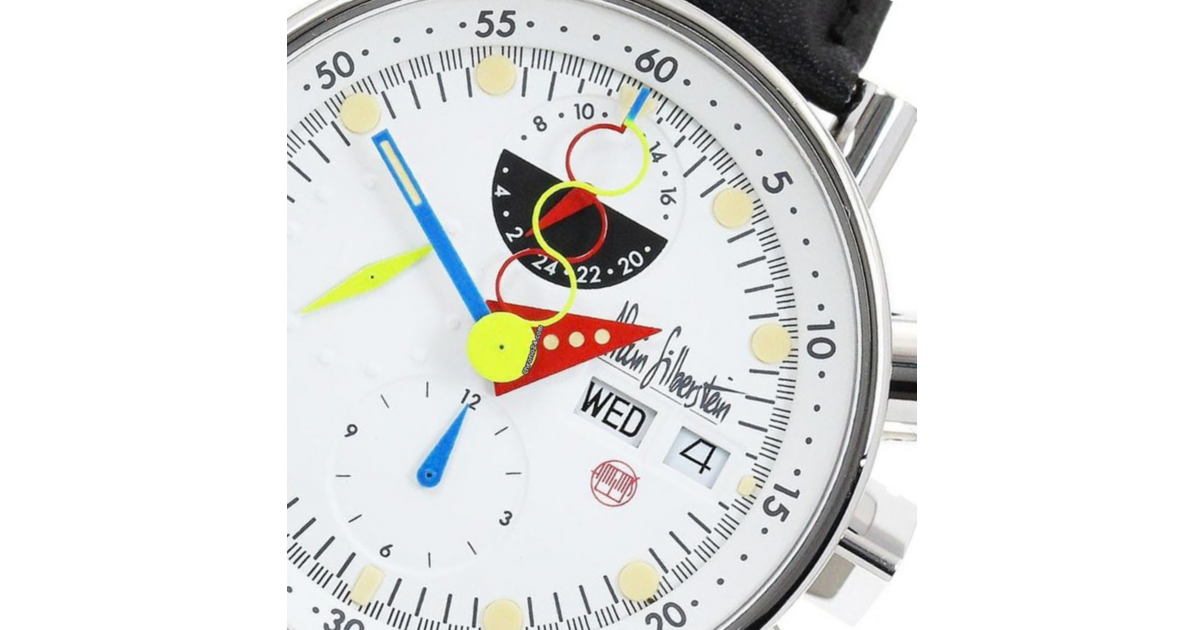
Alain Silberstein, for those who don’t know: a French watchmaker who made watches between the 80s and the end of the 2000s. Dials that look like Bauhaus — primary shapes, red, yellow, blue, geometric hands. Nothing like what others do. He hasn’t produced anything for a long time. Which means that if you want one, you go through the secondary market. Which means you expose yourself to people like the one who sold me mine.
The Krono Bauhaus. I’ve been looking for her for months. I knew the prices, the references, the variants. I had read everything. (Read everything, and still missed the point — that’s what hurts.)
The scene
The seller takes the watch out of a burgundy velvet pouch. Slow, almost theatrical gesture. The dial is there, multi-colored, exactly as in the photos. Red triangle, yellow circle, arrow-shaped needles. The logo on the back. The screwed crown.
1,400 euros. Not 900, not 600 — 1,400. Just enough below the normal price for me to say good deal rather than scam. This is precisely where scammers are strong: they don’t cut prices, they undercut them. Just enough for you to rationalize. (No box, no papers — “moving, you understand.” Yes, I understood. I should have left.)
I paid. I returned home with the watch on my wrist and this ridiculous feeling of having maneuvered well. It lasted three days.
What was wrong – out of order, as it came back to me
The movement, first. I opened the bottom of the case. The Krono Bauhaus runs normally with an ETA 7750 — a beefy caliber, with a clean mechanical sound, almost musical when well adjusted. What I found inside made the opposite noise: a metallic, dry, poorly oiled clicking sound, like a cheap music box that had been forced. No caliber engraving. No finishes on the bridges. Nothing identifiable.
The glass, then. I had read that the Silbersteins of this era were equipped with sapphire. Sapphire makes water pearl — the drop remains round, it rolls. On mine, the water spread out in a sheet. Mineral at best. Maybe plastic. (The kind of test that takes ten seconds and which I didn’t do before buying.)
The logo on the back. Comparing with reference photos on WatchUSeek, the typography did not match. On a real one, the letters have a precise thickness, a specific slight tilt — the kind of detail that you don’t see with the naked eye but that you perceive when you superimpose the images. On mine, it was approximate. Copied from a photo, obviously, by someone who had never held the original in their hands.
And the dial. Under a magnifying glass, the surface had a grainy, uniform texture, characteristic of digital printing. A true Silberstein dial has layers — depth. This one was flat as a label.
The expert, rue de la Paix
I took it to a watchmaker specializing in collector’s watches — a former Christie’s veteran who converted to second-hand sales and expertise. He took the watch. Thirty seconds.
“My friend, I’m sorry.”
Case: low-grade metal copy, probably melted somewhere in Asia. Movement: anonymous sketch, worthless. Dial: digital printing. Signature on the back: stamped, not engraved. A clean counterfeit — clean enough that a eager, eager buyer would see nothing in it.
That was me, the eager, eager buyer.
What I should have done — no order of priority, they are all important
Pay 60 euros for expertise before purchase. A competent watchmaker, half an hour of his time — it’s nothing compared to 1,400 euros. I didn’t do it because it “broke the momentum”. Beginner’s mistake.
Send the photos to the forum before taking out the wallet. WatchUSeek, the Facebook groups of Silberstein collectors — these people know every screw, every font. A photo of the case back, one of the dial under natural light, and they will respond to you within a few hours. Free of charge.
Hold the watch in direct sunlight. Not under a neon shop sign — outside. Natural light highlights every surface imperfection, every dial irregularity. The counterfeiters work for the photo and for the dark interior. Not for the sun.
Never pay by transfer to a stranger. No traceability, no protection, no recourse. The seller disappeared within 48 hours of the transaction. Number cut, profile deleted.
Treat the absence of a box and papers as a veto — not as a negotiation. True collectors keep everything. “Lost while moving” is not an explanation, it’s a prepared excuse.
The sequel
Complaint filed. No follow-up. These scams are designed to be invisible — amount below the threshold that warrants serious investigation, ghost seller, untraceable payment.
Six months later, I found a real Krono Bauhaus. Original box, papers, purchase invoice from 1998, full history. Purchased from a certified reseller in Geneva, with expertise included. The difference from the knockoff was obscene — the weight in the hand, the way the sapphire caught the light, the sound of the 7750 spinning: steady, deep, almost soothing. A living watch.
The other made a noise like iron. I should have heard it from the start.
If you are looking for a Silberstein: take your time, involve the community, pay for an expertise. The secondary market is the only access to these watches — and the scammers know it perfectly well. Doubt is not an obstacle to purchasing, it is information. Listen to him.