Table of Contents
Why the GMT bezel still fascinates so much
The GMT bezel is the elegance of a 1950s transatlantic flight translated onto a wrist. Born from the request of Pan Am pilots and immortalized by the Rolex GMT-Master, it did more than help out crews: it codified a language. That of orientation, time discipline, stylish travel. Understanding this bezel means rediscovering the taste of a world in motion, where we read the time like we read a map.
Understanding GMT Architecture
The three key elements
- The 24-hour bezel: graduated from 0/24 to 23, sometimes two-tone (day/night), fixed or rotating.
- The GMT hand: an additional hand, often arrowed, which makes one revolution in 24 hours.
- The main 12-hour dial: local hours and minutes, the “usual” reading.
The magic happens when the GMT hand points to a number on the 24-hour bezel: you immediately obtain a 24-hour reference time (no AM/PM ambiguity). With a rotating bezel, you can even track a third time zone.
“Flyer” vs “Caller”: two philosophies
- “Flyer” (or “traveler”) movement: the local hour hand is adjusted in one-hour jumps without stopping the movement. Ideal for traveling. Ex: Rolex GMT-Master II, Tudor Black Bay GMT.
- “Caller” movement: the GMT hand is adjusted independently, the local remains fixed. Perfect for calling another zone without moving. Ex: numerous Seiko GMTs, Sellita SW330.
In both cases, the reading remains the same: the GMT hand gives the reference time over 24 hours, the local reading is over 12 hours.
Reading a GMT bezel correctly: step-by-step
1. Two time zones, fixed bezel
Most common configuration. Setting example:
- Set the GMT hand to your reference time (often UTC or your “home time”) in 24 hours.
- Then set the local time with the hour hand (on a flyer, in one hour jumps; on a caller, you adjust the GMT hand and keep the local time stable).
Reading: the GMT hand points to the 24-hour bezel for the reference time; the classic hands indicate local time at 12 o’clock. If the bezel is two-color, the border 18–6 materializes at night: useful to know if you are calling at 8 a.m. or 8 p.m.
2. Three time zones, rotating bezel
With a 24-hour rotating bezel, you get a third time zone on the fly.
- Leave the GMT hand on the reference time (eg: UTC).
- Rotate the bezel: shift the “0/24” triangle by the number of hours difference from the desired time zone.
- Read the third time zone at the tip of the GMT hand, but at the new bezel position.
Memory tip: turning the bezel to the right (clockwise) adds hours, to the left detracts.
3. Concrete example
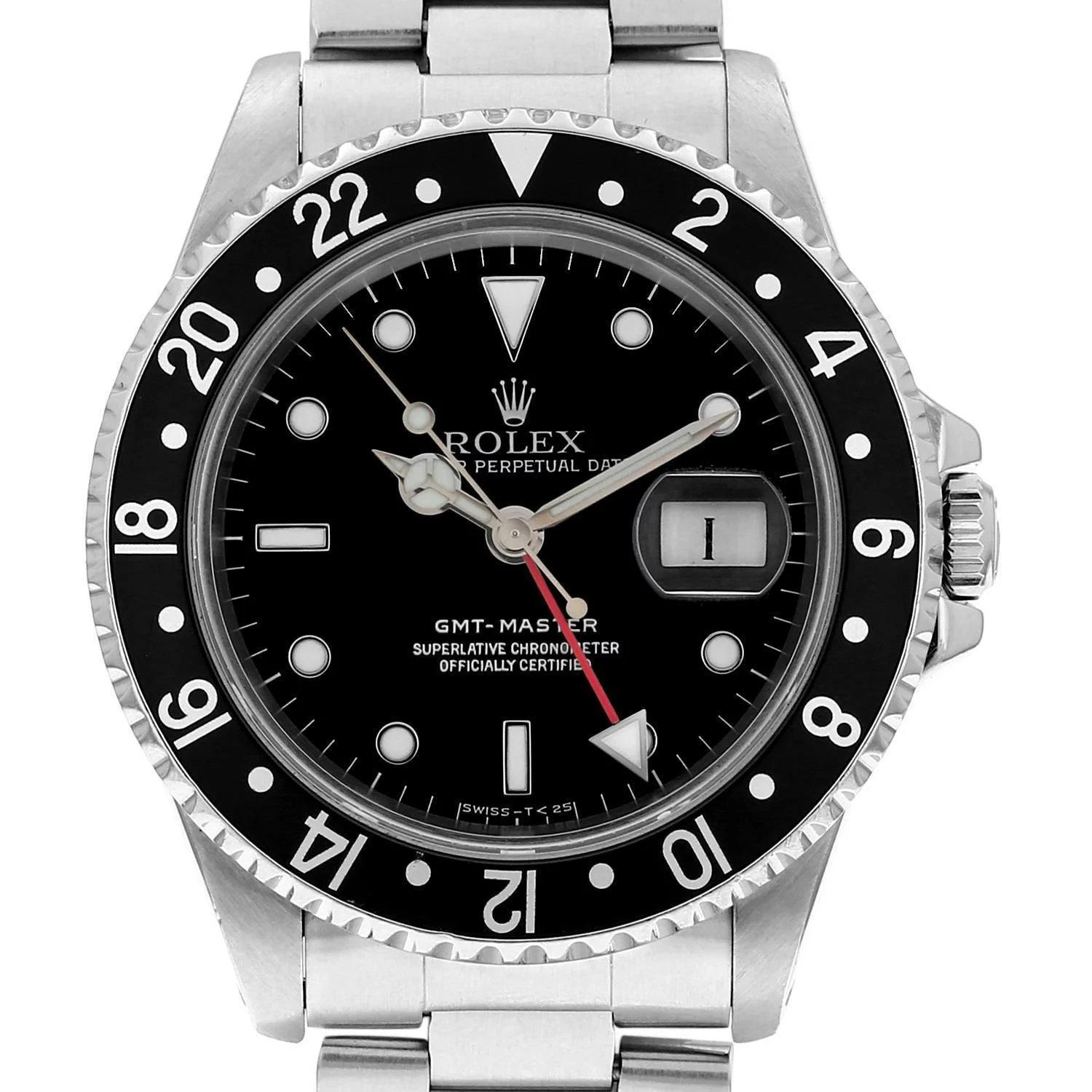
You are in Paris (local time 10:10), your GMT hand is set to UTC and points 9 on the bezel (because Paris is UTC+1 in winter). You must follow Tokyo (UTC+9):
- Rotate the scope +9 from the triangle. The GMT hand will then point 18 on the offset bezel.
- Conclusion: in Tokyo, it is 6:10 p.m. You keep Paris on the 12 o’clock dial, UTC on the triangle index if you go back to zero, and Tokyo by the rotation.
Traps to avoid
- AM/PM confusion: the GMT hand is in 24 hours. If it says 16, it’s 4:00 p.m., not 4 a.m. The two-tone bezel helps with day/night viewing.
- Summer time: the GMT hand does not “advance”; it’s your local time that changes. Remember to adjust the seasonal difference if you follow a third time zone.
- Half and quarter zones: India (UTC+5:30), Nepal (+5:45), Central Australia (+9:30). A full hour bezel will not display them accurately. Some internal 24-hour dials or half-hour bezels exist, otherwise do the mental math.
- Position of “0/24”: on some glasses, the zero is marked “24”. It’s the same point. Midnight and midnight coincide.
- Inadvertent rotation: On a non-notched or bidirectional bezel, check the triangle alignment regularly. One click too many, and it’s an hour’s error.
- Reverse Reading: Do not attempt to read the local time on the bezel. The bezel belongs to the GMT hand; The 12 o’clock dial is the local time scene.
Choose your GMT according to usage
If you cross time zones, choose a “flyer” which allows you to move the local time forward or backward without disturbing the reference. If you often call a foreign office, a “caller” is enough, with the GMT hand set to the head office. The rotating bezel is a bonus for multi-country profiles: it instantly transforms your watch into a tri-zone instrument. Two-tone? Beyond the style, it is an appreciable day/night reference in meetings or in the cockpit.
The universal method in 30 seconds
- Set your “reference time” on the GMT hand (UTC or home) in 24 hours, triangle aligned.
- Read your local time on the 12 o’clock dial.
- Need a third time zone? Turn the bezel to the number of hours difference and read it at the tip of the GMT hand.
With this triad, you won’t go wrong: dial for the present, GMT for the reference, bezel for the exception.
An alphabet of travel, from the cockpit to the office
From the GMT-Master created for Pan Am to the contemporary GMTs from Tudor, Grand Seiko or Longines, the 24-hour bezel tells a story of efficiency and style. Using it well means honoring this heritage. And beyond the tool, it is a posture: knowing where you are, knowing where you come from, and keeping a discreet but precise eye on the time of those who count elsewhere.
Mini checklist to stop hesitating
- Reference in 24 hours on the GMT hand, local on 12 hours.
- Fixed bezel: two zones. Rotating bezel: three zones.
- Turn right = + hours; left = − hours.
- Check daylight saving time and half time zones.
- The “24” is “0”: midnight and 24 p.m., same point.
After all, reading a GMT bezel is not a navigation exam. It is a simple grammar, serving a mobile elegance. And when the second arrow finds its correct graduation, the world becomes readable again at a glance.