Table of Contents
On a dial, the moon is not a simple romantic motif. It is a slow mechanism, a precise ballet between steel and sky. The moon phase complication tells the story of the lunation over 29 and a half days, carves out the nights and reminds us that time, sometimes, does not move in step with the chronograph but with the tides. This is how this poetry becomes precision.
A meeting between sky and gear wheel
The moon phase is one of the oldest complications in watchmaking. Long before universal time and the jumping second, people watched the moon to navigate, sow, fast or celebrate. The bell tower clocks already displayed it; pocket watches followed; wristwatches have reinterpreted it with an elegance that spans the ages. Its strength lies in this double language: an immediately understandable display and a subtle mechanism hidden under the dial.
The principle, simply
The disc and its 59 teeth
At the heart of the complication is a disc adorned with two identical moons, which rotates beneath a crescent-shaped opening. This disc is driven by a small wheel with 59 teeth. Why 59? Because two average lunar cycles (2 x 29.5 days) are 59. Each day, a finger drives this wheel by one tooth, very slightly shifting the image visible in the aperture.
- The time train (linked to the hour hand) drives the calendar mechanism.
- A lever or a finger pushes the 59-tooth wheel by one notch once every 24 hours.
- The disc thus rotates gradually, showing a waxing moon, a full moon, a waning moon, then a new moon.
The actual synodic month lasts 29.53059 days. The system of 59 teeth, timed for 29.5 days, therefore introduces a slight difference of approximately 44 minutes per lunation. Result: after approximately 2 and a half years, the displayed phase drifts by one day and requires correction.
From high precision to lunar records
To refine the display, some houses replace the 59-tooth wheel with more sophisticated gear trains that come very close to 29.53059 days. We then speak of high-precision moon phases: a drift of just one day in 122 years has become an ambitious standard (A. Lange & Sohne, Patek Philippe, Jaeger-LeCoultre, among others). Others go further: H. Moser & Cie announces a drift of one day in approximately 1,027 years; Ochs und Junior, one day in 3,478 years; Andreas Strehler, poetic record holder, recalls more than two million years. The principle remains the same, but the gear ratio corrects the duration of the lunation more precisely.
Read and set a moon phase
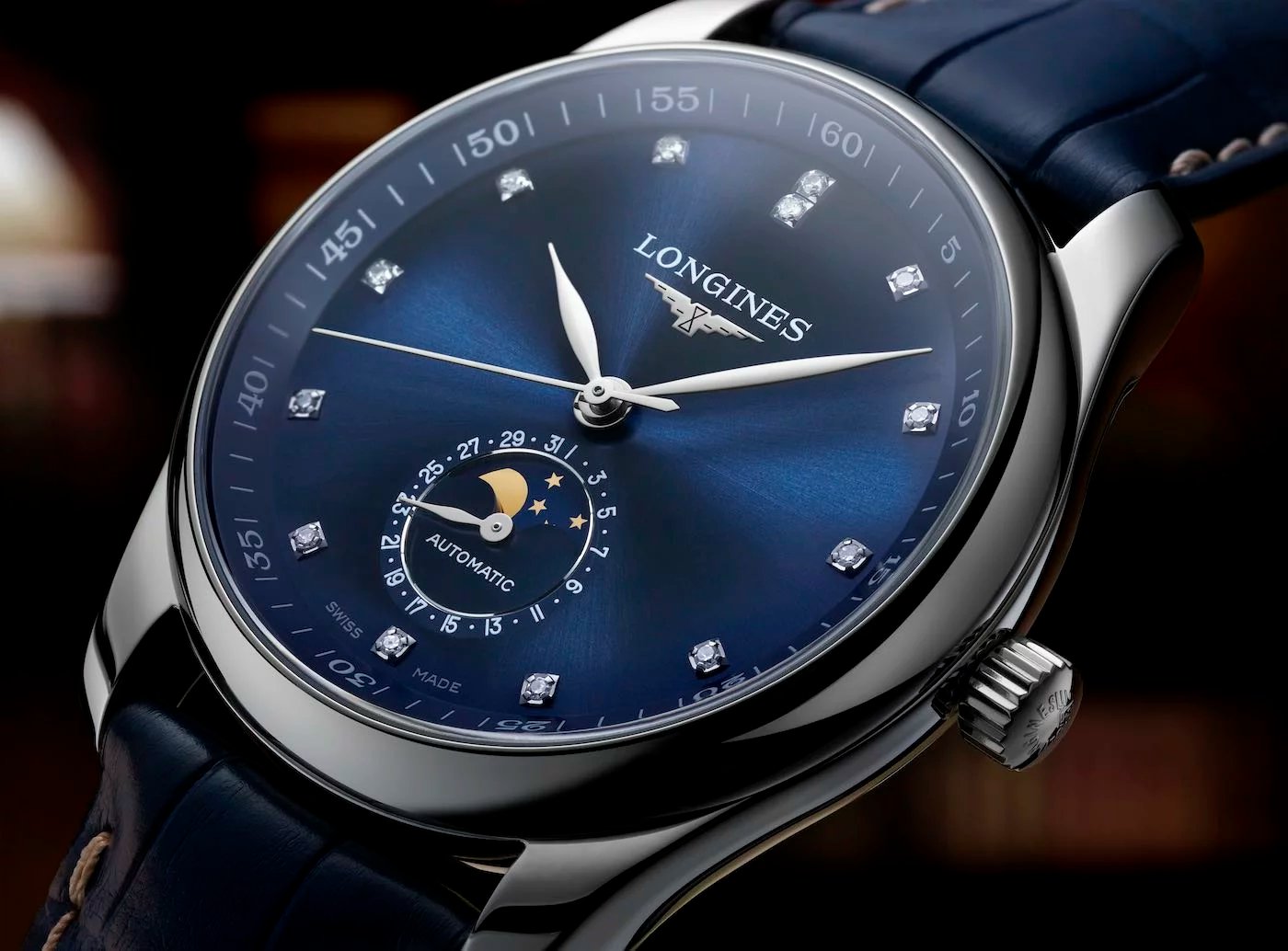
The reading is intuitive: on the left, the moon is growing; on the right, it decreases (on the majority of watches intended for the northern hemisphere). A round aperture may show a bumped moon in relief, an arcuate aperture reveals a crescent that expands and constricts. Some watches display the age of the moon (from 0 to 29), useful for adjusting a moon phase watch to the nearest day.
Express instructions for use
- Find the date of the last full moon (ephemeris sites or weather app).
- Move the time out of the critical calendar zone (avoid 8 p.m. – 2 a.m.), so as not to damage the mechanism.
- With the dedicated corrector (a small pusher in the middle) or via the crown depending on the watch, position the disc on the perfect full moon.
- Count the number of days since the actual full moon, then move forward that many notches.
- Then set the time and date. A fine seasonal correction will be enough every two to three years on a 59 tooth system; almost never on high precision.
Style variations: from the wicket to the sculpted moon
For the southern hemisphere, some houses invert the display so that waxing and waning coincide with your sky. Others offer double hemisphere versions, superb on a large dial.
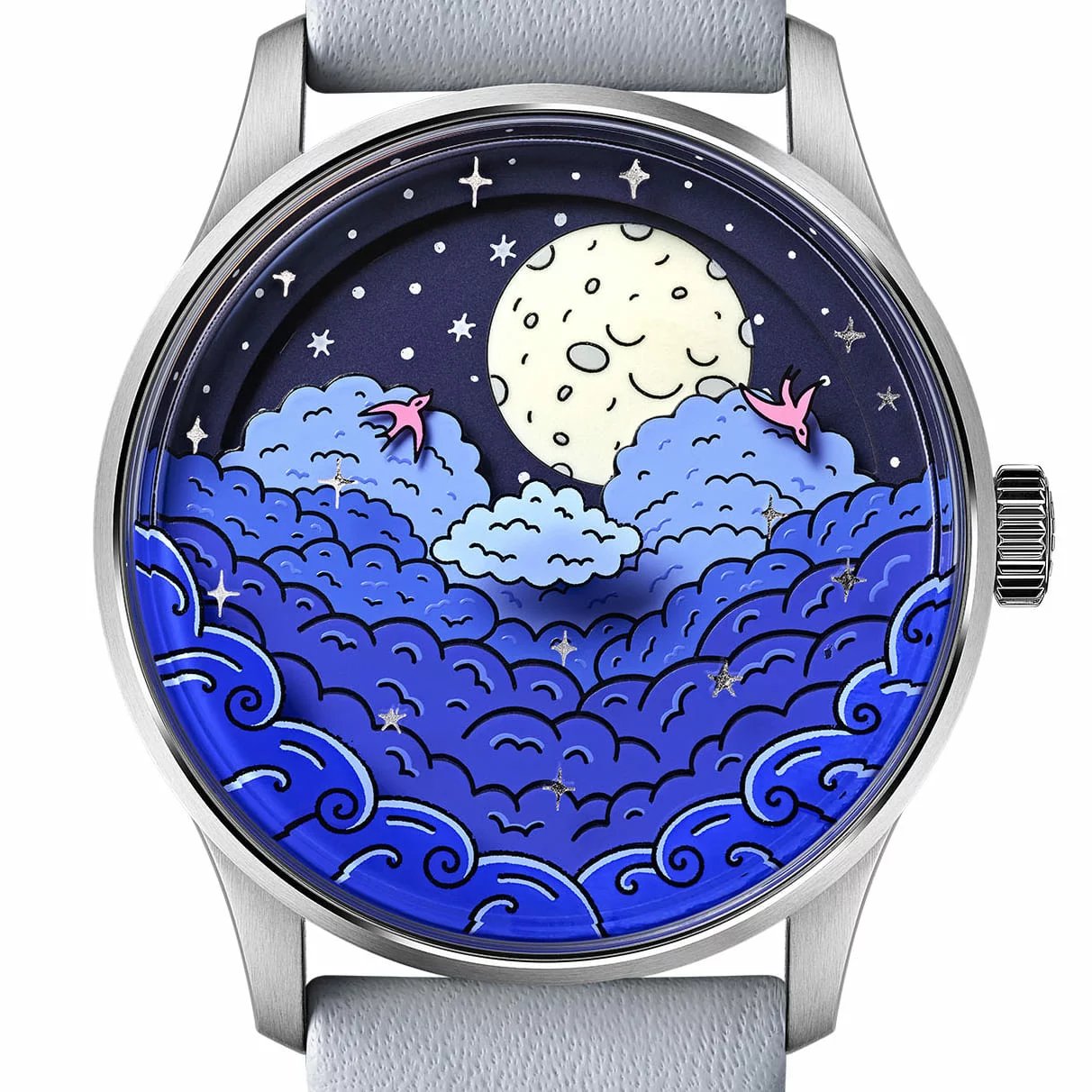
The interest of the moon phase also lies in its aesthetics. The schools respond to each other:
- Classic wicket: two moons on a matte disc, midnight blue sky; legible and discreet.
- Lune a humpback: a polished, textured dome, sometimes gold, that catches the light like a real crescent.
- Large moons: dials devoted almost entirely to the firmament (Arnold & Son, for example), for a hypnotic presence.
- Poetic materials: sparkling aventurine, grand feu enamel, deep lacquer, engraved meteorite for a textured lunar surface.
- Combined complications: combined with a complete or perpetual calendar, the moon becomes the breath of a more complex architecture.
Each house signs its night: Patek Philippe and its cosmic sobriety, Jaeger-LeCoultre and graphic rigor, A. Lange & Sohne and the granite skies, De Bethune and its bluish vaults anodized with titanium. On the wrist, it’s an invitation to look up.
Why it still fascinates us
Because it humanizes the watch. Where the chronograph captures the moment, the moon phase captures the wait. It introduces a controlled slowness, a measured drift against which we come back from time to time, like putting a book back to its page. It speaks to sailors, poets, collectors who like mechanics to tell a story larger than the passing minute.
To remember
- The heart of the classic system: a 59-tooth wheel advances one notch per day.
- Standard accuracy: correction of approximately one day every 2.5 years; high precision: 1 day in 122 years and beyond.
- Ideal setting: outside the date change range, from a reference full moon.
- Multiple styles: discreet window, embossed moon, double hemisphere, poetic materials.
Basically, the moon phase achieves what watchmaking does best: transforming a celestial phenomenon into intimate mechanics. A fragment of night fixed to your wrist, adjusted not to the second, but to beauty.