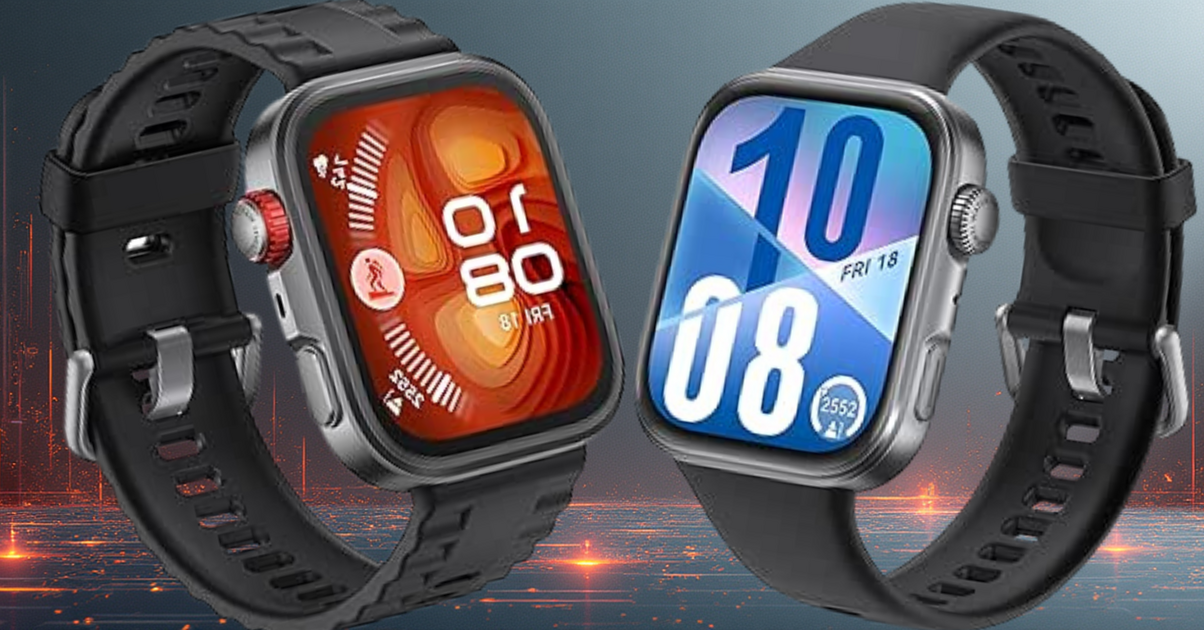
Here, we are not going to redo the technical sheet. We’re going to talk about what it’s like in real life when you run 4 times a week, whether you’re preparing for a half, a marathon, a 30 km trail or a big bike ride. And above all help you answer just one question: Which one best fits YOUR training life?
If you want to go into detail model by model, you can also read my full review of the Huawei Watch Fit 4 and my detailed review of the Huawei Watch Fit 4 Pro.
Design and comfort: the feather against the light tank
The two watches have the same overall format: a thin rectangular dial, designed to look more like a bracelet than a large outdoor watch. On the wrist, it changes everything: it goes under a shirt, it doesn’t bang everywhere, it’s forgotten in the office.
Huawei Watch Fit 4 :
See Huawei Watch Fit 4 price and reviews on Amazon
- Very light, truly a “sport bracelet” for everyday use.
- Discreet look: you can keep it at work without looking like you just came from an ultra-trail.
- At night, you barely feel it. On a small wrist, it’s a real plus.
Huawei Watch Fit 4 Pro :
See Huawei Watch Fit 4 Pro price and reviews on Amazon
- More premium case, more robust materials (more serious frame, more resistant glass).
- A little more “technical watch” look, assumed, which is less gadgety.
- It remains light for its category, but you feel it a little more than a classic Fit 4.
When worn 24/7, the difference is especially felt if you have a thin wrist or if you systematically sleep with your watch. The Fit 4 is almost disappearing. The Pro remains present, without being annoying, but you know it is there.
Verdict: if you want the lightest and most discreet watch possible, especially for sleeping and keeping it non-stop → advantage Huawei Watch Fit 4. If you want a more robust, more “tool” watch and a slightly more premium look that can withstand everyday shocks → advantage Huawei Watch Fit 4 Pro.
Screen, readability and ergonomics: same comfort, same pleasure
Good news: on the screen, you almost can’t go wrong. Both offer a large, bright AMOLED screen, with lots of contrast and excellent readability in direct sunlight like on a gym mat.
When running or cycling, you can easily read:
- your instant and average pace,
- your heart rate,
- distance and elapsed time,
- laps during an 8 x 400m or a threshold session.
The ergonomics remain the same from one model to another: fluid interface, simple gestures, customizable training screens. You prepare your session, you throw, you take a look at the wrist, you understand everything in a second. This is exactly what we want.
Verdict: here it is draw. You won’t choose between the Huawei Watch Fit 4 and the Watch Fit 4 Pro for the screen or readability. Both perform very well.
Sports monitoring and training tools: solid generalist vs multisport coach
This is where things start to separate a little.
Huawei Watch Fit 4 :
- Complete profiles for running, cycling, swimming, treadmill, rowing, strengthening, etc.
- Training plans, session recommendations, HR zones, overall training load.
- Enough to prepare for a 10 km, half, marathon or “amateur” triathlon without worrying.
In practice, if you do, for example, three outings per week (a pace session, a cool jog, a long outing), the Fit 4 records everything, gives you a consistent training load and offers you suitable sessions. You can progress without burning out.
Huawei Watch Fit 4 Pro :
- Same profile base… but more depth on “complex” sports: trail, mountain, multi-sport, water sports.
- More advanced tools for the outdoors: height difference, route profiles, management of effort uphill and downhill.
- More analyzes for those who do a series of sports (running + cycling + swimming + skiing, for example).
On a typical “serious sportsman” week:
- Monday: strengthening + light jogging,
- Wednesday: split 8 x 400 m,
- Saturday: 25 km trail with D+,
- Sunday: 3 hour bike ride.
Both watches follow, but the Pro gives you a finer view of the overall load and your recovery, especially when you really mix several endurance sports.
Verdict: if your thing is mainly running (with a little cycling and swimming), Huawei Watch Fit 4 does the job perfectly. If you start doing triathlon, serious trail running in the mountains, and want more in-depth analysis on several sports, the Watch Fit 4 Pro becomes more coherent.
Navigation, cartography and GPS: stay on track… or really go on an adventure
We’re not going to beat around the bush: for the outdoors, this is one of the big differentiating points.
Huawei Watch Fit 4 :
- Accurate GPS for roads, paths, tracks in town and in the countryside.
- Simple route tracking: you can prepare a route and follow it on the screen.
- Perfect for not getting lost on a 15–20 km loop around your home.
Huawei Watch Fit 4 Pro :
- GPS at least as reliable, with better performance in complicated environments (dense forest, deep valleys, mountains).
- More advanced navigation functions: better track management, more detailed displays, more readable guidance for long outings.
- More suitable for outings of 30 km, 40 km and committed hikes/trails with high D+.
Really, what does that give? On a 10 km in town or a 12 km outing in the forest, you will hardly see any difference. On a 30 km trail with passages through undergrowth, crests, frequent changes of direction, the Pro will be a little more comfortable to keep an eye on your track, especially if you go alone.
Verdict: for classic training (road, known paths, small loops), the Huawei Watch Fit 4 is more than enough. If you spend a lot of time in the mountains, on a long trail or on a hike with tracks, the most logical thing remains Watch Fit 4 Pro.
Heart rate accuracy: very good, but not magical
Let’s talk cardio. You want to know if your threshold is clean, if you don’t explode your nervous system with each outing, in short, if your zones are reliable.
Both watches use modern optical sensors, very good at rest, very good when jogging, a little more “lagging” on very sudden changes in pace (like all watches on the wrist, in fact).
In practice:
- At rest and during the day: the two are very close, nothing to say.
- On a Z2/Z3 run: clean, stable, consistent curve.
- On an 8 x 400 m or a 10 x 30″/30″: slight latency, peaks sometimes a little smoothed. Normal.
The Watch Fit 4 Pro generally maintains a small advantage in terms of stability and smoothness of curves during sustained efforts, especially if you tighten the bracelet well and have a wrist that doesn’t move too much. But it’s not day and night either.
And anyway, if you want ultra-precise monitoring for hardcore splits, VMA work or very specialized sessions, the truth doesn’t change: Bluetooth cardio belt. Both watches can connect to it, and then you enter another world.
Verdict: for 95% of athletes, it is almost drawn match. The Pro takes a slight advantage if you pay close attention to your curves and do a series of structured sessions. But both are enough to manage load, zones and progression correctly.
Battery life: charge once a week, not every evening
You don’t want a watch that you have to plug in every day, we agree.
Both models are around a week of battery life in mixed use:
- port 24/7,
- sleep monitoring activated,
- 4 GPS training sessions per week,
- notifications, a little consultation of schedules, weather, etc.
With the screen always on, things obviously go downhill. You spend more on 3–5 days depending on your training frequency and the duration of your outings. But the two watches behave very similarly.
On a “marathon prep” block with a lot of volume, such as:
- 5 sessions per week,
- a long outing of 2:00–2:30 hours on the weekend,
- a little extra reinforcement or bike,
You basically stay on a charge every 5–7 days. Which is already very comfortable compared to a real classic smartwatch.
Verdict: draw. You’re not going to choose between the Huawei Watch Fit 4 and the Watch Fit 4 Pro for one day more or less battery.
Connected functions and ecosystem: enough for everyday use, not mini smartphones
The two watches play in the “very connected sports watch” field, not in the “mini phone on the wrist” field. And that’s a good thing if you want a training tool, not a distracting toy.
In common:
- smartphone notifications,
- display of messages and possibility of quick responses depending on the phone,
- Bluetooth calls with mic/speaker,
- phone music control,
- deep integration with the Huawei Health application.
Huawei Health, in fact, remains at the center of the game. This is where you see:
- your heart rate curves,
- your detailed sleep (stages, awakenings, recovery),
- your training load over the week and month,
- your progress on VO2 max and your estimated times over 5 km / 10 km / half, etc.
Regarding payments on the wrist, let’s be clear: depending on your bank and your country, it can be very limited. Don’t plan to buy your watch just to “pay everywhere” with it. You would be disappointed.
Verdict: once again, draw. Both are connected enough to manage your daily life, but they’re not Apple Watches or Pixel Watches. If you are mainly looking for a good balance of sport + notifications, both do the job. You don’t choose here, you choose on the sports part.
Huawei Watch Fit 4 or Watch Fit 4 Pro: who should choose which?
We summarize. No bla-bla.
The Huawei Watch Fit 4 is the best choice if:
- you run regularly (2 to 4 times a week) with sometimes a little cycling and swimming,
- you want an ultra light watch, comfortable 24/7, that you almost forget on your wrist,
- you do trail running and hiking, but over reasonable distances, rather close to home,
- you want real serious sports/health monitoring, without paying for functions that you will never use.
The Huawei Watch Fit 4 Pro is the best choice if:
- you mix several endurance sports: running, cycling, swimming, skiing, sometimes triathlon,
- you spend a lot of time in the mountains, on long trails, on hikes with tracks,
- you want a more robust case, which is more resistant to scratches and shocks,
- you are sensitive to advanced health functions (finer measurements, more in-depth analyses).
Honestly, you can’t really go wrong between the two. If you are mainly a “classic” runner, with a few objectives such as 10 km, half, marathon, the Huawei Watch Fit 4 is already largely at the level. If you switch to a more outdoor / multisport profile, if you do large blocks of training and difficult terrain, the Huawei Watch Fit 4 Pro becomes the logical choice.
In the end, you don’t choose “the best on paper”. You choose the watch that best fits your real training life. And that, when you cross the finish line with a time you’ve never seen before, that’s all that matters.