Table of Contents
Key Features (Quick Sheet)
| Case size | 41mm |
|---|---|
| Thickness | 12mm |
| Weight | 30.1 g (case) |
| Display technology | OLED |
| Resolution | 460 dpi |
| Sensors | Heart rate monitor, Barometric altimeter, GPS, Compass, SpO2 (blood oxygenation) |
| Maximum sealing depth | 50m |
| Speaker | Yes |
| Payment solution | Yes |
| Internal memory | 8 GB |
| Music storage | Yes |
| Standard bracelet compatible | Yes |
| Compatibility | Android, iOS |
| Operating system | Owner |
| Measured autonomy | 137 hours |
Yes, I insist: these figures are the basis. Afterwards, everything depends on use (AOD, nighttime SpO2, notifications, GPS + music, etc.).
Why the Venu 3S fits just right on the small wrist
If you’re still hesitant about the sizes (and the real sensations on the wrist), I also have a complete connected watch guide for small wrists: diameter benchmarks, classic errors, and models that work without looking “bricky”.
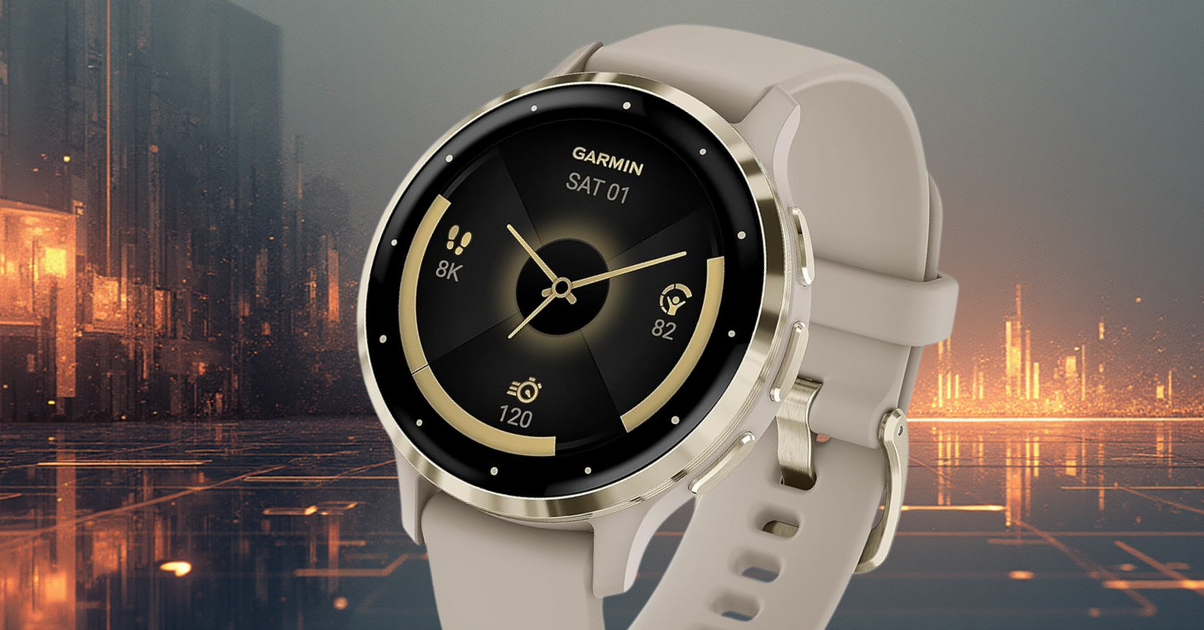
Do you know that moment when you put on a “sports” watch… and your wrist looks like a child who stole his father’s watch? So. The Venu 3S avoids this sketch, because it remains compact and balanced.
The format 41mm and the thickness 12mm keep a clean profile under a sleeve. And the contained weight also helps: less inertia, less rotation, therefore an optical cardio sensor which has fewer reasons to stall. It seems “detail”, but that’s often where the difference comes into play.
Screen: visual comfort, not just “wow”
OLED is clear, contrasty, readable outside if you adjust the brightness correctly. And the density 460 dpi gives this “clean” rendering that feels premium. You read at a glance. You don’t squint.
Waterproofing 50m : shower, rain, swimming pool, it’s in the frame. And the memory 8 GB + music storage, this is the real “freedom mode”: you go running without a phone, just you and your playlist.
Autonomy: less charge, more life
A watch that you have to charge all the time is a watch that you wear less. And if you wear it less, the sleep stats become decoration. The Venu 3S focuses on endurance.
The official figures give a clear basis: up to 10 days in smartwatch mode, up to 5 days in permanent display. In sport, you can aim for the long distance without stress: but the GPS + music combo consumes. Normal.
And then you have your field figure: 137 hours of measured autonomy. It’s not “magic”, it’s just a measure that speaks. Where much remains unclear.
To compare the Venu 3S to other models (autonomy vs. sport vs. “smart”), look at my complete comparison of the best Garmin 2026 watches. It’s faster than 40 tabs.
L’Swiss Made Watch test method
I’m not giving you a fake test booklet. When I validate a Garmin, I always apply the same protocol, because it’s the only way to compare properly. Simple example:
Urban GPS test — Toulouse, Canal du Midi — 45 min — All Systems — objective: identify “cuts” at intersections and stability of pace.
Undergrowth test — Montagne Noire (shaded loop) — 60 min — All Systems — objective: to see if the track “is fraying” and if the cardio is racing.
Daily test — 48 h — notifications + sleep — objective: measure battery drain in normal use and identify the greedy option if it collapses.
You will notice: real places, concrete objectives. No cinema. So, when I say “comfortable autonomy”, I mean “comfortable in real life”.
Sleep and health: here it stands out
The Venu 3S isn’t trying to be a “performance” watch first and foremost. His thing is everyday health. And when you play that game… she becomes very coherent.
Sleep Coach + naps: the duo that changes usage
The Sleep Coach is not satisfied with a pretty score. It tries to link your need for sleep to your load and recovery. And nap detection completes the picture, especially if your days are zigzag. Basically: you stop “guessing”, you adjust.
But don’t fall into the scoring trap: one week = one trend. Two lousy nights = life. You get the idea.
Body Battery & HRV: useful if you know what to look for
Body Battery is the most actionable: you see the reserve go up after a good night, go down after a tense day, and be folded by a session too late. HRV Status is finer, therefore more tricky. A low morning does not mean “danger”. Several days down, there you investigate.
If your main goal is to have truly usable wrist cardio (intervals, rowing, crossfit), read my reliable guide to choosing a cardio watch. This avoids “beautiful but shaky” purchases.
SpO2, compass, baro altimeter: the sensors that really matter
SpO2 is interesting…if you don’t let it go to your head. The compass and barometric altimeter add context (elevation, simple orientation), but don’t make it an “orientation watch” however. She does it, without being made for it.
Sport, GPS, calls: real use, without myth
You can train with a Venu 3S, obviously. The question is: does it meet your level of requirements, or are you looking for a disguised “outdoor performance” watch?
GPS: very correct, but not “surgical” everywhere
Multi-GNSS, therefore good stability in the majority of cases. But no multi-band: in dense cities or under heavy trees, the track can be a little less clean than a dedicated performance watch. It’s not dramatic. It’s just reality.
Speaker: practical, but not for chatting for 30 minutes
Speaker + microphone: you take a quick call, you launch the phone’s voice assistant. For short, it’s great. For a long conversation, no. And that’s very good.
Android / iOS compatibility: ok… with a nuance
On Android, the “quick replies” experience is more comfortable. On iPhone, you read the notifications, you interact less. It’s a choice. Some people don’t care. Others hate it.
Prices, alternatives and buying experience
The Venu 3S is in the “premium Garmin” segment. So you pay for the screen, the sensors, the health software… and the fact that it fits well on the wrist on a daily basis. The real question: are you going to wear it every day? If so, the “per day” cost becomes almost ridiculous. If not, get simpler.
Quick (and honest) alternatives
Came 3 : same spirit, bigger. Came 2S : still solid, often less expensive, but less rich in the sleep/assistant aspect. Vivoactive : more “basic sport”, less premium. And if you live on iPhone and responding on the wrist is non-negotiable: Apple Watch maintains the advantage… at the cost of shorter battery life.
Quick recap. The final “big yes” comes when you realize that you wear it all the time… and that you don’t load it much. Consistent, therefore.
- To buy if : small wrist, daily use, sleep/health center, versatile sports.
- You will love it : 41 mm format, crisp OLED, Sleep Coach + naps, Body Battery, fast calls, comfortable battery life.
- To accept : no multi-band, limited navigation, richer message interaction on Android.
- Simple decision : phone + load tolerance. The rest follows.
Sign : David Deteve — L’Swiss Made Watch.