Table of Contents
Who is the Forerunner 965 worth the price for (and who isn’t)
The right profile
You are preparing for a half/marathon, you are doing interval training, long outings, “soft” trail running, triathlon… and you want cards directly on the wrist. You also want Garmin metrics (HRV, load, readiness) that structure your week. Not just a pretty ring that closes. Concrete.
The wrong profile
Do you run twice a week “to sweat a little” and you never open a stats screen? Frankly, it’s a bad idea. A 265 (or even less) will make you smile the same, for less violence on the CB.
If you’re really hesitant, read this useful Garmin 265 vs 965 comparison before purchasing: you save time (and sometimes €250).
Design & screen: the upgrade that can be seen, every day
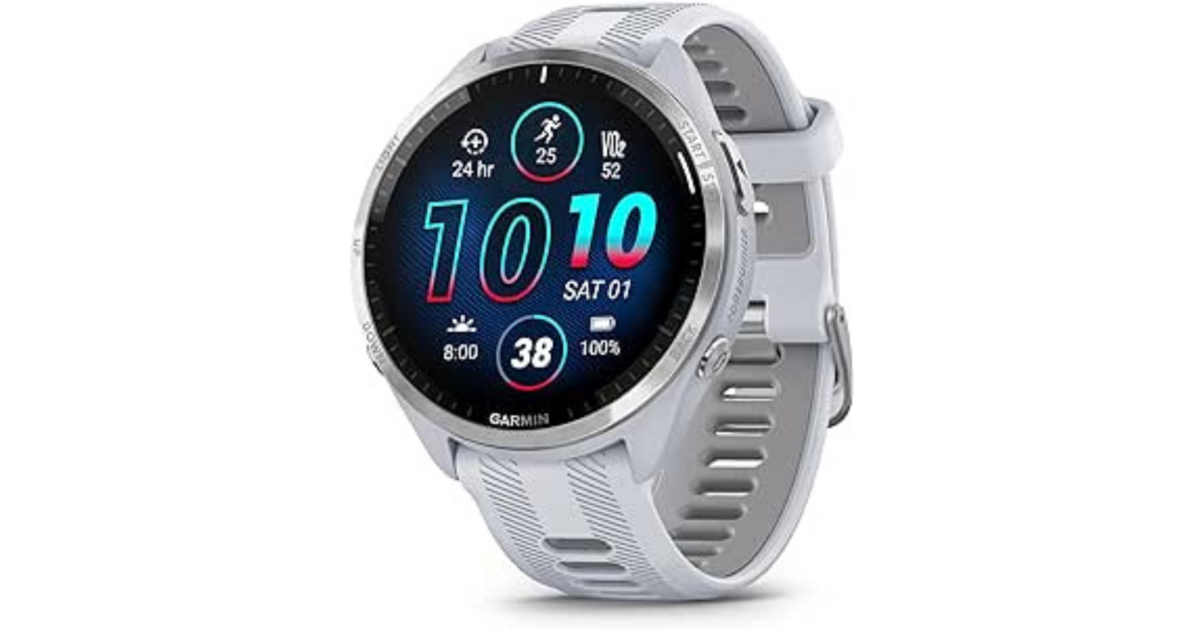
1.4” AMOLED: true luxury is reading
The AMOLED screen of the 965 is discreet “wow”: deep contrast, sharp colors, readable maps, clean widgets. And above all: when sailing, you suffer less. You turn, you understand. You move forward.
Titanium bezel, low weight
On the scale and on the wrist, it remains surprisingly “thin” for a watch that does so much: 52gtitanium bezel, 47.1 mm case. It goes daily. It goes under a sleeve. Well… it depends on your shirts.
The annoying point: no sapphire
It aims for premium, but the glass is not sapphire. So yes: if you rub walls, rocks, branches, you’re playing. A protective film? It’s not sexy, but it’s smart.
Features (integrated cleanly, not in bulk)
| Case size | 47.1mm |
| Weight | 52g |
| Thickness | 13.2mm |
| Screen | OLED (AMOLED) – 1.4″ |
| Resolution/density | 454 × 454 – 459 dpi |
| Internal memory | 32 GB |
| Music | Yes (storage + Spotify/Deezer type services depending on configuration) |
| Payment | Garmin Pay: yes |
| Waterproofing | 50m (5ATM) |
| Speaker | No |
| Compatibility | Android/iOS |
| System | Garmin (proprietary) |
| Sensors | Cardio, GPS, baro altimeter, compass, dual frequency GNSS, SpO2, temperature |
| Measured autonomy | 480 |
Quick aside: the “temperature” sensor exists, but on the wrist it’s being influenced by… you. Normal. For a clean room temperature, a dedicated external sensor does better.
Autonomy & GPS: the truth is in your settings
The figures announced (and what they mean)
Garmin roughly announces up to 23 days in connected watch mode and until 31 p.m. in GPS. On paper, it’s beautiful. In real life, it holds up… if you stay consistent.
The trio that makes the drums explode
Always-on + multiband + music. There, you transform an enduring watch into a watch “to be recharged more often”. Not dramatic, just… to assume. And if you go long, you feel it coming.
SatIQ: intelligent adjustment (often the best compromise)
The SatIQ / AutoSelect mode is used to automatically switch to the correct GNSS config depending on the environment (city, forest, open). Basically: you keep a clean track without burning the battery “for nothing”.
GPS accuracy: city + undergrowth, it defends itself very well
Dual frequency GNSS + multi-constellations: this is typically what makes tracks more stable in difficult environments (buildings, trees, relief). And when you follow a map while running, you want a logical trace. Not a zigzag of pigeons.
If your obsession is “GPS precision vs competition”, check out this full Garmin 965 vs Coros Pace Pro comparison: it’s the most relevant duel, not the one that makes noise.
Garmin Coaching: Training Readiness, HRV, charging… the real interest
Training Readiness: not magical, but useful
Readiness is the score that tells you if you can send or if you’d better slow down. Garmin calculates it by mixing sleep, recovery, HRV, acute load, sleep/stress history. He’s not a doctor. It’s a dashboard. And a good dashboard avoids bullshit.
HRV status: the data that calms egos
When your variability goes out of control (fatigue, stress, poor recovery), the “fitness” metrics start to tell a different story. This is where the 965 is interesting: it forces you to look at the trend, not just the clock of the day. Yes, it gets rough sometimes. So much the better.
Wrist Power, PacePro, ClimbPro, Stamina
You don’t buy a 965 to “count your steps”. You buy it to structure: running power without external sensor, pace strategies, management of climbs, effort reading. And map + turn-to-turn guidance when you change terrain. This is where it justifies its premium badge.
Optical cardio: good… but not invincible
With regular efforts, things are going well. On aggressive interval training, weight training, mountain biking, it can fail (like many optics). If you want “clean” data for metrics, a cardio belt remains the cheat code. So.
Prices, promotions, and alternatives: the rational choice (without lying)
Price: what you should remember
When it was launched, it was displayed higher (logical, new + “premium”). Today, we regularly see it below the psychological bar of €600, sometimes around €500 depending on the merchant and the period. So yes: wait for a promotionit’s rarely stupid.
965 vs 955: the screen changes everyday life
The 955 remains a machine. But the 965, with AMOLED + finesse + card reading, has this “I want to wear it” side. It’s stupid, but it’s true. And a watch that you wear… serves you.
If you want to decide quickly, I put this here: key differences between Garmin 955 and 965.
965 vs Epix / fēnix: same brain, different philosophy
The fēnix/Epix is the armor. The 965 is the lighter “race/tri” performance, easier to live with. Do you want a committed hike, shocks, hard outdoors? fēnix. Do you want to run fast, for a long time, with maps and without a tank on your wrist? 965.
And now that there is the 970?
Since the arrival of a generation above, the 965 has become interesting for a simple reason: performance/price ratio. The new features (micro/HP, “newer” sensors, etc.) are not always worth the difference if your use is running + navigating + recovering. But if you want the latest… you already know what you’re going to do. No point in telling stories.
Buying experience: two tips that avoid regrets
1) Check the seller’s return policy and warranty. A premium watch can also be judged on that (pixels, battery, buttons, waterproofness, etc.).
2) Think “real use”: are you going to sleep with it? Are you going to run to music? Are you going to use the card every week? If so, you’ll pay off quickly. If not… you pay for a technical sheet. And that, frankly, is sad.
Recap (clear, clear)
- To buy if : serious runner / triathlete, need maps, want a premium AMOLED without losing the Garmin DNA.
- Avoid if : you want a smartwatch “phone on the wrist”, calls, microphone/HP, gadgets like Apple Watch.
- The strong point : readability + map + Garmin metrics + solid autonomy.
- The weak point : no sapphire, no micro/HP, no ECG.
- My advice : aim for a promotion, and keep a “cardio belt” budget if you want really clean metrics.
Article written for L’Swiss Made Watch.
David Deteve — editor & field tester (method and public sources; no “false tests” here).
Health note: the measurements (HR, SpO2, HRV) are indicative, not medical.