Table of Contents
Navigation and outdoor features: without mapping
This is the weak point. No onboard maps. But you still have:
- Route tracking : follow a route created in the app (breadcrumbs)
- Turn by turn : turn by turn indications during the race
- Breadcrumbs : display of the GPS track in real time
- Return to start : follow your track in the opposite direction to return
- Navigation to POI : go to points of interest
- Barometric altimeter : precise measurement of altitude (manual or auto calibration possible during the activity)
- Compass : basic orientation
- Weather report : forecasts from the app
Multi-band and multi-GNSS GPS (the most precise) or multi-GNSS alone (more durable). Suunto has removed GPS-only mode.
Verdict: sufficient for runners. Not for hikers who need detailed maps.
GPS and sensor accuracy testing
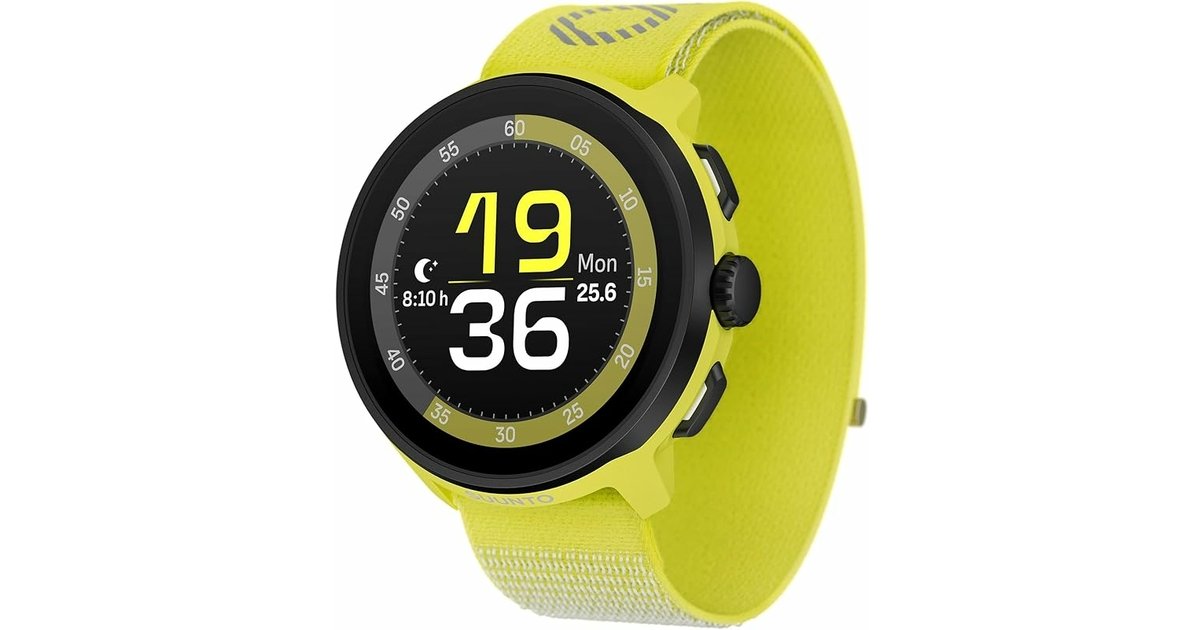
We compared the Suunto Run with a Garmin Forerunner 165 and a COROS PACE 3 on the same routes.
GPS: The dual frequency (L1 + L5) of the Suunto Run offers better precision in urban and undercover environments. The measured distances correspond to our references (Strava, Garmin). No noticeable drift. Rapid signal acquisition (a few seconds).
Optical heart rate: Good performance under normal conditions. Less reliable at high intensity (sprints, intervals). We recommend an external sensor for very demanding sessions. Suunto has improved the sensor compared to previous generations.
Barometric altimeter: Accurate. Manual calibration during activity (new) is useful for mountain runners.
Accelerometer: Automatic detection of laps on track. Works well.
Quick comparison:
| Criteria | Suunto Run | Garmin Forerunner 165 | COROS PACE 3 |
|---|---|---|---|
| GPS | Dual band (L1+L5) | Single-band (L1 only) | Dual band (L1+L5) |
| GPS accuracy | Excellent | Good | Excellent |
| Cardio sensor | Optics (improved) | Optical | Optical |
| Altimeter | Yes (barometric) | No | No |
| AMOLED screen | Yes | Yes | No (MIP) |
Battery life: 20 hours in precise GPS
Suunto announces 12 days in connected watch, 20 hours in dual-band GPS (performance mode), 40 hours in economy mode.
Our actual tests:
- Connected mode (active Bluetooth, continuous cardio): approximately 7-8 days
- Dual band GPS (performance mode): 18-20 hours depending on alerts and screen
- Dual band GPS with always-on display: ~16 hours (20% loss)
- Economy mode (single band GPS): 30-40 hours
Charging: magnetic cable supplied. Approximately 1 hour 45 minutes for a full charge.
Verdict: 20 hours is enough for a marathon (4-5 hours) with battery to spare. Better than the Forerunner 165 (17 hours) and the PACE 3 (15 hours in performance mode). Less than the PACE 3 in economy mode (38 hours).
MP3 player: 4 GB of music without a phone
Rare at this price. You can store your MP3 files directly in the watch.
Limitations:
- MP3 files only (no FLAC, AAC, etc.)
- No support for Spotify, Deezer, Apple Music (streaming)
- 4 GB = approximately 1000 songs in standard quality
- Compatible with standard Bluetooth headsets
- Playback controls from the watch (play, pause, next)
Real usefulness: you can run without a phone and listen to your music. This is a real plus for runners who like to isolate themselves.
Comparison: the Garmin Forerunner 165 Music also offers music, but it costs €299 (Music version). The COROS PACE 3 does not have an MP3 player.
Suunto app and sync
The Suunto app is well thought out. Clear interface. No hassle finding your data.
Main features:
- Creating routes : the creation tool is renowned as the best on the market (according to testers)
- Suunto Route Planner : web version to create from a computer
- AI Analytics : intelligent summaries of your sessions
- Tracking widgets : training load, recovery, progression
- Komoot sync : import routes from Komoot
- Social sharing : share your performances
Synchronization: generally fast (a few seconds after the activity ends). Sometimes slow (rarely, but it happens).
Integration: Strava, TrainingPeaks, etc. No Garmin Connect, but you can export to TCX/FIT.
Advantages and disadvantages: the honest assessment
| Benefits | Disadvantages |
|---|---|
| Ultra-light (35g) | No mapping |
| Dual band GPS (accurate) | No contactless payment (except China) |
| Bright AMOLED display | No music streaming (MP3 only) |
| Integrated MP3 player | Cardio sensor less reliable at high intensity |
| Battery life 20 hours in precise GPS | Not repairable (unlike other Suuntos) |
| Advanced running tools (dynamics, VO2max, training load) | No ECG |
| Unbeatable price (€249) | Less refined interface than Garmin |
| Intuitive interface | Fewer sporty profiles than high-end models |
Direct comparison with competitors
Suunto Run vs Garmin Forerunner 165
Same price (€249 for the Garmin Music version, often on sale). Same AMOLED screen. Same weight (~40g).
Suunto Run Advantage:
- Dual band GPS (Garmin only has L1)
- Native MP3 player (Garmin Music costs €50 more)
- Barometric altimeter
- More detailed running dynamics
Garmin Forerunner 165 advantage:
- Smoother and more refined interface
- More mature Garmin ecosystem
- Slightly more reliable cardio sensor
- Suggested Workouts (Garmin Coach)
Verdict: the Suunto Run wins on hardware (GPS, MP3, altimeter). Garmin wins on software (interface, training).
Suunto Run vs COROS PACE 3
Same price (249€). Same dual-band GPS. Same lightness (~40g).
COROS PACE 3 advantage:
- Exceptional battery life (38 hours in GPS)
- MIP screen (less battery consumption)
- Lighter (30g vs 35g)
- Very clean interface
Suunto Run Advantage:
- AMOLED screen (more beautiful, more readable)
- MP3 player
- Barometric altimeter
- More complete running tools
- Training load and recovery
Verdict: COROS PACE 3 for extreme autonomy. Suunto Run for comfort and functionality.
Suunto Run vs Suunto Race S
The Race S costs €349 (€100 more). She suggests:
- On-board mapping
- Greater autonomy (30 hours in GPS)
- Bigger screen
- More robust housing
The Run has no mapping but offers better value for pure runners.
Final verdict: for whom? At what price?
The Suunto Run is made for:
- Road and track riders who want a reliable, lightweight tool
- Triathletes looking for a compact watch (34 sports profiles)
- Runners who love music and want to run without a phone
- Those who want precise GPS without paying €400+
- Thin wrists (compact 46mm case)
It is NOT made for:
- Hikers who need mapping
- Demanding trail runners (not robust enough, no maps)
- Those who want Spotify to show
- Divers (no dive computer)
Price: €249
Where to buy it: Suunto official website, i-Run, Amazon, specialist resellers.
Guarantee : 2 years (Suunto standard).
Repair : Not repairable (unlike the Race S and Vertical). To be replaced in case of breakage.
Summary in 3 points
- Light and precise: 35g, dual band GPS, AMOLED screen. Everything you need to run fast and well.
- Musical: 4 GB of onboard MP3. Run without a phone.
- Affordable : €249 for hardware and features that competitors sell for €100 more.
Frequently asked questions
Is Suunto Run waterproof for swimming?
Yes. 50 meters (5 ATM). You can swim in pools and open water. No diving.
How long does the battery last in GPS mode?
20 hours in performance mode (dual band). 40 hours in economy mode (single band). Our tests: 18-20 real hours in performance mode.
Can you listen to Spotify on Suunto Run?
No. Only MP3 files stored locally (4 GB). No streaming.
Does Suunto Run have mapping?
No. You have route tracking (breadcrumbs) and turn by turn, but no detailed maps.
What is the exact weight?
35 grams (bracelet included).
Is it repairable?
No. Unlike other Suunto watches (Race S, Vertical), the Run is not repairable. To be replaced in case of breakage.
Do I need an external cardio sensor?
No, the built-in optical sensor works fine. But for very intense sessions (sprints, intervals), an external sensor (Bluetooth) improves precision.
Is the Suunto Run suitable for trail running?
Yes, she has a trail profile and the necessary tools. But without mapping, it is less suitable than the Race S for technical trails.
Who is the best competitor?
It depends on your priorities. Garmin Forerunner 165 for the interface. COROS PACE 3 for extreme autonomy. Suunto Run for overall balance (GPS, MP3, AMOLED, price).
Is there a version for small wrists?
No. The 46mm case is unique. But it’s compact and lightweight, so it fits even small wrists.
Can the watch be charged without the supplied cable?
No. Suunto uses a proprietary magnetic connector. You have to keep the cable.