Table of Contents
Design, comfort and screen: the bracelet you forget on your wrist
Fitbit Inspire 3 data sheet
| Characteristic | Detail |
|---|---|
| Model | Fitbit Inspire 3 |
| Category | Entry-level fitness bracelet / activity tracker |
| Release date | September 2022 |
| Introductory price | Around €100 (≈$99.95/£84.99) |
| Current price (2025–2026) | Often between €60 and €90 depending on promotions |
| Weight | ≈ 17.7g |
| Screen | ~1.5″ color AMOLED screen – 72 × 128 px – Always-On option |
| Sensors | Optical cardio, 3-axis accelerometer, SpO2, skin temperature sensor |
| Health monitoring | HR 24/7, HRV, respiratory rate, nocturnal SpO2, sleep score, stress |
| Sports | 20+ sport modes, SmartTrack (auto exercise detection) |
| GPS | GPS connected via smartphone (no integrated GPS) |
| Waterproofing | 5 ATM – up to 50 m (swimming, shower OK) |
| Autonomy announced | Up to 10 days |
| Typical actual battery life | 7–10 days in mixed use; 3–5 days with Always-On display |
| Charging time | ≈ 2 h (0 to 100%) |
| Compatibility | Android 9+ / iOS 15+ |
| Connectivity | Bluetooth |
| Connected functions | Call/SMS/app notifications, silent wake-up, timer, alarm |
| Related services | 6 months of Fitbit Premium included (then subscription) |
| Special features | Ultra light, several colors, clip accessories and dedicated bracelets |
Comfort and presence on the wrist
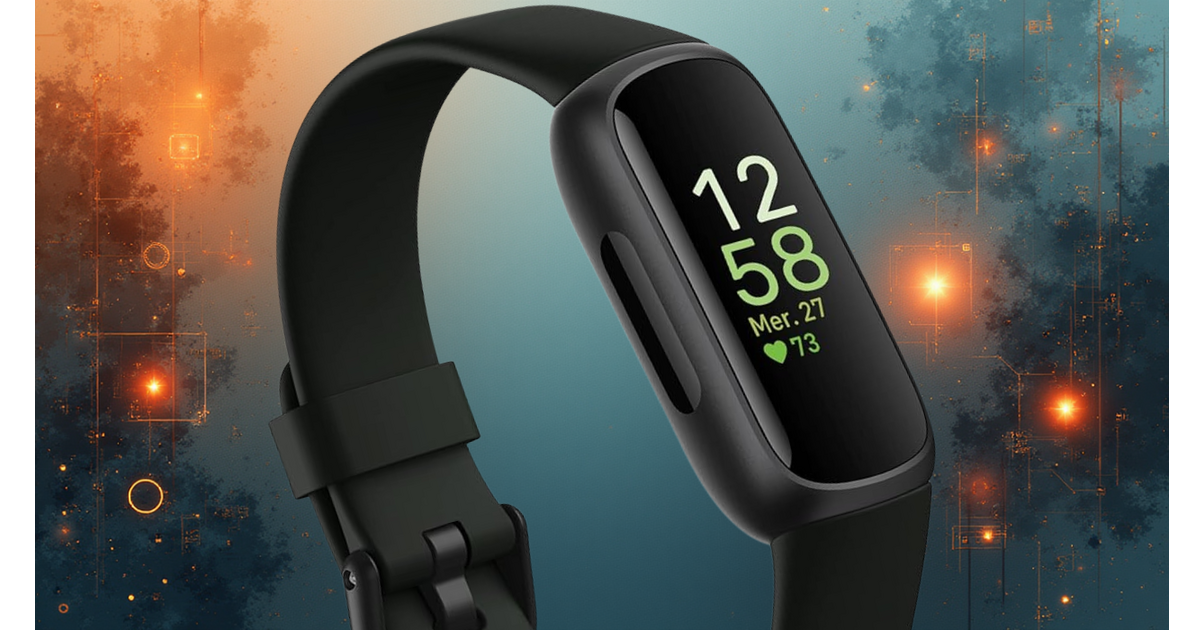
First thing you notice when you put on the Fitbit Inspire 3: we almost don’t notice it. At approximately 17.7g, it is lighter than many fabric bracelets. Honestly, after two days I sometimes had to check if I really had it on my wrist.
The format is the one we know from Fitbit: small rectangular module embedded in a silicone bracelet. The colors (discreet black, softer purple, more sunny yellow) allow you to find something that suits your style without falling into garish plastic. You can wear it to the office, in the evening, while running, it goes everywhere.
At night, that’s where comfort comes into play. I kept her on for 9 consecutive nights, including 3 nights that were a little restless (waking up, legs moving, work stress). Never had this feeling of “block” which bothers the wrist bone. And frankly, it changes everything when you really want to exploit the sleep tracking.
AMOLED screen: small, but effective
The screen Color AMOLED is not gigantic, but it does the job for a bracelet: time, heart rate, stages of the day, shortened notifications. You don’t stay on it, you take a look and move on. That’s the goal.
In direct sunlight, I sometimes had to tilt my wrist slightly to clearly see the numbers. Nothing dramatic, but we’re not at the level of a big OLED watch with a huge panel, normal. On the other hand, the contrast is very good in the evening: in a slightly dark room or in the van, the information remains ultra readable.
The option Always-On is practical for the impatient, but it’s the thing that hurts autonomy the most. So, I left it activated for 3 days to test, then turned it off. We’ll talk about it a little further down.
Health, sleep and stress: where the Inspire 3 shines
Health sensors and data: the heart of the product
In terms of sensors, the Fitbit Inspire 3 is well equipped for a bracelet of this price:
- Optical heart rate sensor : heart rate 24/7, during exercise, estimation of variability (HRV)
- Nocturnal SpO2 : oxygen saturation at night
- Skin temperature sensor : displayed in “variation” (more or less compared to your base)
- 3-axis accelerometer : steps, distance, movement, SmartTrack automatic detection
Over 4 nights where I clearly felt tired, I saw my HRV remain rather low and my sleep scores between 68 and 74. Over two much calmer nights (weekend in a van, fewer screens in the evening), the score rose to around 82–85. This is not an absolute truth, but the curves matched my feelings well.
Important : it is not a medical device. It gives you signals, trends, not diagnoses. If you take it as a “well-being” dashboard and not as a traveling laboratory, you are using it well.
Sleep tracking: a real strong point
If you type “Fitbit Inspire 3 sleep review” in Google, you are not the only one. This is clearly the main argument of the bracelet.
You recover:
- A overall sleep score every morning
- The total duration and details of the phases (light, deep, paradoxical)
- The regularity of your bedtime/wake-up times
- Your average heart rate and nighttime restlessness
On my test, I appreciated something simple: on the days when I overindulged a little (bedtime at 1 a.m., waking up at 7 a.m.), the score clearly dropped below 70, with a remark like “sleep shorter than usual”. Nothing magical, but it puts a few things in their place.
With Fitbit Premiumyou get more in-depth analyses, trends over several weeks and advice. Without Premium, you keep the essentials: score, time per phase, regularity, which is already more than enough to correct two or three bad habits.
Stress, SpO2, HRV: weak everyday signals
The Fitbit Inspire 3 also displays a stress management scoreyour minutes in active zone and indicators such as HRV (variability), respiratory rate and SpO2 at night.
In a somewhat nervous week, I saw the stress score remain relatively average despite decent activity, while my minutes in the active zone exceeded the objectives. It doesn’t replace a session with the psychologist, but it reminds you that “moving more” is not always enough to calm the brain. Basically, it helps you look at yourself in the face.
Some leading indicators, such as Daily Readiness Scoreask again for Fitbit Premium. You can do without it if you just want to know if you’re completely burned out or not, but if you like data, you might be tempted.
Sport, connected GPS and autonomy: how far it holds up
Sports tracking: very correct for everyday use
The Fitbit Inspire 3 offers more than 20 exercise modes : walking, running, cycling, yoga, weight training, treadmill, etc. You can launch them manually or let SmartTrack detect certain activities automatically.
Over three running outings of 6 to 8 km, the heart rate was consistent with that of a more advanced watch that I use in parallel. It’s not exactly beat, but for a “I run to keep in shape” profile, it’s more than enough.
Where it starts to show its limits is when you want:
- do highly structured split
- carefully analyze your pace per kilometer over a 10 km
- follow the height difference on a mountain trail outing
In these cases, let’s be clear: the Fitbit Inspire 3 is not for you. This is where you upgrade to a real sports watch. If you are hesitant with a more sport-oriented bracelet, you can take a look at reading the full Galaxy Fit 3 Inspire 3 duel.
Connected GPS: the famous sensitive point
We are not going to go around: the Fitbit Inspire 3 does not have built-in GPS. It is based on the Connected GPS from your smartphone. If your phone stays at home, the watch does the best it can with the accelerometer, but you won’t have an accurate GPS track.
On two outings with phone in my pocket, I had:
- 7.8 km on the Fitbit app
- 7.6 km on a third-party app such as Strava
The difference remained reasonable for leisure use. But if you’re aiming for a time over 10 km or a half, you’ll quickly find it limited. For me, it is clearly OK for fast walking and leisurely runningnot for athlete training.
Autonomy: no need to live with the charger
Officially, Fitbit talks about up to 10 days of battery life. In real use, it looks something like:
- Notifications activated, 3 sports sessions, screen without Always-On: between 7 and 9 days
- Always-On activated + lots of sport + SpO2: more like 3 to 5 days
On my test, I noted:
– Day 1: 100%
– Day 4 (2 sports sessions): 63%
– Day 7: 21%
– Full recharge in just under 2 hours.
We are not looking for a GPS trail watch with 3 weeks of battery life. But for one connected fitness bracelet compatible with Android and iOSlast a week without worrying, it’s already very pleasant. You don’t feel like you’re managing a battery all the time.
Fitbit Inspire 3 vs alternatives: value for money in 2026
Faced with the Fitbit Charge 6
The question often comes up: Fitbit Inspire 3 or Fitbit Charge 6 ? By simplifying:
- Inspire 3 : lighter, simpler, slightly better autonomy, ideal for beginners and those who especially want health + sleep.
- Charge 6 : more comfortable screen, Integrated GPSmore advanced sports functions, more advanced Google integration.
If you do a little sport but your obsession is above all to regain control over your pace of life, the Inspire 3 is enough. If you start accumulating sessions, looking at your pace per kilometer, monitoring your personal records, the Charge 6 becomes more logical.
Faced with Xiaomi / Huawei / Amazfit bracelets
On paper, certain Chinese bracelets outperform the Fitbit Inspire 3 in terms of “specs/price”. More options, more dials, sometimes more battery, for less money.
Where Fitbit remains interesting is:
- there maturity of the health appclear and correctly translated
- sleep/stress monitoring, very readable for the general public
- the Fitbit / Google ecosystem, especially if you consider other products behind it
If you are also looking at Amazfit watches for beginners, I have made a dedicated comparison to prevent you from getting lost: understand the Amazfit Fitbit difference for beginners.
Verdict: Who is the Fitbit Inspire 3 a good choice for?
Quick table: good idea or not?
| User profile | Relevance of the Fitbit Inspire 3 |
|---|---|
| Beginner who wants to move more | Very suitable: simple, light, motivating on a daily basis |
| Weight loss/fitness goal | Excellent combo of steps + calories + sleep |
| Brisk walking, occasional jogging | OK if GPS connected via smartphone is enough for you |
| Regular performance-oriented athlete | Limited: no integrated GPS, less advanced stats |
| Trail runner, triathlete, marathon runner | Not suitable: aim for a Charge 6 / Garmin type GPS watch |
My final opinion on the Fitbit Inspire 3
If you are looking for a ultra complete sports watchcapable of managing precise interval training, training plans and serious elevation, the Fitbit Inspire 3 will be no match. And that’s normal: it’s not his playground.
On the other hand, if you recognize yourself in this profile:
- you want track your sleep and understand why you wake up flushed
- you want move more without becoming obsessed with numbers
- you want a bracelet light, discreet, with real autonomy
- you don’t want to burn your budget on a €300 watch
So yes, the Fitbit Inspire 3 remains a very good choice in 2026. And every time Amazon cuts its price, as I show in see the current Fitbit Inspire 3 good deal, its quality/price ratio becomes frankly difficult to beat.
Basically: if your goal is to regain control over your sleep, your activity and your stress, without thinking of yourself as a triathlon pro, you can buy it in peace. It’s not the perfect watch. But for what she promises, she keeps her word.
Updated: December 8, 2025
Test location: Toulouse and surrounding areas (walking, running, light cycling)
Article written for L’Swiss Made Watch by David Deteveeditor & field tester.